steem

Wednesday, March 9, 2022

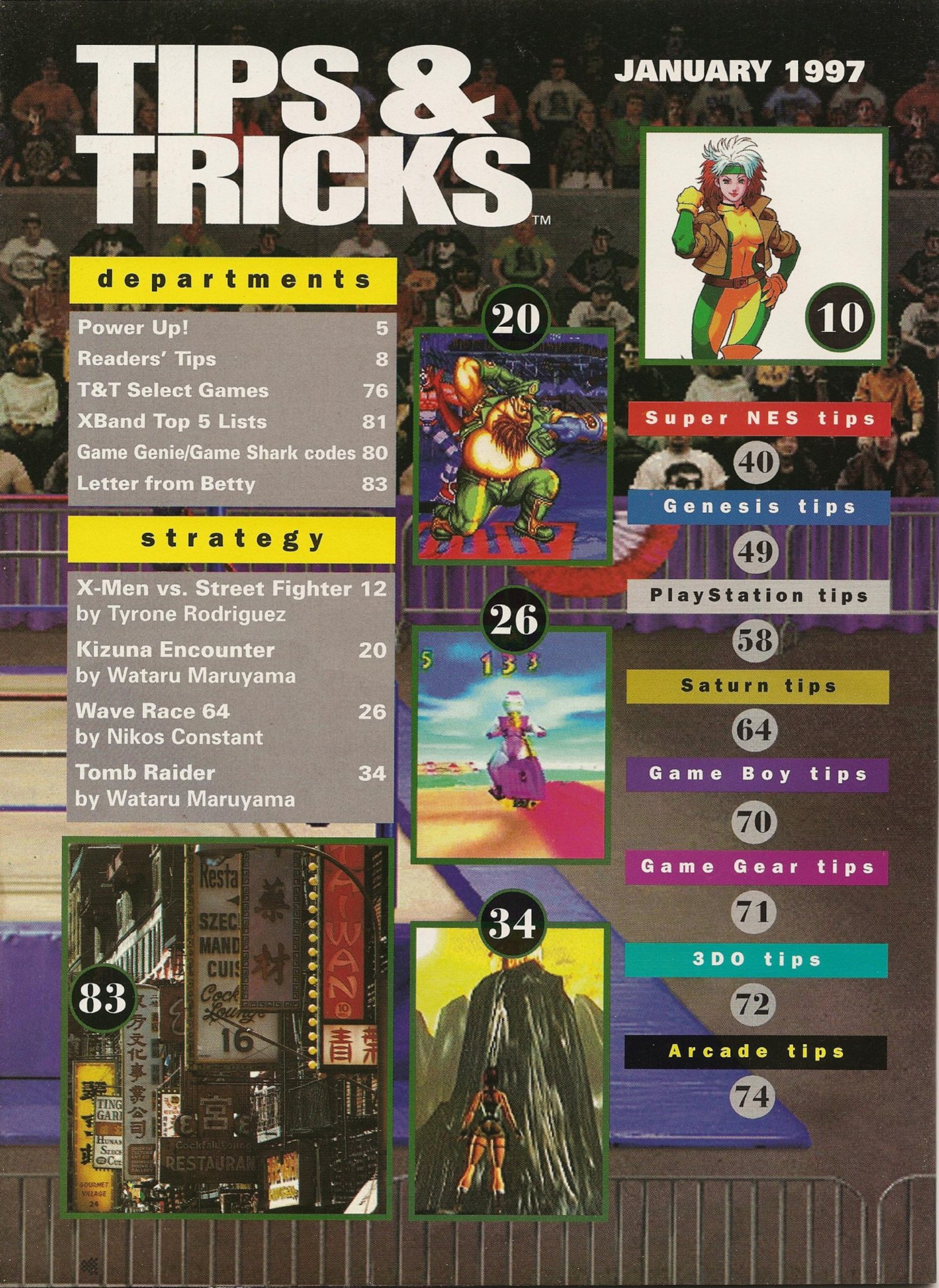
Tips & Tricks (January 1997)

Tips & Tricks (January 1997)

Though descended from my favorite magazine, VideoGames & Computer Entertainment, Tips & Tricks was never a magazine I paid much attention to. Many loved the hints, strategy guides and cheats it provided but I was always more interested in news, reviews and that sort of thing. The January 1997 issue includes:

Departments

  • Power Up! - An introduction to the staff which includes Chris Bieniek, Wataru Maruyama, Ione Flores, Nikos Constant, Bett Hallock, Tyrone Rodriguez and Deborah Lockhart.

  • Readers' Tips - Readers write in with tips on Daytona USA as well as various questions and comments.

  • T&T Select Games - Overviews and previews of recent and upcoming games including:
    • Jet Moto (PlayStation) - A racing game featuring a vehicle something like a Jet Ski.
    • Crime Wave (Sega Saturn) - A vehicle combat game featuring a top-down point of view.
    • Ten Pin Alley (PlayStation) - A bowling game of course.
    • Suikoden (PlayStation) - An RPG that allows not only individual and group combat but full scale wars.
    • Powerslave - A Doom-like game in which you wield magic as well as weapons.
    • NFL '97 (Sega Saturn) - A football game featuring licensed teams, stadiums and players.
    • NBA Live '97 (PlayStation) - Because we need a new basketball game every years...
    • FIFA Soccer '97 (PlayStation) - ...and soccer too of course.
    • FIFA Soccer Gold Edition (Sega Genesis, Super Nintendo) - A soccer game for the 16-bit systems.
    • Tips & Tricks provides a little of that also but it's emphasis is, as the name would imply, on tips and tricks.
    • FIFA Soccer '97 (Game Boy) - Blurry soccer...
    • Madden '97 (Game Boy) - Blurry football...
    • Burning Road (PlayStation) - A racing game out of France that is somewhat similar to the likes of Daytona USA and Ridge Racer.
    • Toshinden URA (Sega Saturn) - Another tweek to the Toshinden 3D fighting game franchise.
    • Ultimate Mortal Kombat 3 (Sega Genesis, Super Nintendo) - The pinnacle of Mortal Kombat on 16-bit systems.


    Table of Contents from the January 1997 issue of Tips & Tricks
  • Game Genie/Game Shark Codes - Game Genie codes for the Genesis games Toy Story, Vectorman and Garfield: Caught in the Act; Game Genie codes for the Super NES games Porky Pig's Haunted Holiday (I swear I've never heard of that one); Game Shark codes for the PlayStation games Bubble Bobble, Crash Bandicoot, Olympic Soccer, Project Horned Owl and Robo-Pit; and Game Shark codes for Sega Saturn games Bubble Bobble, Iron Storm and Shining Wisdom.
Strategy

  • X-Men vs. Street Fighter - A detailed strategy guide for this arcade game featuring general moves and how to use them as well as details for each character. Also, how to play as a couple of hidden characters.

  • Kizuna Encounter - Another fighting game strategy guide, this one for the Neo Geo.

  • Wave Race 64 - A detailed guide for this Nintendo 64 racing game featuring Jet Skis. It was a pretty outstanding racer for the time.

The last half of the magazine features tips on dozens if not hundreds of games for the Super NES, Genesis, PlayStation, Saturn, Game Boy, Game Gear, 3DO and arcade.

Read more: https://www.megalextoria.com/wordpress/index.php/2022/03/09/tips-tricks-january-1997/

Monday, March 7, 2022

Debunking the Myth That Minimum Wage Laws Are ‘Progressive’

The minimum wage is a sort of litmus test. And not only for economists. For social justice advocates, too.

Forget, for a moment, the economics of it. In essence, minimum wage legislation imposes compulsory unemployment on the poor, the unskilled, racial minorities, the young, the physically and even more so the mentally handicapped—the very people all men of good will most want to help. Before the advent of this law, the unemployment rate for white middle-aged people and black teens was just about the same. Now, the latter are unemployed at quadruple the rate of the former.

For the moment let’s just discuss the ethics and logic of the minimum wage. I now make you an offer: come work for me: you can wash my car, clean my house, etc. I’ll pay you $3 per hour. If I were serious about this offer, I could go to jail for making it. If you accepted it, you would also be breaking the law, but you would not get more than a slap on the wrist, since the judge would think I was exploiting you. Did I violate anyone’s rights? Did I violate your rights by making you this offer? Hardly.

As we should know from pure logic alone that an offer of employment such as I am now making to you, theoretically (I do not welcome being arrested), cannot help but improve your economic welfare. It is a proposal of an option you simply did not have before I made it. If you reject it, you are no worse off than you otherwise would have been. If you accept it, this job necessarily benefits you, at least ex ante (looking ahead), since, presumably, you had no better alternative than this one. I am your benefactor, not your exploiter.

Now for the economics of it. Some people believe the minimum wage is like a floor; raise it, and pay scales rise, particularly those at the lower end of the economic pyramid. If this were so, why be so modest as to want to raise it, only, to $15 per hour. Why not $1,500 hourly? Then, we would all be rich! We could stop all foreign aid to poor countries. We might just tell them, instead, to install a minimum wage decree at a high level.

No, the minimum wage is more like a barrier over which you have to jump in order to get a job in the first place and then keep it. The higher this hurdle, the harder it is for you to jump over it. Let us return to my offer to you at $3 per hour. Suppose you are very unskilled. Your productivity, the amount of revenue you can add to my bottom line, is only $3 per hour. If I hire you at $15, I’ll lose $12 per hour. Thus, I won’t hire you if I want to maximize profits. If I do so anyway, I will risk bankruptcy. Which is better for you: no wage at all, zero, nada, with this law in place? Or $3 per hour, with no such enactment? Clearly, $3 per hour is better than nothing.

Here are three objections to the foregoing. First, if you were totally unemployed, you might be eligible for welfare; if employed at a low wage, likely not. So the minimum wage, at least with a welfare program, is a benefit to the poor. True enough. But, here, we are not holding fast to ceteris paribus (all else equal) conditions. If we want to clearly see the economic effects of this regulation, we have to hold all else constant. Assume, either, no welfare at all, or, an equal amount of such payments whether on the job or not. Then, we can see clearly that something is better than nothing, and, also, that something plus a welfare payment is greater than nothing plus the same welfare payment.

Second, there is the claim of monopsony, which is a single buyer of labor, or, oligopsony, a situation in which there are only a few employers. This is a divisive concept within the dismal science (economics), which we need not discuss here. But one thing is clear: this applies, if it does at all, only to firms which employ highly skilled workers. For example, the NBA, the NFL, MLB and other such sports teams; to doctors, engineers, lawyers, computer experts, with very narrow specialized skills which can be utilized only by one or a very few companies. But these people earn vast multiples of the $15 per hour many are pushing for. Thus, this objection is not even relevant to our present discussion.

Third, several economists have not been able to find the unemployment effects implied by this directive in their econometric studies. Response: they should look a little harder, probe a bit deeper. They have not done their full homework.

The minimum wage law should not be raised, it should not remain constant, it should not be lowered. It should be ended, forthwith, and salt sowed where once it stood. It’s proponents may have good intentions, but in practice it is a malicious attack on the least of us.

Walter Block
Walter Block

Walter Edward Block is an American economist and anarcho-capitalist theorist who holds the Harold E. Wirth Eminent Scholar Endowed Chair in Economics at the J. A. Butt School of Business at Loyola University New Orleans. He is a member of the FEE Faculty Network.

This article was originally published on FEE.org. Read the original article.

Debunking the Myth That Minimum Wage Laws Are ‘Progressive’

Vintage Photos - Oestreicher (1050-1057)

See the previous post in this series here.

I had the opportunity to pick up a huge batch of slides a while back. These are pictures span from as early as the late 1940s to as late as the early 1990s. These came to me second hand but the original source was a combination of estate sales and Goodwill. There are several thousand...maybe as many as 10,000. I will be scanning some from time to time and posting them here for posterity.

Apparently, getting your pictures processed as slides used to be a fairly common thing but it was a phenomenon I missed out on. However, my Grandfather had a few dozen slides (circa late 1950s) that I acquired after he died. That along with having some negatives I wanted to scan is what prompted me to buy a somewhat decent flatbed scanner that could handle slides and negatives, an Epson V600. It can scan up to four slides at a time with various post-processing options and does a decent enough job.

This set continues a rather large batch of slides that originally came from an estate sale and appear to have belonged to a locally well known photographer (or perhaps a friend or family member) from the Spokane Washington area and later Northern Idaho named Leo Oestreicher. He was known for his portrait and landscape photography and especially for post cards. His career started in the 1930s and he died in 1990. These slides contain a lot of landscape and portrait photos but also a lot of photos from day to day life and various vacations around the world. Here's an article on him from 1997 which is the only info I have found on him: http://www.spokesman.com/stories/1997/jan/04/photos-of-a-lifetime-museum-acquisition-of-leo/

Many of these slides had the date they were processed stamped or printed on them. I've found that in cases where I could verify the date, either because a more specific date was hand written or there was something to specifically date the photo in the photo itself, that this date has typically been the same month the photos were taken. In other words, I expect that in MOST cases these photos were taken relatively near the processing date.

Click on one of the images or the link below to also see versions processed with color restoration and Digital ICE which is a hardware based dust and scratch remover, a feature of the Epson V600 scanner I am using. There are also versions processed with the simpler dust removal option along with color restoration.

The first three photos are not labeled or dated but appear to be from a trip to a lake or river and show some water skiing action as well as the results of a fishing expedition. the final photo is rather blurry but it looks like there is some sunbathing going on and probably swimming but I'm not sure if it is from the same time or not. It was processed in July 1962. The others are likely from the 1960s as well.


The entire collection that has been scanned and uploaded so far can also be found here.

Ahoy! (January 1984)

Ahoy! (January 1984)

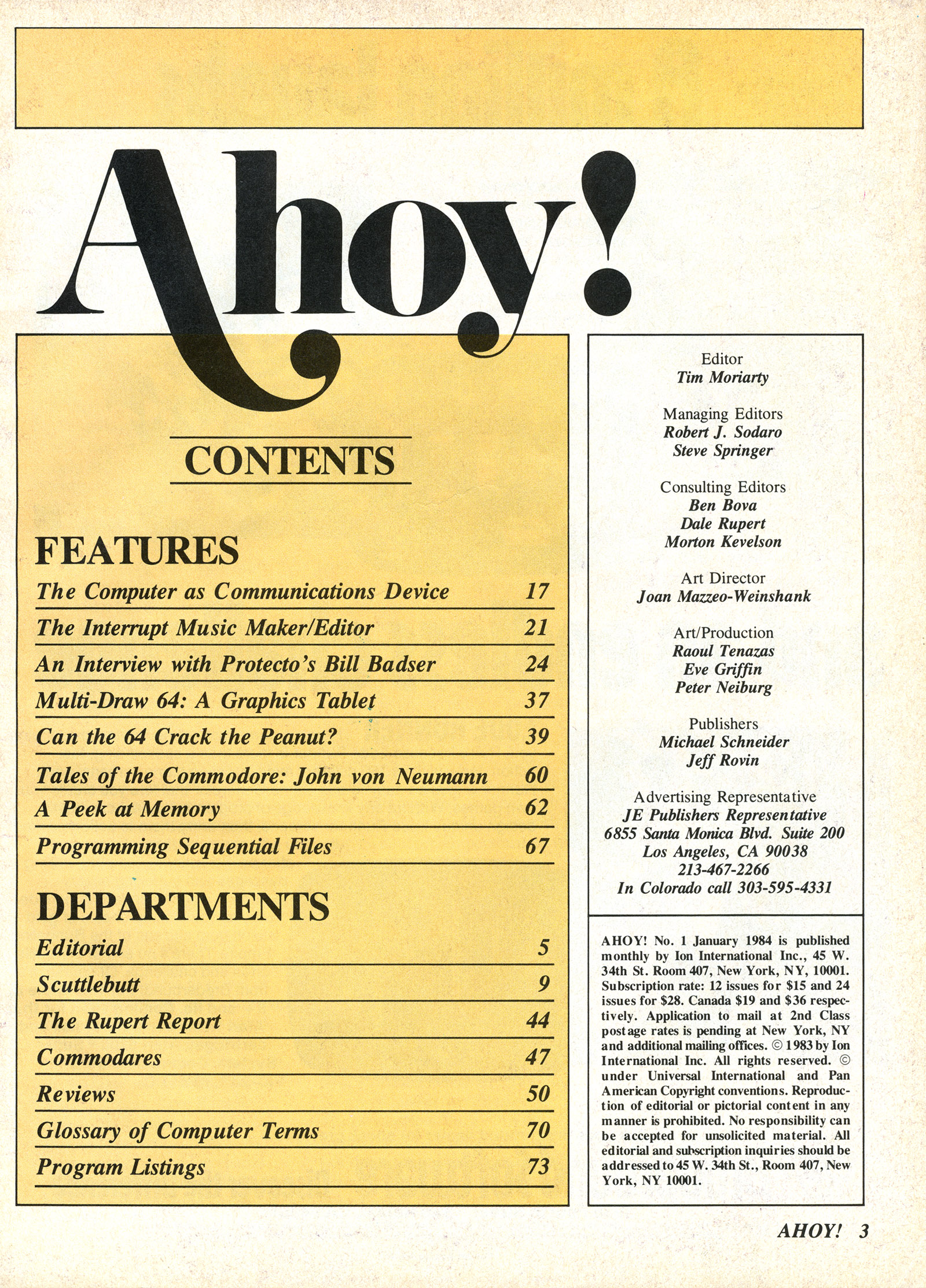
While not quite as popular as RUN or Compute!'s Gazette, Ahoy! was another major Commodore magazine covering Commodore's 8-bit computers (primarily the Commodore 64). The premiere issue claims to have a circulation of 190,000 and includes:

Features

  • The Computer as Communications Device - All about going online with your Commodore 64 or VIC-20 and a modem calling the modem the "indispensable appliance of the '80s." At the time, a 300 BPS modem would set you back at least $100 and 1200 bps was generally considered unaffordable costing more than a Commodore 64 itself at the time.

  • The Interrupt Music Maker/Editor - A type-in program that includes a small music making program and a 'driver' that allows music to be played while doing other things with your Commodore 64.

  • An Interview with Protecto's Bill Badser - Protecto was one of the majory mail-order shops for Commodore computers and other Commodore related hardware. Bill Badser was one of the co-founders.

  • Multi-Draw 64: A Graphics Tablet - A type-in drawing program for the Commodore 64.

  • Can the 64 Crack the Peanut? - Peanut was the code name for IBM's PCjr. This article contemplates how successful the Commodore 64 could be against it. Apparently when rumors of the Peanut first appeared, Apple's stock dropped by half and there was similar panic regarding other computer makers. It was felt IBM would easily dominate the home market. It turned out to be an accurate but premature fear. Other computers would have years more of success and it would not be the PCjr that finally led to the PC standards dominance but cheap clones. The PCjr on the other hand was a complete flop.


Table of Contents from the January 1984 issue of Ahoy!

Departments

  • Editorial - Editorial by Ben Bova about the Microcomputer Revolution, prominently featuring the Commodore 64.

  • Scuttlebutt - New products coming soon include the portable Commodore 64 (SX-64 or Executive 64), low cost printers from Alphacom, an EPROM burner called The Promqueen/64, new speech add-ons from Commodore and Alien Group, and much more.

  • Reviews
    • Astroblitz - A Defender clone for the Commodore 64.
    • Fort Apocalypse - A decent attack and rescue arcade type game somewhat similar to games like Choplifter.
    • Keyword Cross Reference - A couple of BASIC programs designed to generate a cross reference list given a series of inputs.
    • Moondust - A rather unique game available in cartridge format for both the C-64 and VIC-20.
    • Speed Racer - No relation to the anime, this is a not so good racing game.
    • Candy Bandit - An apparently terrible game for the Commodore 64.
    • Mailing List and Labels - A program designed for keeping track of mailing lists and printing mailing labels.
    • Suspended - Another Infocom classic text adventure for the Commodore 64.
    • Hometax - An income tax program for the Commodore 64 provided that you have a CP/M add-on.
    • Cannonball Blitz - A game by Sierra On-Line for the VIC-20 that happens to be very much like Donkey Kong.


Read more: https://www.megalextoria.com/wordpress/index.php/2022/03/07/ahoy-january-1984/