steem

Thursday, March 31, 2022

Commodore Magazine (January 1987)

Commodore Magazine (January 1987)

Commodore Magazine was one of the first magazines I ever bought on a regular basis. It covered the Commodore 64, Commodore 128 and Amiga line as well as Commodore's PC clones. I only had the Commodore 64 but I enjoyed reading about the Amiga since I wanted one at the time. The January 1987 issue includes:

Departments

  • Letters - Comments on previous articles and reviews including Invisible BASIC, Kinney Video Digitizer, and more.

  • News - Making the news this month is Epyx's 500XJ Joystick, a laser printing service using GEOS and QuantumLink, an update to the 128 Buyer's Guide, The Commodore Show at L.A., and more.

  • Software Reviews
    • Mind Walker - An odd sort of puzzle game for the Amiga.
    • Where in the World Is Carmen Sandiego? - Explore the world looking for Carmen Sandiego with this game for the Commodore 64.
    • Vizastar 128 - Vizistar 128 is a combination spreadsheet/database/graphing program. It takes advantage of the Commodore 128's additional memory and 80 column display.
    • Color Mail - A program for the Commodore 64 published by Hallmark for creating and sending (via CompuServe) electronic greeting cards.

  • Tips & Tricks - This month, a Commodore 128 mind reader, a disk buyer's guide, tips on using the second side of a disk, making tabs and labels, storing disks, making disk mailers, a program loading tip, and a screens saver.

  • Technical Tips
    • How to Build a Light Pen - A complete parts list and instructions for building a light pen for your Commodore 64.
    • CP/M Public Domain - A guide to obtaining public domain CP/M software that will work with the Commodore 128.


    Table of Contents from the January 1987 issue of Commodore Magazine
  • Telecommunications
    • Connect! - A beginner's guide to telecommunications including the definitions of some commonly used terms such as Answer/Originate Mode, ASCII, Baud, Bit, Buffer, Bulletin Board, and more.

  • Computer Tutor
    • Mobsters! - A guide for creating and using Sprites and other Moveable Objects on the Commodore 64 and Commodore 128.

  • 64 Users Only
    • Show Anything Slide Show - This type in program provides a slide show that will work with your graphics in a variety of formats, including KoalaPainter, Doodle!, Flying Colors, UltraBASIC 64, HES Graphics BASIC, CadPak 64, Two Color, title and B/Graph.

  • Jiffies
    • Kaleidoscope - A short program that displays an ever changing kaleidoscope pattern on your Commodore 64.
    • E.S.P. - A program that tests your E.S.P. abilities by letting you sense what shape will be displayed on the next card.
    • Basic Clock - This short program displays an on screen clock.

  • User Groups - A list of Commodore user groups around the country that have been officially recognized by Commodore as Approved User Groups.
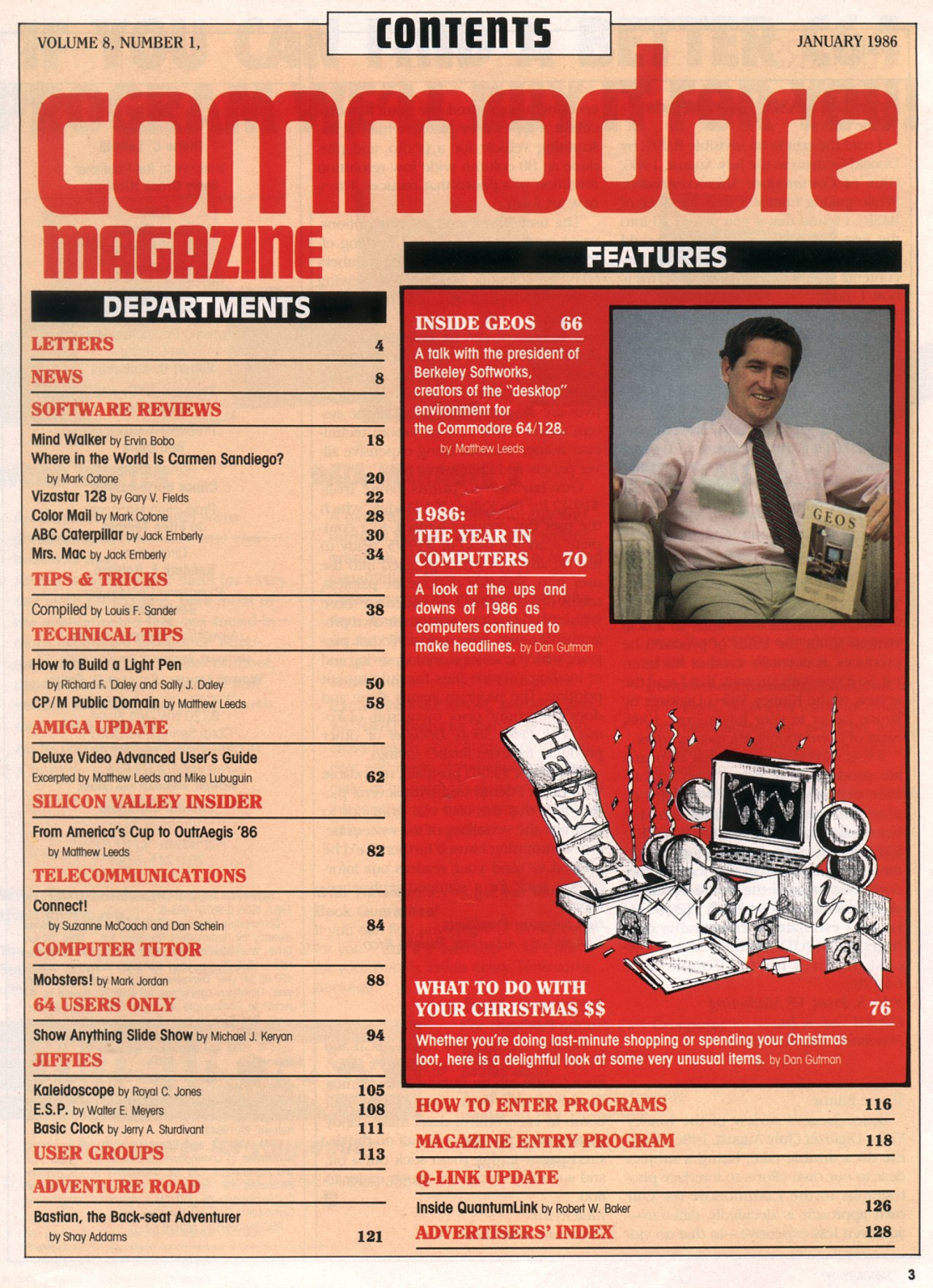
Features

  • Inside GEOS - GEOS was the graphical user interface for Commodore 64 and 128 computers by Berkeley Softworks. This is an interview with the president of Berkeley Softworks and includes some of their plans for GEOS and associated applications.

  • 1986: The Year In Computers - Some computer related highlights for 1986 including quotes from Ronald Reagan, Jay Leno, Matthew Broderick and others; first year success for the Commodore 128; the redesigned Commodore 64C; the first wave of software for the Amiga and much more. For context, 1986 included the Challenger disaster, Halley's comet, Microsoft announces public stock offering; Max Headroom is born...
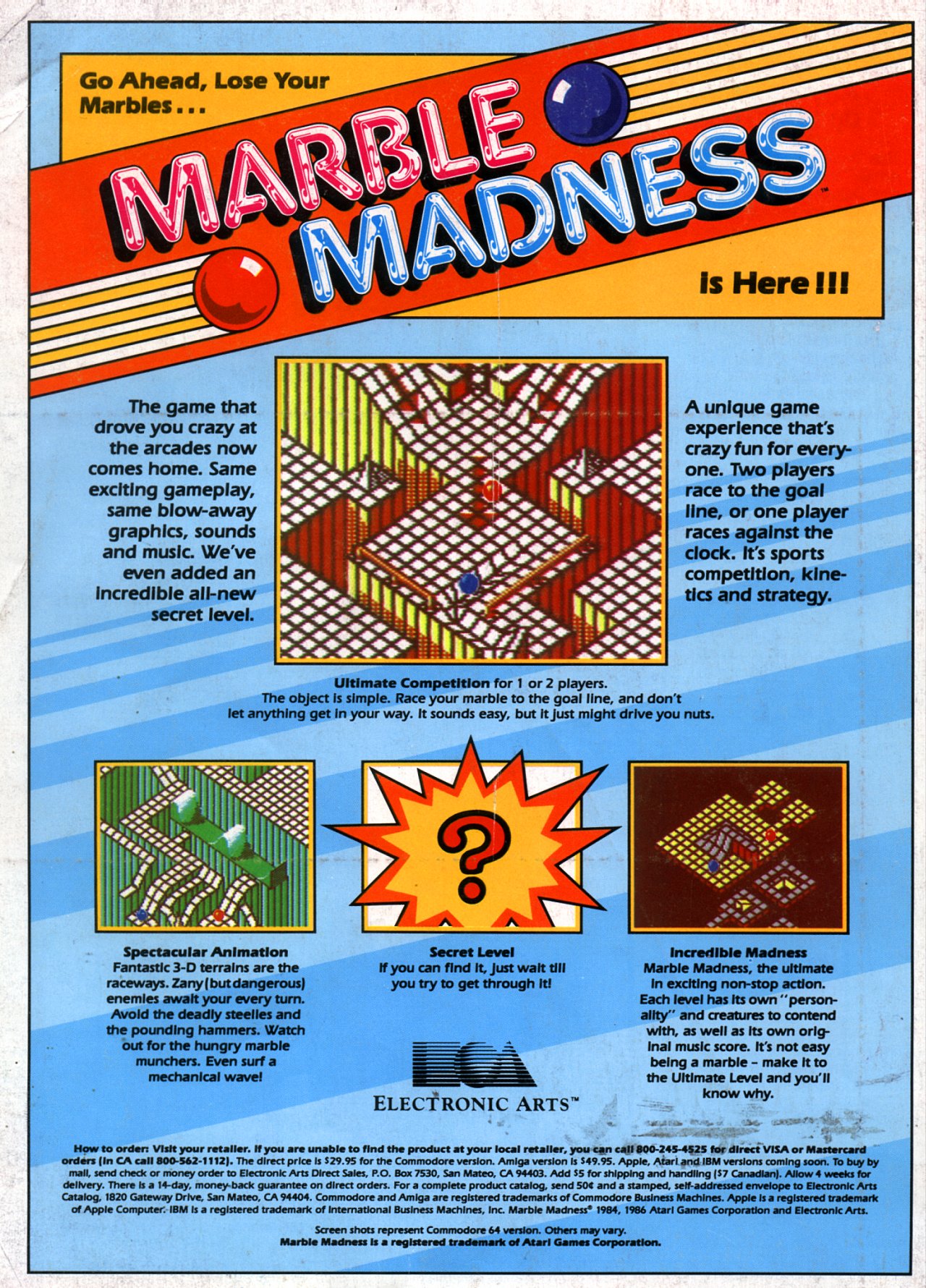

Back cover of the January 1987 issue of Commodore Magazine

Read more: https://www.megalextoria.com/wordpress/index.php/2022/03/31/commodore-magazine-january-1987/

Tuesday, March 22, 2022

Vintage Photos - Oestreicher (1062-1065)

See the previous post in this series here.

I had the opportunity to pick up a huge batch of slides a while back. These pictures span from as early as the late 1940s to as late as the early 1990s. These came to me second hand but the original source was a combination of estate sales and Goodwill. There are many thousands of these slides. I will be scanning some from time to time and posting them here for posterity.

Getting your pictures processed as slides used to be a fairly common thing but it was a phenomenon I missed out on. However, my Grandfather had a few dozen slides from the late 1950s that I acquired after he died. That along with having some negatives I wanted to scan is what prompted me to buy a somewhat decent flatbed scanner that could handle slides and negatives, an Epson V600. It can scan up to four slides at a time with various post-processing options and does a decent enough job.

This set continues a rather large batch of slides that originally came from an estate sale and appear to have belonged to a locally well known photographer (or perhaps a friend or family member) from the Spokane Washington area and later Northern Idaho named Leo Oestreicher. He was known for his portrait and landscape photography and especially for post cards. His career started in the 1930s and he died in 1990. These slides contain a lot of landscape and portrait photos but also a lot of photos from day to day life and various vacations around the world. Here's an article on him from 1997 which is the only info I have found on him: http://www.spokesman.com/stories/1997/jan/04/photos-of-a-lifetime-museum-acquisition-of-leo/

Many of these slides had the date they were processed stamped or printed on them. I've found that in cases where I could verify the date, either because a more specific date was hand written or there was something to specifically date the photo in the photo itself, that this date has typically been the same month the photos were taken. In other words, I expect that in MOST cases these photos were taken relatively near the processing date.

Click the link below to also see versions processed with color restoration and Digital ICE which is a hardware based dust and scratch remover, a feature of the Epson V600 scanner I am using. There are also versions processed with the simpler dust removal option along with color restoration.

The first photo was processed in October 1969 and appears to be of some trees decorated with lights, perhaps for Christmas. It's a pretty bad photo though. The second has the same date and appears to be of a parade (Shriners are featured in the photo walking down the street). There's a sign in that photo that says "City of Rockford". The first Rockford that comes up in a Google search is in Illinois but there is also one in Minnesota and probably others. The third photo was processed in June 1966 and features a lake or maybe river. The last photo was processed in May 1962 and would appear to be of some historic building in Italy (the flag is a dead giveaway even if the building and statue didn't do it).


processed October 1969


processed October 1969


processed June 1966


processed May 1962

The entire collection that has been scanned and uploaded so far can also be found here.

Al Gore’s 2009 Warning on Vanishing Polar Ice and the Perils of Censoring ‘Misinformation’

While speaking at a climate change summit in Denmark in 2009, former Vice President Al Gore made an alarming statement.

Citing research from Dr. Wieslaw Maslowski, a professor of oceanography at the Naval Postgraduate School in California, Mr. Gore said it was likely that the north polar ice caps would soon be completely melted.

"These figures are fresh,” Mr. Gore said. “Some of the models suggest to Dr. Maslowski that there is a 75 percent chance that the entire north polar ice cap, during the summer months, could be completely ice-free within five to seven years."

In his 2006 documentary An Inconvenient Truth, Gore cited studies which said “in the next 50 to 70 years” the ice caps would be completely melted. What had caused the melting to suddenly increase by a factor of ten? Well, nothing. As NPR noted, Mr. Gore was misrepresenting the data of Maslowski.

"It's unclear to me how this figure was arrived at," Dr. Maslowski told The Times UK. "I would never try to estimate likelihood at anything as exact as this."

Gore’s office soon issued a statement saying the 75 percent figure was a "ballpark figure" Dr. Maslowski had used in a casual conversation with Gore several years earlier.

Fortunately, both Gore and Maslowski were wrong.

In 2021, the Arctic sea ice extent was 4.72 million square kilometers, about 11 percent more than the 4.16 million kilometers in 2007, according to NASA’s estimates.*

As Reuters reported in a recent fact-check, Mr. Gore was guilty of misrepresenting scientific data—or “spreading “misinformation.”

In 2009, many responded playfully to Gore’s faux pas.

“Like most politicians, practicing and reformed, Al Gore has been known to stretch the truth on occasion,” NPR noted, adding that Gore had also claimed he’d helped create the internet.

Today, misinformation is treated in a much different way—at least in some instances. Throughout the COVID-19 pandemic, many writers and scientists who questioned the government’s use of lockdowns, mask mandates, enforced social distancing, and vaccine mandates were banned from social media platforms while others lost their jobs.

Earlier this month, San Francisco attorney Michael Senger was permanently banned from Twitter after calling the government’s pandemic response “a giant fraud.” In August, it was former New York Times reporter Alex Berenson who got the boot after questioning the efficacy of vaccines in preventing COVID-19 transmission. Months earlier it was author Naomi Wolf, a political advisor to the presidential campaigns of Bill Clinton and Al Gore.

Twitter is hardly alone, of course. Facebook and YouTube also announced policies banning the spread of COVID misinformation, particularly information related to vaccines, which is what got Drs. Peter McCullough and Robert Malone ostracized and banned.

Some may argue these policies are vital, since they protect readers from false information. However, there is nothing that says Big Tech can only ban information that is false. On the contrary, in court proceedings Twitter has claimed it has “the right to ban any user any time for any reason” and can discriminate “on the basis of religion, or gender, or sexual preference, or physical disability, or mental disability.”

Facebook, meanwhile, has argued in court that the army of fact-checkers they employ to protect readers from false information are merely sharing “opinions,” and are therefore exempt from defamation claims.

What Big Tech is doing is concerning, but the fact that this censorship is taking place in coordination with the federal government makes it doubly so.

In July, in arguably the most anti-free speech pronouncement made at the White House in modern history, White House press secretary Jen Psaki noted the White House is “flagging problematic posts for Facebook.”

“We are in regular touch with these social media platforms, and those engagements typically happen through members of our senior staff, but also members of our COVID-19 team,” Psaki explained.

All of this is being done in the name of science, but let’s be clear: there’s nothing scientific about censorship.

This week I’ll participate in an event at the Kirby Center in Washington, DC, hosted by the Academy for Science and Freedom. Led by leading scientists Scott Atlas, Jay Bhattacharya, and Martin Kulldorff, the event will explore the future of science in the face of widespread censorship, which has eroded faith in science.

To rebuild that trust we must remember that censorship is about power, not science, and recall the wisdom of one of history’s greatest scientists: Albert Einstein.

“[F]reedom of communication is indispensable for the development and extension of scientific knowledge … it must be guaranteed by law,” Einstein wrote in a 1940 essay on freedom and science. “But laws alone cannot secure freedom of expression; in order that every man may present his views without penalty there must be a spirit of tolerance in the entire population.”

That spirit of tolerance is missing today and must be restored. Scientists and public officials will make mistakes—just ask Al Gore—but purging ideas from the public square is a sign of a dogmatic society, not a scientific one.

*Correction: The Arctic sea ice extent was 4.72 million square kilometers in 2021—not kilometers. We regret the error.  

Jon Miltimore
Jon Miltimore

Jonathan Miltimore is the Managing Editor of FEE.org. His writing/reporting has been the subject of articles in TIME magazine, The Wall Street Journal, CNN, Forbes, Fox News, and the Star Tribune.

Bylines: Newsweek, The Washington Times, MSN.com, The Washington Examiner, The Daily Caller, The Federalist, the Epoch Times. 

This article was originally published on FEE.org. Read the original article.

Al Gore’s 2009 Warning on Vanishing Polar Ice and the Perils of Censoring ‘Misinformation’

Monday, March 21, 2022

Info (Spring/Summer 1987)

Info (Spring/Summer 1987)

Info is a magazine that covered various Commodore computers throughout its life. In 1987 that included the Commodore 64, Commodore 128 and Amiga. One of the interesting things about Info is that it was produced entirely using Commodore computers. The Spring/Summer 1987 issue includes:

  • Gallery - Screen shots and summaries of 6 new software releases including Starglider (Commodore 64), Bard's Tale (Amiga), Uridium (Commodore 64), MandFXP-Enhanced (Amiga), Scrabble (Commodore 64), and Deja Vu (Amiga).

  • New Amigas - An introduction to the new Amiga 500 and Amiga 2000, replacements for the original Amiga 1000.

  • Product Roundup - A comprehensive round-up of software available for the Commodore 64, Commodore 128, Commodore 128 CP/M and Amiga). Over 2100 products are included with name, price, distributor, issue in which it was reviewed and a brief description. This feature makes up the bulk of this issue.

  • Double-Take - A photo of the Three Stooges with the Stooges replaced with Commodore executives Sam, Jack and Leonard by Amiga photo manipulation software.


  • Table of Contents from the Spring/Summer 1987 issue of Info
  • CES Report - Berkeley demonstrates several new GEOS related software titles including GEOS v1.3, GeoCalc, GeoFile, GeoDex, and more; Progressive Peripherals shows off Superbase Personal for the Amiga, Vizawrite for the Amiga and C128, and Vizastar for the C128; Firebird shows off Tracker, Talking Teacher and Starglider; Epyx introduces Street Sports Basketball, Street Sports Baseball, Sub Battle Simulator all for the Commodore 64 with Temple of Apshai, World Games and Winter Games coming for the Amiga; Electronic Arts introduces PHM Pegasus, Bards Tale II and a reissue of Archon II for the Commodore 64; and lots more.

  • Mail - Praise for the magazine from someone who found out about it on QLink; comments upon the latest version of GEOS disabling work disks not copied in the officially proscribed way in order to curb piracy; a debate on Compuserve's copyright policy...apparently Compuserve was trying to claim copyright on public domain software; a reader writes about an appearance of an Amiga in Miami Vice; and more!


Back Cover of the Spring/Summer 1987 issue of Info

Read more: https://www.megalextoria.com/wordpress/index.php/2022/03/21/info-spring-summer-1987/