I had the opportunity to pick up a huge batch of slides a while back. These pictures span from as early as the late 1940s to as late as the early 1990s. These came to me second hand but the original source was a combination of estate sales and Goodwill. There are many thousands of these slides. I will be scanning some from time to time and posting them here for posterity.
Getting your pictures processed as slides used to be pretty common but it was a phenomenon I missed out on. However, my Grandfather had a few dozen slides from the late 1950s that I acquired after he died. That along with having some negatives I wanted to scan is what prompted me to buy a flatbed scanner that could handle slides and negatives, an Epson V600. It can scan up to four slides at a time with various post-processing options and does a decent enough job.
This set continues a large batch of slides that originally came from an estate sale and appear to have belonged to a locally well known photographer (or perhaps a friend or family member) from the Spokane Washington area and later Northern Idaho named Leo Oestreicher. He was known for his portrait and landscape photography and especially for post cards. His career started in the 1930s and he died in 1990. These slides contain a lot of landscape and portrait photos but also a lot of photos from day to day life and various vacations around the world. Here's an article on him from 1997 which is the only info I have found on him: http://www.spokesman.com/stories/1997/jan/04/photos-of-a-lifetime-museum-acquisition-of-leo/
Many of these slides had the date they were processed stamped or printed on them. I've found that in cases where I could verify the date, that this date has typically been the same month the photos were taken. In other words, I expect that in MOST cases these photos were taken relatively near the processing date.
Click the link below to also see versions processed with color restoration and Digital ICE which is a hardware based dust and scratch remover, a feature of the Epson V600 scanner I am using. There are also versions processed with the simpler dust removal option along with color restoration.
The first photo features two ladies standing in front of a house. It is undated but was probably taken in the late 1950s or early 1960s. The next three photos were processed in May 1966 and were probably taken near the same place. This looks like some kind of beach resort in Europe somewhere but I can't say that I recognize it.
processed May 1966
processed May 1966
processed May 1966
The entire collection that has been scanned and uploaded so far can also be found here.
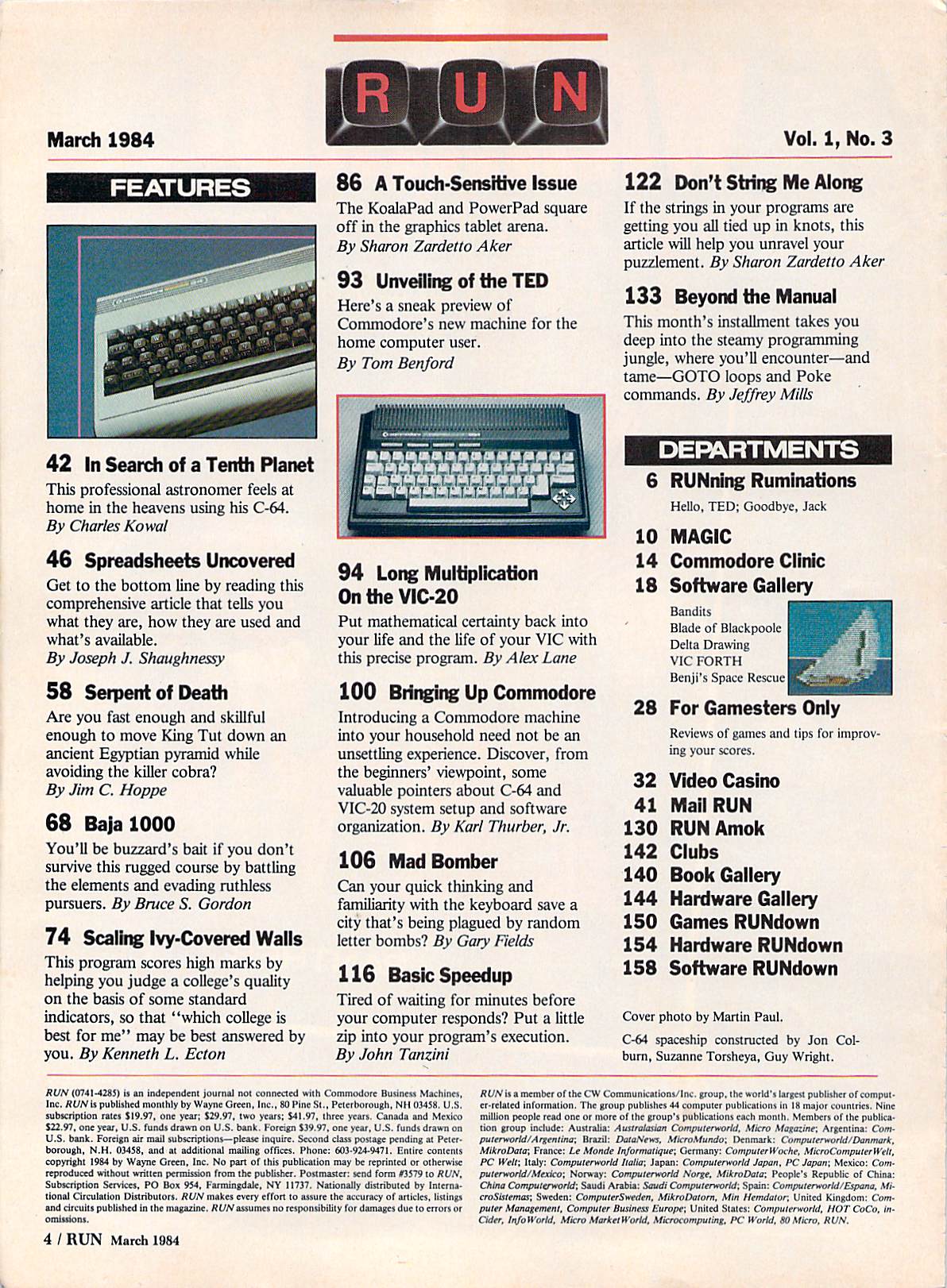
While RUN was primarily a Commodore 64 magazine, it did cover other Commodore 8-bit computers over the years. In the early days, that meant the VIC-20. The March 1984 issue of RUN includes:
Features
In Search of a Tenth Planet - How one astronomer uses a Commodore 64 to help him search for a 10th planet.
Spreadsheets Uncovered - A general overview of spreadsheet software as well as a look at specific examples, including BCalc, BusiCalc 64, Easy Calc Result, ESP-Calc, Home-Calc, PracticalC64, and more.
Serpent of Death - A type-in Egyptian themed game for the VIC-20.
Baja 1000 - A type-in game for the VIC-20 in which you must flee a pursuing helicopter in your Jeep.
Scaling Ivy-Covered Walls - A type-in program for the Commodore 64 that helps you choose the right college by providing various information.
A Touch-Sensitive Issue - An overview of graphics tablets, a popular input device for a brief period of time, and some of the software that support them. The KoalaPad was probably the most popular.
Unveiling of the TED - A preview of the upcoming Commodore 264 (A.K.A. the Plus 4). While it had some interesting features, overall the Commodore 64 was a better machine (especially for games) and the Plus 4 was a complete market failure.
Table of Contents from the March 1984 issue of RUN
Departments
RUNning Ruminations - The introduction of the Plus/4 coincides with Jack Tramile leaving Commodore.
MAGIC - Short programming snippet for performing magic on your Commodore. This month, scrolling stars, delay loops, repeating keys, resetting a VIC-20 and Commodore 64, programming function keys, disabling the list command, and much more.
Commodore Clinic - Questions answered about PET, C64 and VIC-20 compatibility, RS232 adapters for the C64, changing the blink speed of the C64 cursor, printers for the C64, reverse scrolling on the C64, printing graphics from the C64, interfacing the VIC-20 with a robot arm, and more.
Software Gallery - Reviews of Bandits (VIC-20), The Battle of Blackpoole (Commodore 64), Delta Drawing (Commodore 64), VIC Forth (VIC-20), and Benji's Space Rescue (Commodore 64).
For Gamesters Only - Tips and strategies for Computer Wars (VIC-20), Submarine Commander (VIC-20), Neutral Zone (Commodore 64), Beach-Head (Commodore 64), and Archon (Commodore 64).
Video Casino - A type-in game for the VIC-20 called Tunnel Run in which make your way through various tunnels while escaping aliens.
Mail RUN - Letters from readers mostly commenting about the premiere issue of RUN.
In June,The New York Timesran an exposédetailingthe tragedy that we may never know the origins of COVID-19.
“For three years, the U.S. government has been tied in knots over the origins of the coronavirus pandemic, frustrated that China’s hindrance of investigations and unwillingness to look critically at its own research have obscured what intelligence agencies can learn about whether the virus escaped from a lab,” reported Julian Barnes. “Inquiries during the Trump and Biden administrations have yielded no definitive answers.”
That the conversation on the origins of the virus is shifting from “preponderance of evidence” to “definitive answers” is itself evidence that we may be closer to answering the mystery of COVID’s origins than many realize.
Patient Zero?
In November 2019, three lab researchers from the Wuhan Institute of Virology in China became severely ill, according to a U.S. intelligence reportobtained bytheWall Street Journalin 2021. The researchers, whose identities were not disclosed, became so sick they were hospitalized, the report stated. The timing of the event is noteworthy. The three lab workers, theJournalnoted, were hospitalized in November 2019, “roughly when many epidemiologists and virologists believe SARS-CoV-2, the virus behind the pandemic, first began circulating around the central Chinese city of Wuhan.”
Two years later, the identities of the three lab workers allegedly hospitalized were revealed. US government sources identified the three lab researchers as Ben Hu, Yu Ping, and Yan Zhu,according torecent reporting from Michael Shellenberger, Matt Taibbi, and Alex Gutentag inPublic.
The Atlanticnotedthe “extraordinary” nature of the findings, if true.
“These proposed patient SARS-CoV-zeroes aren’t merely employees of the virology institute; they’re central figures in the very sort of research that lab-leak investigators have been scrutinizing since the start of the pandemic,” writes Daniel Engber. “Their names appear on crucial papers related to the discovery of new, SARS-related coronaviruses in bats, and subsequent experimentation on those viruses.”
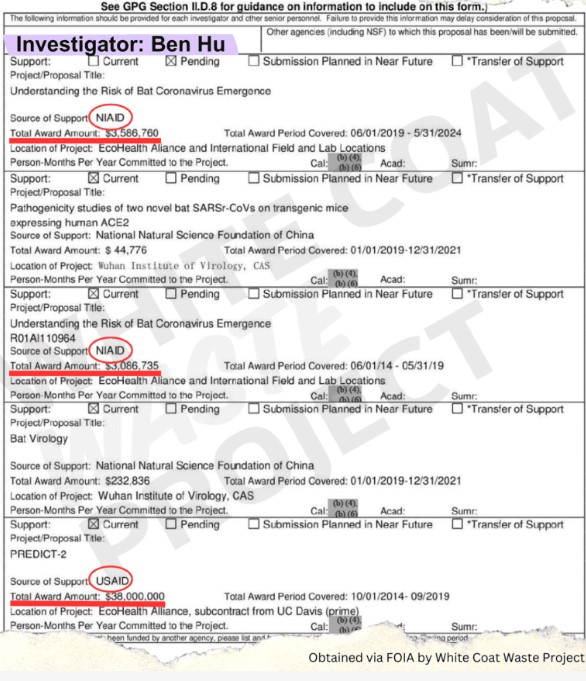
Hu’s name is especially important. The man many are dubbing “patient zero” didn’t just work at the Wuhan Institute of Virology. According to documents published by the White Coat Waste Project obtained via a FOIA request, Hu was receiving US grant money to perform gain-of-function research on coronaviruses.
“The funding came in three grants totaling $41 million, doled out by USAID and the National Institute of Allergy and Infectious Diseases, or NIAID, the agency then headed by Dr. Anthony Fauci,” theInterceptreports. “Hu is listed as an investigator on the grants.”
Pretty Specific Symptoms
These are not the only important details that have many suspecting Hu is “patient zero.” There’s also the fact that he was a top lieutenant of Shi Zhengli, a scientist literally named “batwoman” for her extensive research on viruses taken from bats in caves. And then there’s the fact that unreleased intelligence reportedly says the sick lab workers lost their sense of smell—one of the telltale signs of COVID.
“That doesn’t medically prove that they had COVID but that’s some pretty specific symptoms,” Josh Rogin of theWashington Postnoted inan interview with Bari Weiss.
Finally, asSciencenotes, Hu is an “appealing suspect” because he “was a lead author on a 2017 paper in PLOS Pathogens describing an experiment that created chimeric viruses by combining genes for surface proteins from bat coronaviruses that would not grow in cultures with the genome of one that did. This paper has received intense scrutiny because it was partially funded by the U.S. National Institutes of Health (NIH) … .”
None of this is a “definitive answer,” of course. And Hu claims the entire story is “fake news.”
“The recent news about so-called ‘patient zero’ in WIV are absolutely rumors and ridiculous,” Huwrote in an emailtoScience. “In autumn 2019, I was neither sick nor had any symptoms related to COVID-19.”
That Hu would deny involvement in the incident is hardly surprising.
“Denials of culpability and dismissals of evidence by a likely culpable person cannot be taken at face value,”saidRutgers Professor Richard H. Ebright, a molecular biologist.
The Smoking Gun?
That those responsible for the deadliest pandemic in a century would not wish to take responsibility for it should not surprise us. And I’m not just talking about Ben Hu.
There’s little reason to believe the Chinese government would be forthcoming if their investigation determined they were responsible for COVID-19. Similarly, there’s little reason to believe the US government, which was funding China’s coronavirus research, would be eager to get to the truth either.
Let’s not forget there was a serious effort by the US government to prevent Americans from even openlyspeculatingabout the lab-leak theory. In February 2021, almost certainly at the behest of federal agencies, whichwere working with social media platformsto combat COVID “misinformation,” Facebook announced it would remove posts that suggested “COVID-19 is man-made or manufactured.” Months later, after it became widely accepted that the lab-leak theory was not “a crackpot idea” after all, Facebook wasforced to backtrack.
Today many agencies within the federal government itself concede that the lab-leak theory isn’t just possible, but the most likely cause of COVID.
“The Department of Energy and the Federal Bureau of Investigation assess that a laboratory-associated incident was the most likely cause of the first human infection with SARS-CoV-2,”a reportfrom the Office of the Director of National Intelligence found.
Indeed, a preponderance of evidence is emerging that points to the Wuhan lab, and Hu may turn out to be the key.
“It’s a game changer if it can be proven that Hu got sick with COVID-19 before anyone else,” Jamie Metzl, a former member of the World Health Organization expert advisory committee on human genome editingtoldPublic. “That would be the ‘smoking gun.’ Hu was the lead hands-on researcher in Shi’s lab.”
Dizzy With Success
That the deadliest pandemic in a century might have been triggered by scientists pursuing risky genetic research in pursuit of a “greater good” should not surprise us.
“Many of the most monstrous deeds in human history have been perpetrated in the name of doing good—in pursuit of some ‘noble’ goal,” the philosopher Leonard Read once observed.
Nor should it surprise us if it’s found that the Chinese government (with help from the US) was responsible. Governments have been responsible for the worst atrocities in history, usually while using collective force to advance utopia. This includes famous genocides like the Holocaust, the Holdomor, and Mao’s Great Leap Forward, but also eugenics policiesthat forcibly sterilized tens of thousandsof Americans to create a “purer race.”
A half-century ago, F.A. Hayek warned about humanity becoming essentially drunk—“dizzy with success”—in their faith in the physical sciences, “which tempts man to try…to subject not only our natural but also our human environment to the control of a human will.” He feared humanity’s faith in its ability to control the physical world stood to make those who controlled it a “destroyer of a civilization.”
Hayek was alluding to collectivism when he made these remarks inhis Nobel Prize-winning speech, but it’s a similar Frankenstein-like hubris that lurks in gain-of-function research—which NIHcontinued to pursuedespite warnings and pauses.
If the lab-leak theory turns out to be true, don’t expect these officials to be any more forthcoming than Ben Hu.
I had the opportunity to pick up a huge batch of slides a while back. These pictures span from as early as the late 1940s to as late as the early 1990s. These came to me second hand but the original source was a combination of estate sales and Goodwill. There are many thousands of these slides. I will be scanning some from time to time and posting them here for posterity.
Getting your pictures processed as slides used to be pretty common but it was a phenomenon I missed out on. However, my Grandfather had a few dozen slides from the late 1950s that I acquired after he died. That along with having some negatives I wanted to scan is what prompted me to buy a flatbed scanner that could handle slides and negatives, an Epson V600. It can scan up to four slides at a time with various post-processing options and does a decent enough job.
This set continues a large batch of slides that originally came from an estate sale and appear to have belonged to a locally well known photographer (or perhaps a friend or family member) from the Spokane Washington area and later Northern Idaho named Leo Oestreicher. He was known for his portrait and landscape photography and especially for post cards. His career started in the 1930s and he died in 1990. These slides contain a lot of landscape and portrait photos but also a lot of photos from day to day life and various vacations around the world. Here's an article on him from 1997 which is the only info I have found on him: http://www.spokesman.com/stories/1997/jan/04/photos-of-a-lifetime-museum-acquisition-of-leo/
Many of these slides had the date they were processed stamped or printed on them. I've found that in cases where I could verify the date, that this date has typically been the same month the photos were taken. In other words, I expect that in MOST cases these photos were taken relatively near the processing date.
Click the link below to also see versions processed with color restoration and Digital ICE which is a hardware based dust and scratch remover, a feature of the Epson V600 scanner I am using. There are also versions processed with the simpler dust removal option along with color restoration.
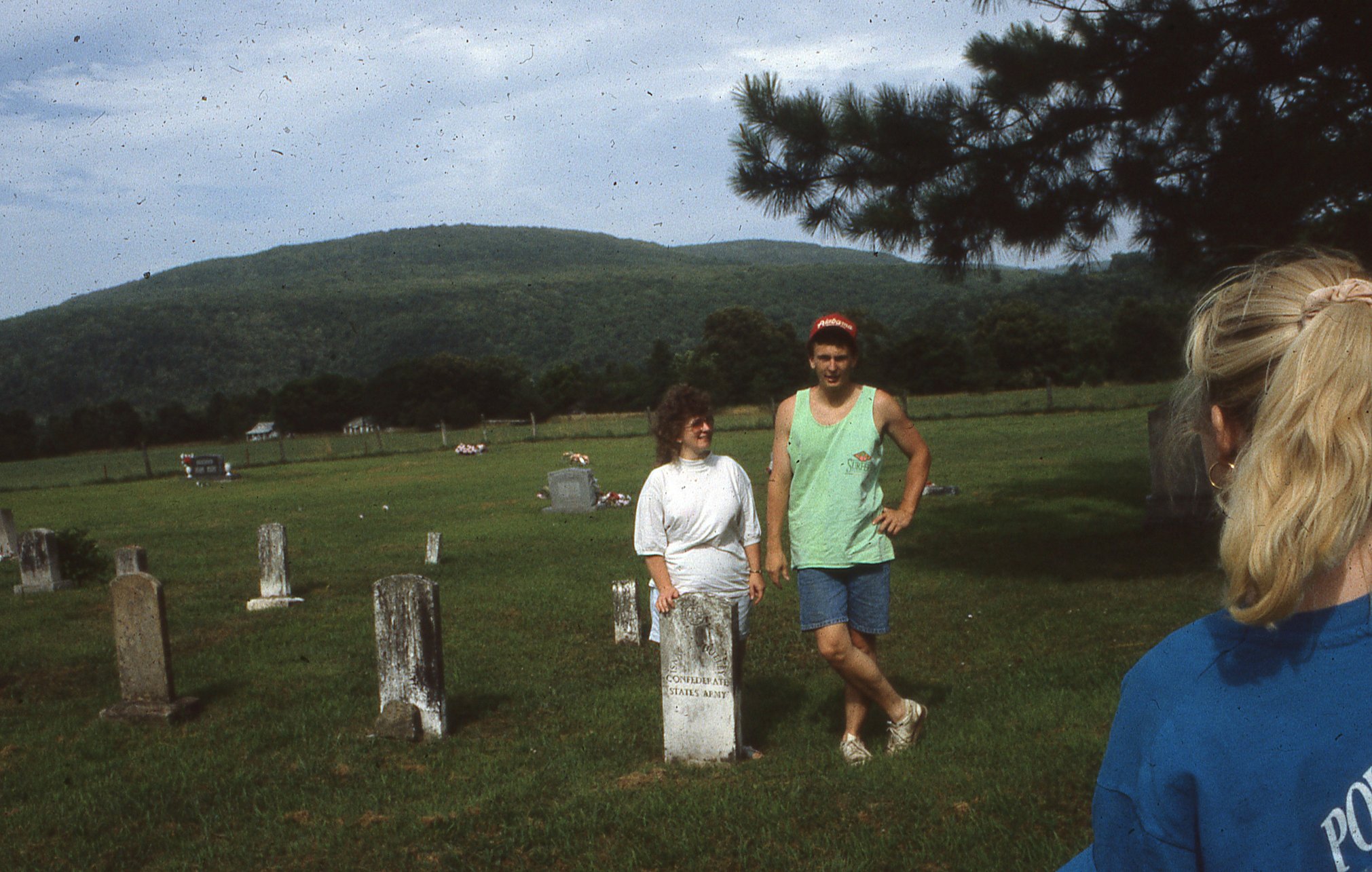
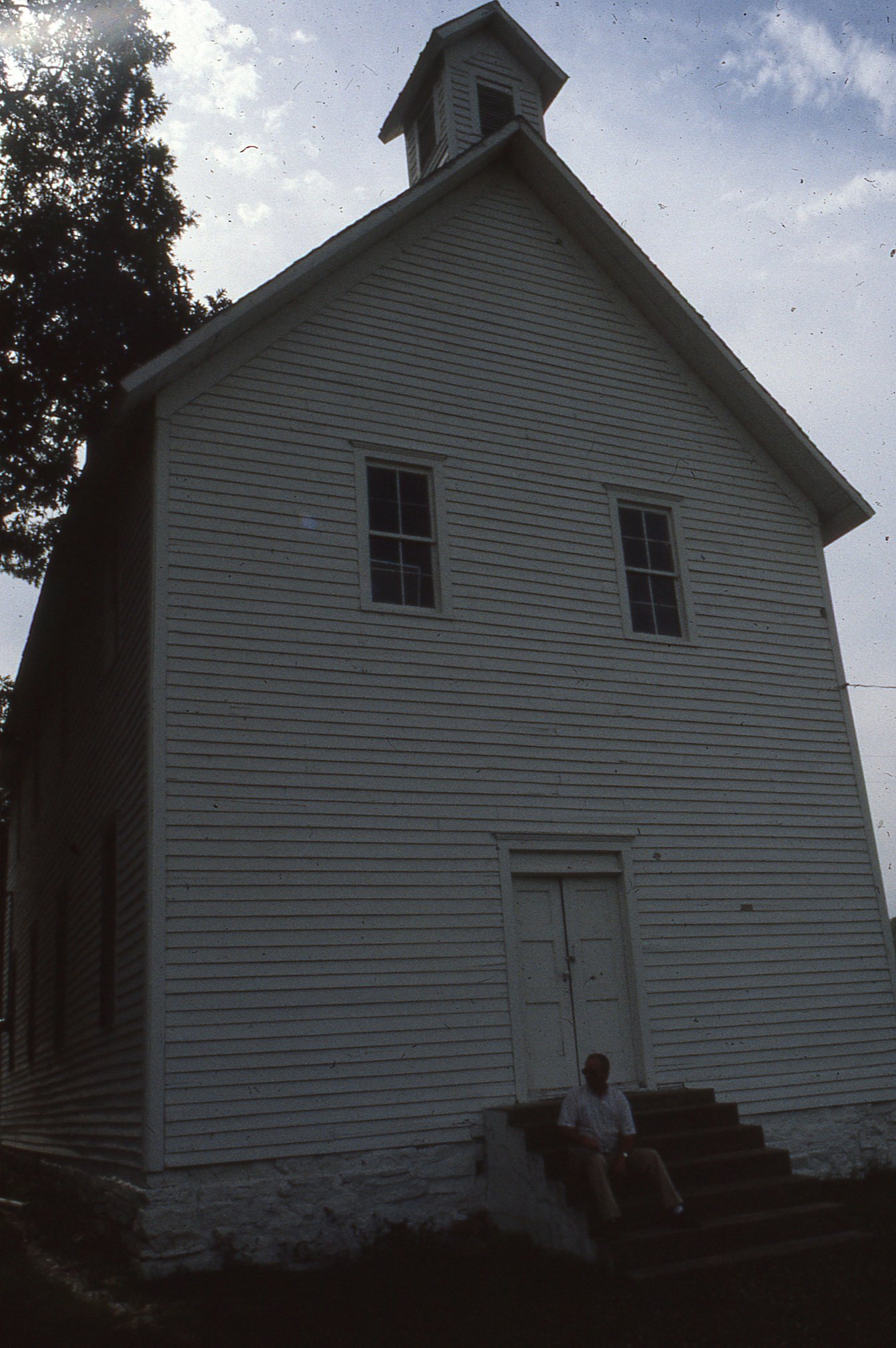
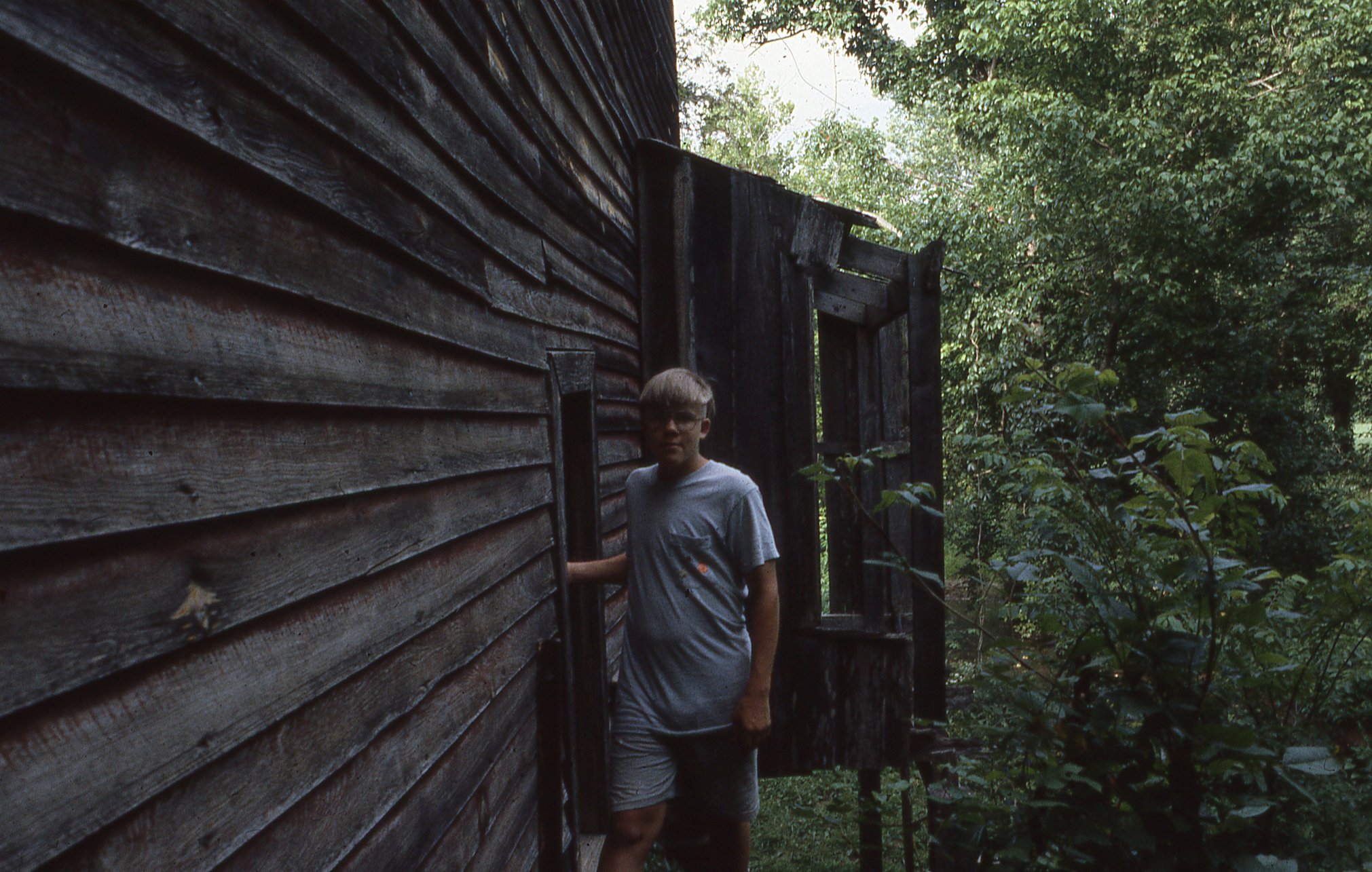
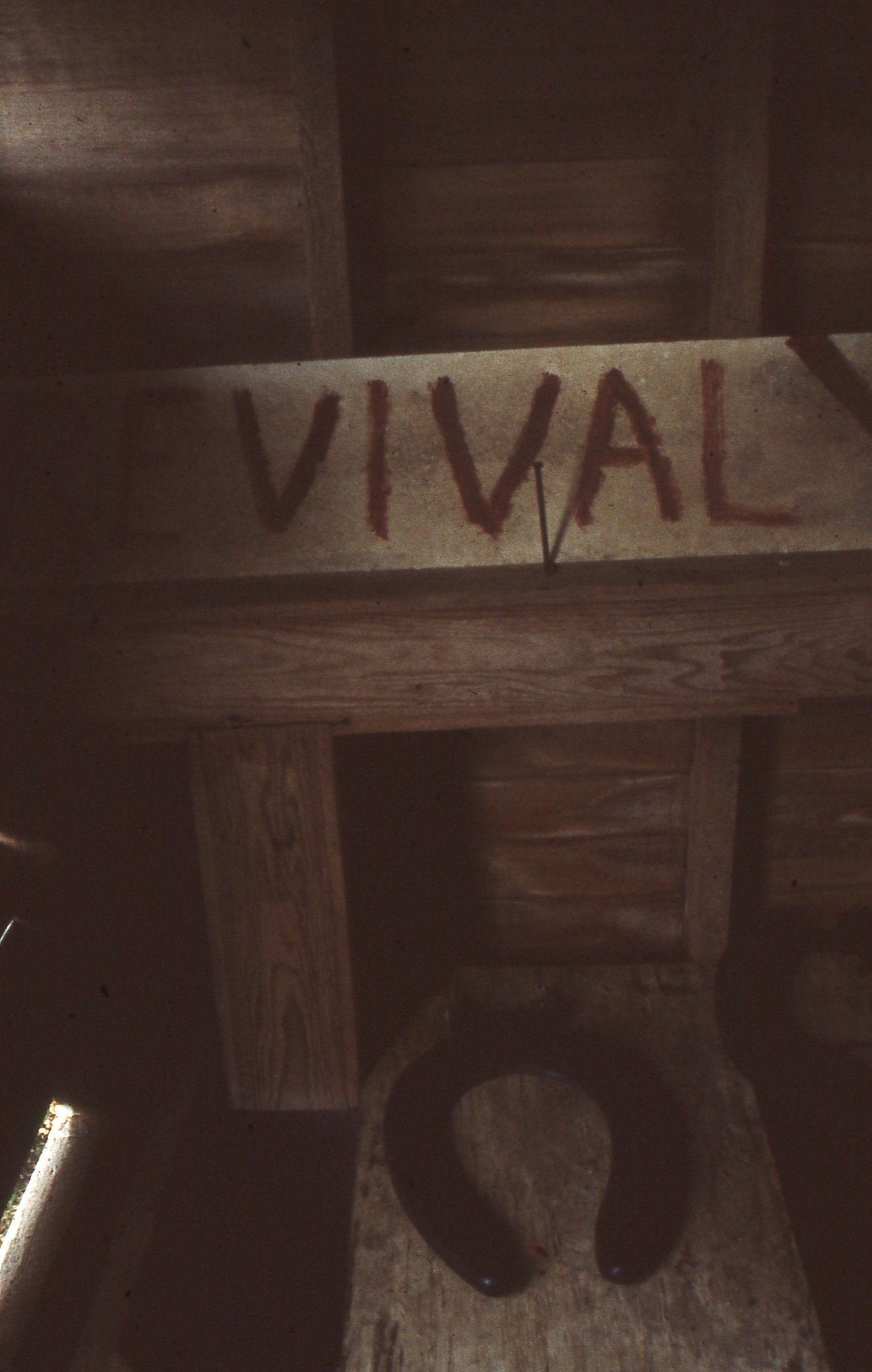
These photos appear to be from the late 1980s or early 1990s. The first features a Confederate grave. Presumably the people in the picture are related but I can't make out the name compeletely. A similar shot showed up in a previous set. I'm not sure where this is but there is a guy wearing an Alabama hat so that seems a resonable possibility. The second photo features what looks like a church with someone sitting on the steps. The third photo shows a boy next to what looks like a cabin in the woods. It looks like it could be the set of a horror movie, especially looking at the fourth photo...
The entire collection that has been scanned and uploaded so far can also be found here.