This was getting close to end days for EGM. Sadly, the time I had for gaming was already greatly reduced by this time. I was probably mostly playing Mario Kart on the Wii. I definitely wasn't buying EGM anymore at this time except for maybe a very occasional issue. The May 2007 issue of EGM includes:
Cover Story
The Future of Gaming - Article that looks at the next 20 years of gaming. This issue is from 2007 so we are getting pretty close to that.
Letters
Literacy: It's fun for everyone - Reader letters about failed systems and bad controllers, emulation on the PS3, Zelda: Twilight Princess, Guitar Hero II, and more.
Table of Contents from the May 2007 issue of Electronic Gaming Monthly
Press Start
Feature: Brain Watch - How video games affect your brain and how developers are taking advantage of this.
Foreign Object - A brief look at Fist of the North Star, a Japan release for the PS2.
Online Scene - The results of pointless polls.
Preview: Ninja Gaiden Sigma - The first PS3 release for this action game franchise.
Afterthoughts: MotorStorm - An interview with MotorStorm Producer Simon Benson about the game and ideas for the future.
Preview: Team Fortress 2 - The long awaited sequel from Valve for the PS3 and Xbox 360.
Take This Job - An interview with he Director of Platform Strategy for Microsoft, Scott Henson.
Preview WWE SmackDown vs. Raw 2006 - A wrestling game from THQ for the PS3 and Xbox 360. I haven't played a wrestling game since the WWF...
Table of Contents from the May 2007 issue of Electronic Gaming Monthly (continued)
Reviews
Super Paper Mario - The latest Paper Mario game for the Wii.
Cooking Mama: Cook Off - I don't really understand the appeal of a cooking game but I guess it plays more as a series of mini-games.
Medal of Honor: Vanguard - Apparently not one of the better FPS games in this series.
The Elder Scrolls IV: Oblivion - This is a series of games that I have wanted to play for a long time but have never gotten around to. I had a friend in college who played Arena (Elder Scrolls I), another who played Daggerfall (Elder Scrolls II)...both buggy as hell and I guess that's what turned me off. Then I played a little bit of Morrowind (Elder Scrolls III) as part of a school project. This is a review of Oblivion (Elder Scrolls IV) on the PS3. If I ever play it, it will be on the PC.
Earth Defense Force 2017 - An arcade style 3D shooter for the Xbox 360 where you run around blowing up UFOs, giant robots, giant insects and other things that would destroy the Earth.
Ghost Recon: Advanced Warfighter 2 - Another FPS series that just seemed to keep going. This iteration was apparently pretty good though.
Game Over
Seanbaby's Rest of the Crap - Next gen video game technologies that just didn't work out including the Mindlink (Atari 2600), R.O.B. (NES), U-Force (NES), The Interactor (SNES, Genesis), and others.
Retro: Utopia or Dystopia? - A look at retro games with a vision of the future including Crystalis (NES), Ratchet & Clank (PS2), Mega Man (NES), Snatcher (Sega CD), Chrono Trigger (SNES), Shadowrun (Genesis), F-Zero (SNES), and more.
Back cover of the May 2007 issue of Electronic Gaming Monthly
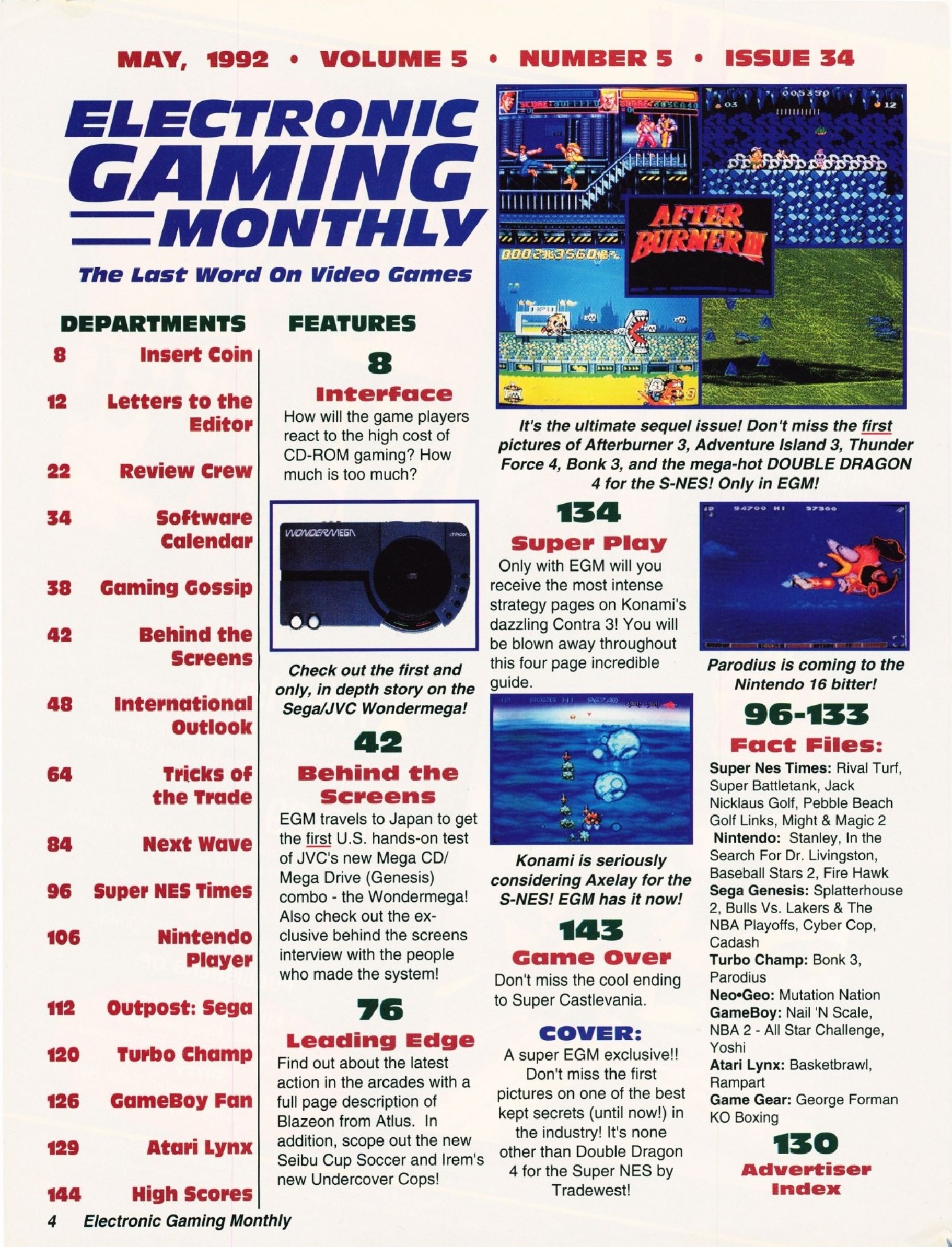
I still have this particular issue of Electronic Gaming Monthly which I bought off the shelf back in the day. Consolidation has its advantages but I miss the variety of systems that used to be around. At this time, EGM was covering the Nintendo, Super Nintendo, Sega Genesis, TurboGrafx-16, Neo Geo, and a variety of portable systems including the Game Boy, Sega Game Gear, and Atari Lynx. The May 1992 issue includes:
Departments
Insert Coin - An editorial on the inevitable wave of CD-ROM based games and whether or not the gaming industry is really ready for it.
Letters to the Editor - Letters from readers about the Super NES version of Street Fighter II, The Super NES CD-ROM, Genesis coverage, the Magicom and Super Magicom, Mega CD coverage, the Consumer Electronics Show, and more.
Review Crew - Four reviewers give their score for a variety of games including Super Scope 6 (SNES), The Rocketeer (SNES), Spanky's Quest (SNES), Might & Magic (NES), Blues Brothers (NES), Lemmings (Genesis), Earnest Evans (Genesis), D&D: Warriors of the Eternal Sun (Genesis), Jordan vs. Bird (Genesis), Star Saver (Game Boy), Top Gun (Game Boy), Batman: Return of the Joker (Game Boy), Outrun Europa (Game Gear), and Hydra (Lynx).
Software Calendar - A list of planned releases for May 1993. There are a total of 38 games listed including Batman: Return of the Joker (Game Boy), George Foreman KO Boxing (Game Gear), Last Resort (Neo Geo), Steel Empire (Genesis), Rampart (Lynx), Ballistix (TurboGrafx-16), The Empire Strikes Back (NES), Legend of Zelda: A Link to the Past (Super NES), and others.
Gaming Gossip - News and rumors regarding the new Street Fighter 2 Competition Joystick from Capcom, a new "Quad" development system for the Super NES, Camerica's Aladdin project, Super high Impact from Acclaim for the Super NES, Cool World for the Mega CD, Dolphin for the Genesis, and much more.
International Outlook - A look at new and upcoming games being released internationally (mostly Japan). Games covered this month include Axelay (Super Famicom), Adventure Island 3 (Famicom), Parodius (Super Famicom), Gargoyle's Quest (Famicom), Astral Bout (Super Famicom), Macross (PC-Engine Super CD-ROM), Spindizzy Worlds (Super Famicom), Thunder Force IV (Mega Drive), Loom (TurboGrafx Super CD-ROM), After Burner III (Mega CD-ROM and cart), Blazeon (Super Famicom), Cameltry (Super Famicom), Ultimate Football (Super Famicom), Battleblaze (Super Famicom), Dinosaurs (Super Famicom), and Twinkle Tale (Mega Drive).
Tricks of the Trade - Tips, tricks, codes and strategies for Super Smash T.V. (Super NES), The Legend of the Mystical Ninja (Super NES), Joe & Mac (Super NES), Snow Bros. Jr. (Game Boy), Sim City (Super NES), Hole In One Golf (Super NES), Rolling Thunder 2 (Genesis), Batman: Return of the Joker (NES), Snow Brothers (NES), Captain Planet and the Planeteers (NES), Teenage Mutant Ninja Turtles 3 (NES), Faceball 2000 (Game Boy), and Parasol Stars (TurboGrafx-16).
Next Wave - Previews of upcoming games including Return of Double Dragon (Super NES), American Gladiators (Super NES), Super Soccer Champ (Super NES), Wordtris (Super NES), World Trophy Soccer (Genesis), Muhammed Ali Knockout Boxing (Genesis), Dragon Strike (NES), Barcelona '92 (Game Gear), Double Dragon (Game Gear), and Spanky's Quest (Game Boy).
Table of Contents from the May 1992 issue of Electronic Gaming Monthly
Features
Behind the Screens - A look at the making of the Wondermega. This was the all-in-one Sega Genesis/CD unit created by JVC.
Leading Edge - A look at some of the latest and upcoming arcade games, including Blazeon from Atlus, Seibu Cup Soccer from Seibu Kaihatsu, and Undercover Cops from Irem.
Super Play - A strategy guide for Contra III: The Alien Wars on the Super Nintendo.
Game Over - A look at the last stage and end of Super Castlevania IV for the Super Nintendo.
Back cover of the May 1992 issue of Electronic Gaming Monthly
I had the opportunity to pick up a huge batch of slides a while back. These pictures span from as early as the late 1940s to as late as the early 1990s. These came to me second hand but the original source was a combination of estate sales and Goodwill. There are many thousands of these slides. I will be scanning some from time to time and posting them here for posterity.
Getting your pictures processed as slides used to be pretty common but it was a phenomenon I missed out on. However, my Grandfather had a few dozen slides from the late 1950s that I acquired after he died. That along with having some negatives I wanted to scan is what prompted me to buy a flatbed scanner that could handle slides and negatives, an Epson V600. It can scan up to four slides at a time with various post-processing options and does a decent enough job.
This set continues a large batch of slides that originally came from an estate sale and appear to have belonged to a locally well known photographer (or perhaps a friend or family member) from the Spokane Washington area and later Northern Idaho named Leo Oestreicher. He was known for his portrait and landscape photography and especially for post cards. His career started in the 1930s and he died in 1990. These slides contain a lot of landscape and portrait photos but also a lot of photos from day to day life and various vacations around the world. Here's an article on him from 1997 which is the only info I have found on him: http://www.spokesman.com/stories/1997/jan/04/photos-of-a-lifetime-museum-acquisition-of-leo/
Many of these slides had the date they were processed stamped or printed on them. I've found that in cases where I could verify the date, that this date has typically been the same month the photos were taken. In other words, I expect that in MOST cases these photos were taken relatively near the processing date.
Click the link below to also see versions processed with color restoration and Digital ICE which is a hardware based dust and scratch remover, a feature of the Epson V600 scanner I am using. There are also versions processed with the simpler dust removal option along with color restoration.
The first photo is dated January 19th, 1956. It appears to be at some sort of Christmas/New Year's dinner given the Christmas decorations that can be seen though January 19th seems a little late for that. The second photo is undated but appears to be from the same event and is labeled "Ruth Nystrom Wagar". I didn't find any likely matches doing a quick Google search. The next two photos were processed in May 1966. One features flowers and the other shows two guys on motorized bikes on road overlooking a resort that has shown up in a couple of earlier sets.
January 19th, 1956
Ruth Nystrom Wagar
processed May 1966
processed May 1966
The entire collection that has been scanned and uploaded so far can also be found here.
Argentines witnessed something amazing last week: the government’s first budget surplus in nearly a dozen years.
The Economy Ministry announced the figures Friday, and the government was $589 million in the black.
Argentina’s surplus comes on the heels of ambitious cuts in federal spending pushed by newly-elected President Javier Milei that included slashing bureaucracy, eliminating government publicity campaigns, reducing transportation subsidies, pausing all monetary transfers to local governments, and devaluing the peso.
Milei’s policies, which he has himself described as a kind of “shock therapy,” come as Argentina faces a historic economic crisis fueled by decades of government spending, money printing, and Peronism (a blend of national socialism and fascism).
These policies have pushed the inflation rate in Argentina, once one of the most prosperous countries in Latin America, above 200 percent. Today nearly 58 percent of the Argentine population lives in poverty, according to a recent study.
And Milei rightfully blames Argentina’s backward economic policies for its plight—policies that, he points out, are spreading across the world.
“The main leaders of the Western world have abandoned the model of freedom for different versions of what we call collectivism,” Milei said in a recent speech in Davos. “We’re here to tell you that collectivist experiments are never the solution to the problems that afflict the citizens of the world—rather they are the root cause.”
The revelation that Argentina has done something the US government hasn’t done in more than two decades—run a budget surplus—seems like a newsworthy event.
Yet to my surprise, I couldn’t find a word about it in major US media—not in the New York Times, the Associated Press, the Washington Post, or Reuters. (The New York Sun seems to be the only exception.)
I had to find the story in Australian media! (To be fair, the Agence France Presse also reported the story.)
One could argue that these outlets just aren’t very interested in Argentina’s politics and economics, but that’s not exactly true.
A cynic might suspect these media outlets simply don’t wish to report good news out of Argentina, now that Milei is president.
Indeed, in the wake of the news that Milei’s reforms had already resulted in a budget surplus, both Reuters and the AP ran articles highlighting a new study under the headline “Poverty in Argentina Hits 20-year High.”
Why US media would choose to ignore Milei’s budgetary accomplishments and highlight Argentina’s soaring poverty, which is decades in the making, is a difficult question to answer.
The decision could stem from the fact that these outlets havedescribedMilei as a “far-right libertarian,” and a “Trump-like” figure (even though Trump, unlike Milei, is not a libertarian or classical liberal).
Another possibility is that these media institutions are suffering from something known as “media capture.”
Media capture can come in various forms and has numerous definitions, but the Center for International Media Assistance (CIMA) defines it as “a form of governance failure that occurs when the news media advance the commercial or political concerns of state and/or non-state special interest groups controlling the media industry instead of holding those groups accountable and reporting in the public interest.”
The most obvious examples of media capture would be outlets refusing to cover stories due to explicit threats of retaliation from powerful actors.
Maybe a sponsor says they’ll pull advertising if you run a story about the side effects of their product, or maybe a powerful Hollywood director threatens reprisals if you report his sexual abuses. Perhaps a certain Royal Family threatens to cut off interview access to your network if you run an interview with a sex trafficking victim who says she was victimized by a member of that Royal Family.
These are all very real scenarios of captured media, and such situations can have a profound impact on independent journalism.
“Captured media can go from vigilant watchdog to toothless public relations machine, ignoring the news of the day,” CIMA notes.
This is why the government takes such an interest in media. The economist Murray Rothbard famously wrote that because “its rule is exploitative and parasitic,” the state has a great incentive to shape opinion and ideology, which are the source of power.
Few tools are more effective at shaping thought than media, which is no doubt why the greatest tyrants of the 20th century went to great lengths to control it.
Constitutional systems of course require more subtlety. Which is why, as Rothbard wrote, the state purchases “the alliance of a group of ‘Court Intellectuals,’ whose task is to bamboozle the public into accepting and celebrating the rule of its particular State…”
The state has various methods to “purchase” the allegiance of media and others who can shape opinion, and some of these are downright shocking.
Writing for Rolling Stone in 1977, legendary reporter Carl Bernstein exposed records showing that hundreds of US journalists had been paid by the CIA over years to do work on the Agency’s behalf.
“Some of these journalists’ relationships with the Agency were tacit; some were explicit. There was cooperation, accommodation, and overlap. Journalists provided a full range of clandestine services,” wrote Bernstein, who along with Bob Woodward broke the Watergate scandal.
Some of the journalists were Pulitzer Prize winners, distinguished reporters who considered themselves ambassadors without-portfolio for their country. Most were less exalted: foreign correspondents who found that their association with the Agency helped their work; stringers and freelancers who were as interested in the derring-do of the spy business as in filing articles; and, the smallest category, full-time CIA employees masquerading as journalists abroad. In many instances, CIA documents show, journalists were engaged to perform tasks for the CIA with the consent of the managements of America’s leading news organizations.
To be clear, I’m not suggesting the CIA is paying the above-mentioned media organizations not to write flattering stories about Milei.
Media capture, as mentioned, comes in various forms. And my hunch is that it typically involves applying pressure and offering incentives in more subtle ways than overt quid pro quos.
What I am saying is that no institution is more effective at media capture than the government, which has even more resources and power than Hollywood directors and royal families. And chief among the state’s many agendas is its own self-preservation. This puts the state at odds with free-market libertarians like Javier Milei who wish to create a more prosperous society by reducing (or eliminating) government’s influence over our lives. And this is the reason a resounding free-market success story in Argentina is likely unwelcome news to both the state and the Court Intellectuals who serve it.
The problem is, free-market economics is the only force that can save Argentina from proceeding further into an economic death spiral.
From countries like Hong Kong and Ireland to former Soviet Bloc countries such as Estonia and beyond, free markets have transformed struggling and impoverished economies with what Adam Smith long ago recognized as the surprisingly simple recipe for prosperity: “peace, easy taxes, and a tolerable administration of justice.”
It will do the same in Argentina, given the opportunity—whether media choose to cover it or not.