steem

Showing posts with label deficit. Show all posts

Sunday, August 13, 2023

Why the United States Lost Its AAA Credit Rating

For the second time in its history, the United States saw its AAA rating on long-term debt downgraded by a credit rating firm.

Fitch Ratings said the downgrade of the U.S., which is now rated AA+, “reflects the expected fiscal deterioration over the next three years, a high and growing general government debt burden, and the erosion of governance relative to 'AA' and 'AAA' rated peers over the last two decades that has manifested in repeated debt limit standoffs and last-minute resolutions.”

In the wake of the downgrade, the first since S&P downgraded the U.S. in 2011 amid a similar debt-ceiling showdown, Democratic politicians and White House officials immediately attacked both Republicans and Fitch.

“The downgrade by Fitch shows that House Republicans’ reckless brinksmanship and flirting with default has negative consequences for the country,” said Senate Majority Leader Chuck Schumer (D-NY).

Meanwhile, Treasury Secretary Janet Yellen slammed Fitch, calling the decision “flawed” and “entirely unwarranted.” She was echoed by press secretary Karine Jean-Pierre.

“It defies reality to downgrade the United States at a moment when President Biden has delivered the strongest recovery of any major economy in the world,” Jean-Pierre said. (CNN inexplicably blamed the downgrade on Jan. 6, even though Fitch in its report made no mention of the event, which happened 2 1/2 years ago.)

Perhaps such a reaction should not surprise us. Pointing fingers and blaming others is what politicians do best. Yet pointing fingers will not change a troubling reality: The federal government is facing a fiscal reckoning.

Most people probably don’t even know that in June, the national debt hit $32 trillion. If you find this strange because it feels like only yesterday that the national debt was $20 trillion, you can be forgiven. It practically was.

It was in 2017 that the national debt hit $20 trillion. You read that correctly: The U.S. government racked up an astonishing $12 trillion in six years. Sadly this spending frenzy will have serious consequences for the future of our children and grandchildren.

The federal government is now shelling out an unprecedented amount of money to pay interest on its debt — $476 billion in 2022, an increase of 35% from the previous year.

The nonpartisan Peter G. Peterson Foundation says Americans are likely to spend $9 trillion in interest on the debt over the next decade, making it perhaps the single largest federal expenditure in the coming years and crowding out other programs.

Lawmakers in Washington seem oblivious to the threat. Despite record revenues, federal spending continues to outpace tax receipts at a growing rate. In May 2022, the Congressional Budget Office estimated the federal government would rack up $15.7 trillion in new debt over the next decade; this year, the CBO adjusted the figure to $19 trillion, largely because of legislative changes.

This isn’t to say the debt-ceiling drama did not play a role in Fitch’s downgrade; it clearly did. What partisans are neglecting to tell you is that the standoff stemmed from the other causes Fitch alluded to in its downgrade — ”the expected fiscal deterioration” of the federal government and the “growing general government debt burden.”

These are serious threats, and instead of pointing fingers at Fitch and Republicans, the White House and Schumer should be addressing them. Instead, Democrats are calling for student debt “cancellation,” Medicare for All, and a fatter Pentagon.

There’s a troubling disconnect with reality here. It’s not unlike those who insist the historic inflation that began in 2021 stemmed from “corporate greed,” not trillions of dollars the Federal Reserve printed to flood the economy with money.

The Biden administration is of course not solely to blame for this debt. But it’s time for leaders to get honest about this fiscal recklessness, which history shows is more difficult to correct than it might seem because of the perverse incentives and corruption it spawns.

America’s Founding Fathers warned about such dangers. James Madison called public debt “a public curse, and in a Republican Government a greater curse than any other." Benjamin Franklin called it a threat to liberty.

To keep independence, "we must not let our rulers load us with perpetual debt," warned Thomas Jefferson.

People, especially leaders in Washington, have failed to heed these warnings. Sadly, it will be the generations of tomorrow who will pay if we fail to learn from our mistakes.

This article originally appeared in The Washington Examiner.

Jon Miltimore
Jon Miltimore

Jonathan Miltimore is the Editor at Large of FEE.org at the Foundation for Economic Education.

This article was originally published on FEE.org. Read the original article.

Thursday, March 9, 2023

Congress’s 4,155-Page Omnibus Bill Is a Symbol of American Decadence

On December 20th a handful of Republican senators shuffled before an audience of reporters prepared to issue fiery polemics on the year-end omnibus bill which sat, heavy and ponderous in all its eight-ream absurdity on a wheeled cart before the five-senator assemblage.

“DANGER: $1.7 trillion of hazardous debt” read one of the mock-hazard signs decking the cart. Kentucky Senator Rand Paul declared the bill an “abomination,” while Utah Senator Mike Lee skewered the unseemly pressures to freeze it into law by proclaiming the process “legislative barbarism.”


Every year it happens with textbook repetition: Washington politicians procrastinate in releasing a colossal expense prospectus for the following year which unfailingly runs thousands of pages, requests billions of dollars, and is granted mere hours of scrutiny before being thrust to a congressional vote. The process is riddled with partisan intimidations and shrewd slandering. Democratic politicians trot out folksy pleas about supporting struggling Americans, to which, naturally, passing the bill is postured to achieve. Most Republicans cave to its smothering inevitability; a minority bitterly protest. 

The omnibus bill earns its name from its practice of absorbing a collection of smaller bills into one vote. You might be tempted to call this government efficiency, but think again. In reality, it’s the gateway of legislative sloppiness and profligacy. And you might be tempted to believe Washington’s Christmas tradition is paternal benevolence for the common man but this too is a smokescreen. If our political overlords actually cared for our future in the manner of responsible stewards they would not bankrupt the nation. They would not smuggle dozens of silly congressional pet projects into our legislative initiatives. They would not make a mockery of the political process by demanding decisions on bills scarcely proffered hours of review. They would not egregiously spend money we did not have. They would not thoughtlessly shovel funds to any hungry bureaucratic mouth in the country. They would not insult American taxpayers by destroying our currency, snowballing our debt, and wrapping it all in a veneer of charity and Progress. Grim and apocalyptic though this indictment may be, it is nevertheless the bitter truth. 

As Americans, we have become numb to the money-gobbling maneuvers of the bureaucratic machine. We hardly flinch at billion-dollar price tags, not because we do not cognitively register such a number as large but because we feel detached from its significance. We do not feel connected to its consequences. We don’t even feel particularly sure about what the spending figures should be, so bewildered by the dizzying complexity of contemporary American politics are we. We put our fingers to the glass and watch but we cannot seem to stretch our fingers out and really touch the harrowing reality of a $1.7 trillion bill or a $31 trillion in national debt. Such numbers fail to disquiet our consciences. Why? 

Here are a few potential reasons.

  1. Nobody talks about fiscal conservatism anymore. Republicans love to rhapsodize about this fixture of their intellectual tradition but few are those who actually extend this principle from token rhetoric to the necessary scolding and refashioning efforts of current regimes. No matter whether they claim democratic or republican status, administrations do a sordid job of expenditure restraint. This equivalence between the parties is sobering indeed, indicating that the majority of republicans do not know how to defend small-government and balanced budgets with any authentic confidence. You might hear “fiscal conservatism” sprinkled throughout the campaign trail for its old-fashioned appeal and knack for attracting votes, but it is no longer practiced by those in Washington. Longtime champion of fiscal restraint Sen. Rand Paul has made entreaties for years that are drowned out by the opportunism and apathy swarming the Capitol.
  2. Nobody is sure why fiscal conservatism even matters: Government money has been lamentably scrubbed of morality. It bears no qualms about tempering its quantity or maintaining its quality due to an ethical contract with the people. Money has no scruples attached to it anymore. The modern conscience conceives of it as a hollow instrument; a neutral tool to get from A to B. But what is money really made of? Where does it get its value? In what ways can it be a wonderful thing and in what ways can it equally be a dangerous thing? Few care to mull these questions.
  3. Nobody quite feels the consequences of reckless spending yet: Because we raise debt ceilings with impunity and have thrown that old burden of balancing budgets out the window, we stay disconnected from the ramifications of fiscal hedonism. It is hard enough for politicians to make difficult choices that affect life beyond their term limits, because where's the motivation in that? And so, money becomes this distant, untouchable relic that no one wants to poke at.

And so, not only have we lost a certain emotional reaction to government spending (i.e. an instinctual discernment of when it hits a threshold of moral questionability) but we have also lost an intellectual grasp of it (i.e. an understanding of why extravagance cannot persist in perpetuity.) All of this adds up to a mass desensitization that leaves us dangerously acclimated to an environment that pretends money is a plaything and not actually the beating heart a civilization. 

Here are some of the ways in which this unlucky acclimatization has occurred: 

  1. Money added is rarely scaled back: In government, addition is the path of least resistance. Subtraction has poor incentives, can be politically painful, and sounds mean and parsimonious to us Americans who see government as our rightful pursestrings and sympathetic caretaker.
  2. Added bureaucracy is rarely reviewed or pruned: More money inevitably feeds more bureaucratic cubicles. Bureaucracy is a curious animal: one that has a considerable appetite for more money and workers and administrative projects, but one that also has a deadening effect and leaves decay in its wake. In this way, bureaucracy has always bizarrely appeared to me as a life/death personification. If one thing is for sure, it will seek to justify its existence and once breathed form by taxpayer dollars, will lunge for more funds to legitimize its continuance. 

  3. Law becomes more complex and disorienting: As sentences rain from keyboards and paper churns from the printer and more thousand-page legal monstrosities are produced, we end up building on a (new-ish) toxic American tradition of unintelligible, byzantine law. The less lucid and graspable the law is to the public, the less accountable government becomes—and the more fuzzy the political vision of the masses grows. After all, do we even know what laws were passed in the year-end omnibus bill? More worryingly still, do our politicians even know? Is this state of affairs normal? Would we call it a natural progression? I would warn against this particular temptation: the temptation to believe that increasing complexity is a sign of sophisticated progress, of governmental fine-tuning. It is not. It tangles with its serpentine requests and chokes with its punishing demands. And it throws a veneer of precision and compassion (owing to its seeming charity) over it all. As a general rule of thumb, when edicts becomes more profuse and complex and fail to remain concise and coherent to the public, they are unequivocally not serving the masses. (They are probably serving the elites.)

What does one see when they gaze upon a 4,155-page bill? A symbol of American decadence. A pile of legal jargon so exhaustive its efforts look undeniably frantic. This utter excess inspires notions of blind mania. What are we doing and why? Is there any principle behind governmental motion? Are there any scraps of real thought or prudence? Or is the impetus merely zombie-like bureaucratic appetite? No matter how comprehensive and caring we would like our present government to appear, the rot cannot be fully concealed. An eight-ream bill is no sign of legislative nobility. It is an insult to the common people. It makes for a ridiculous picture of thoughtless excess. It just looks stupid at first glance. This intuitive, gut-level reaction is important. It’s the embarrassing truth of our attempts at managerial sophistry laid bare. It’s worth mentioning that empire decline is marked by an apathetic watering-down of principle, by money deterioration, and by administrative overextension. Check, check, check. 

The larger government grows, the more money it absorbs; sure. But the less functional it becomes too. It ossifies, and its vibrant principles start to decay under the dead weight.

Once a certain threshold in size is reached (and who’s to say exactly where that is) organization lapses into oppression. Vibrancy lapses into atrophy. And decent functionality lapses into chaotic disarray. The lesson?

Overreach and you snuff out life. Congress’ proud 4,155-page creation is a post-empire emblem if there ever was one. Do not be fooled by the legislation’s size: it represents a floundering American system, not a vibrant one.

Lauren Reiff
Lauren Reiff

Lauren is a writer of economics, psychology, and lots in between. To read more of her work, follow her on Medium.

This article was originally published on FEE.org. Read the original article.

Congress’s 4,155-Page Omnibus Bill Is a Symbol of American Decadence

Sunday, February 12, 2023

The Unseen Cost of Government Largesse

The US government recently hit its $31.5 trillion debt limit after years of careening baseline spending on entitlements combined with emergency COVID-19 spending in the last few years to produce record-busting deficits. The new Republican majority in the House of Representatives, elected largely on economic concerns like inflation and runaway spending, now faces an obstinate Senate and White House. A showdown appears likely as does the ritual brow-beating of all those who object to simply raising the debt limit “without conditions,” as President Biden demands.

To those who will inevitably cry, “Don’t use the debt ceiling as a negotiating tool!” over the coming weeks and months, it should be pointed out that it is the only tool that has been even remotely effective at taming Congress’s appetite for spending. In the same way that an intervention is only possible when a drug addict is in crisis, debt limit negotiations are the only context in which Uncle Sam has accepted even modest constraints on government spending in recent decades.

Conservatives and libertarians rightly decry the rapidly-expanding national debt as an embarrassment, a threat to the nation, a root cause of inflation (as the Federal Reserve must expand its balance sheet to purchase the Treasuries that finance these huge deficits, as happened most clearly in the pandemic’s peak), and a promise of higher future taxes. While all these are accurate observations, one effect of massive government spending and deficits is often overlooked in the standard conservative critique: the forgone private investment of capital and therefore forgone economic growth, often termed the “crowding out effect.”

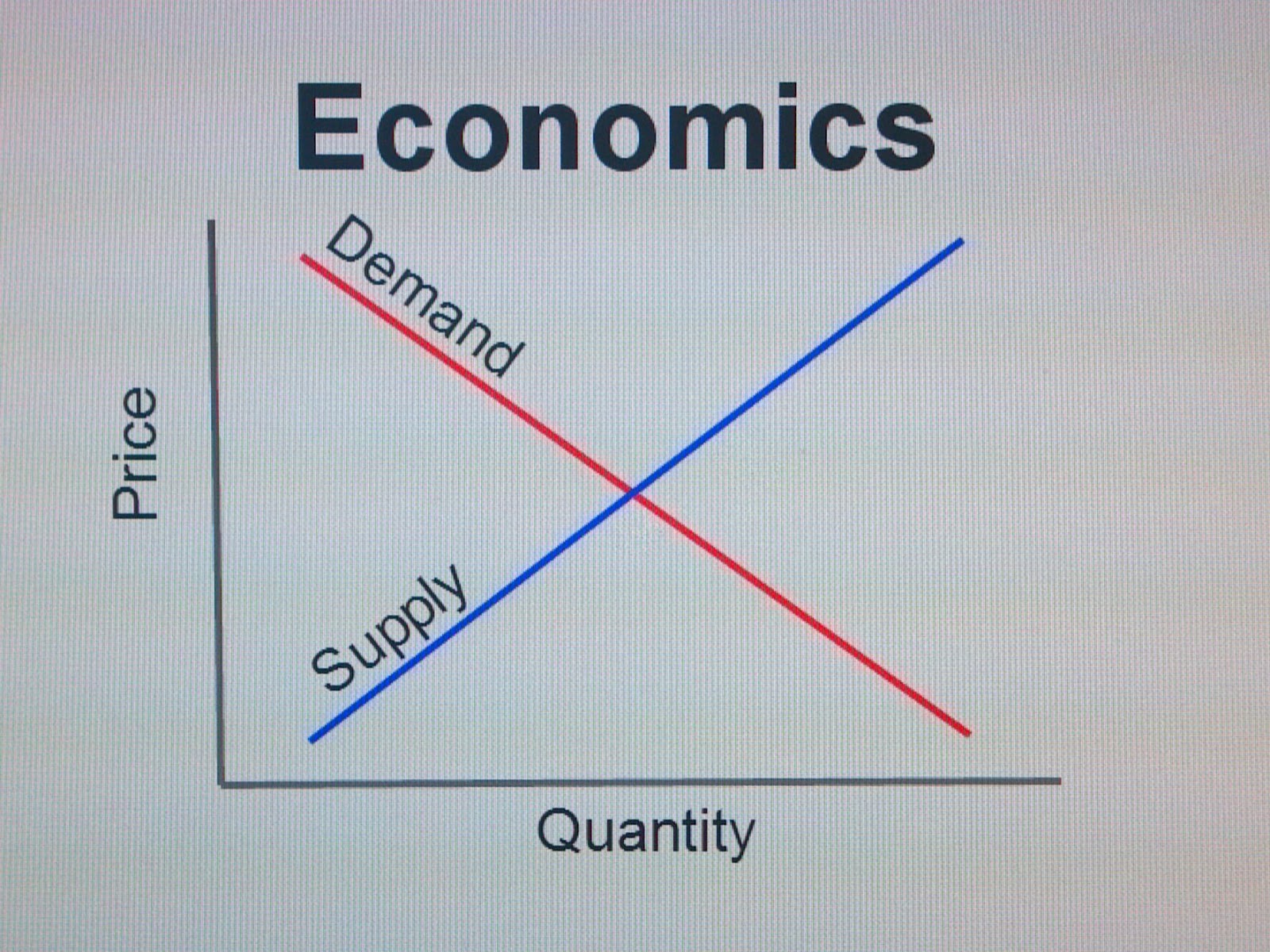
The basic idea is that there exists a total sum of money, or financial capital, that individual and institutional investors are willing to loan out or invest. Most economists call this the “loanable funds market.” The supply of loans, as with any supply curve, slopes upward and to the right. In other words, as the interest rate (the price of a loan) rises, more people will be eager to supply loans. In contrast, the demand for loanable funds slopes, like a normal demand curve, downward and to the right. That is, as the interest rate goes down, more people are interested in borrowing money. Just think of any normal supply-demand graph, but with the good in question being a loan rather than a physical good or a service, and the vertical axis labeled “interest rate” rather than “price,” as in other markets.

The demand for loanable funds is a function of how much capital investment businesses need (which is itself a function of how profitable those capital investments are), what quantity of money consumers need for purchases like homes and new vehicles, and how much money the government needs to borrow. In a game where the total supply of loanable funds per year is set, say at $5 trillion, every $1 trillion the government runs up in deficits is $1 trillion less available for private investment in the innovations that improve quality of life, bring us new medicines, and create new jobs.

Increased government deficits shift the demand for loanable funds to the right. As any student of elementary economics knows, this increases the price, or in this case, the nominal interest rate. Many private sector projects that make sense at 4 percent interest are no longer acted upon if the government runs such a large deficit that the interest rate must increase to 7 percent for investors to shell out the cash necessary to finance that deficit. Increasing the supply of loanable funds through monetary expansion, as happened in the COVID pandemic with breathtaking speed, can temporarily hide this effect. However, this spurs inflation that reduces real returns and hampers economic growth (the stock market’s dismal returns since runaway inflation started in late 2021 is one example of this result).

In contrast to the Keynesian “money multiplier” theory, which insists that government spending stimulates the economy by circulating money via transfer payments that otherwise would have remained in savings and uncirculated, savings in nearly all developed countries are not locked away gathering moths and rust, but invested. Of every dollar put in the bank, more than 90 percent is invested in loans for commercial enterprises, in home loans, and in bonds, and this doesn’t account for the fact that a larger and larger share of surplus savings in the United States are not in the traditional banking system, but in brokerage accounts, 401(k)s, and elsewhere.

Government spending does not multiply the economic power of money, it diminishes it. If the opposite were true, Cuba, North Korea, and Venezuela would be among the wealthiest nations on the planet, since nearly all economic activity is facilitated through government spending in those nations. That they are not, but that nations with relatively free markets such as the United States, Singapore, the United Kingdom, and Japan punch above their weight economically suggests that private investment in the innovations and technologies of tomorrow everywhere and always beats government transfer payments in facilitating economic growth.

Every dollar the government must borrow is a dollar not available for private businesses or individuals to borrow, and that reduces future economic growth and job creation. With America’s debt now hovering near 125 percent of GDP (before netting for debt held by government entities) and deficits topping $1 trillion yearly as far as the eye can see, we can no longer ignore this drag on the American economy.

Nathan J. Richendollar

Nathan Richendollar is a summa cum laude economics and politics graduate of Washington and Lee University in Lexington, VA. He lives in Southwest Missouri and works in the financial sector. 

This article was originally published on FEE.org. Read the original article.

The Unseen Cost of Government Largesse

Friday, November 19, 2021

Interview: Rand Paul Explains What’s Really Causing America’s Inflation Woes

Consumer price inflation just hit the highest level in 30 years. Prices rose 6.2 percent from October 2020 to October 2021, according to new government data, prompting a new reckoning with “temporary” inflation that’s proving not so short-lived after all. I interviewed Senator Rand Paul, a libertarian-leaning Republican from Kentucky, to get his perspective on what’s driving our mounting inflation woes. 

“I think inflation is pretty easy to explain and people need to know what causes inflation,” the senator said. “[The federal government] gets debt, then the Federal Reserve prints up new money to pay for the debt, that new money enters circulation, and that expansion of the money supply [leads to] inflation.”

Paul argued that this kind of inflation, rooted in government policies, is a “bait-and-switch” form of taxation. 

“Big government politicians offer you things they say are ‘free’: free childcare, free healthcare, free college, free cell phones, free this, free that—but it's not really free,” he said. “Either someone else is going to pay for it through higher taxes, or they're going to pay for it through borrowing and ultimately inflation. And it really is a bait and switch because often the same people that are being offered free stuff are also the ones who suffer most through the regressive tax that is inflation.”

“We have to explain to people the second order of thinking that goes to understanding that it's not free,” he concluded.

But what, specifically, is driving the current inflation surge?

“Really the inflation we have this year is probably a responsibility of both parties,” Paul said, referencing the trillions in deficit-financed spending Congress has passed since the COVID-19 pandemic began. “You know, both parties other than myself and a few others were for all the spending of last year. So we borrowed $3-4 trillion last year, and we're set to borrow at least that much or more this year.” 

“I think you may see inflation of 10% or 12% next year,” the senator cautioned. “Now they're all saying the opposite. The Federal Reserve is saying it's transitory, but I think the 6% that we've got now is based on last year's borrowing. And I think there's going to be significantly more borrowing this year. We've already spent an extra $2 trillion on a COVID bailout bill, which really didn't have much to do with COVID, but it was more just a bailout bill, [and now] another trillion on infrastructure.”

But it’s not just Congress, the senator explained, as the Federal Reserve itself shares a large portion of the blame. 

“There's joint blame: Congress is initially to blame for spending money it doesn’t have and then the Federal Reserve says, oh, it's just our job to paper over this,” Paul said. “It's our job to buy up that debt and as they do, they create the increased money supply. So really both Congress and the Fed are to blame and they go hand in hand.”

“If we ran a balanced budget, we wouldn't necessarily need a Federal Reserve,” he continued. “Basically we have a Federal Reserve to pay for all that debt.”

Paul warned that if inflation continues unchecked, we could see a “loss of confidence” in US currency and “people fleeing the dollar.” The senator stressed that with the advent of cryptocurrency, people have more alternatives—taking away protection the dollar may have enjoyed in the past.  

I asked Senator Paul about President Biden’s argument that in order to combat inflation, the federal government actually needs to spend trillions more on his “Build Back Better” climate change and welfare agenda. 

“President Biden has no idea what causes inflation,” he responded. “I mean, someone should ask him that question. How does [the government] spending more money reduce inflation? How does borrowing more money reduce inflation? That's some mental gymnastics. It's hard for me to comprehend.”

I offered the president’s counterargument, bolstered by liberal-leaning economists, that his bill would hugely increase productivity and thus lower inflation pressures over time.

“I think productivity comes from ingenuity and market efficiencies, but I don't think in any way, productivity is increased by government spending,” Paul countered. “In fact, you could probably argue the opposite.” 

“If you had a million dollars and you wanted to let your representatives decide how to spend it, or a bunch of venture capitalists who look at profit and loss and look at markets and make estimates, neither are perfect,” he continued. “It's all our guesses about the future. But my thinking is that when it comes to the government, it's politicized. Whereas the investors will only look at profit and loss because their job is narrowly focused towards trying to invest in things that make money.”

“The marketplace is always wiser and smarter than the government,” Paul concluded. “[Remember] what Milton Friedman used to say... that nobody spends somebody else's money as wisely as their own. And that truism will always mean that the government lacks efficiency and lacks really the drive to make the best decisions for investing. So I would say productivity and the productivity of capital… always has to be less with the government.”

So, the senator warned that if President Biden’s multi-trillion-dollar spending agenda was passed by Congress, it would only worsen, not help, our inflation problems. But Paul noted that this may not happen, because even some moderate Democrats like Senator Joe Manchin are acknowledging the reality of inflation and putting the president’s ambitions on pause. 

Only time will tell. But if the federal government fails to rein in its reckless fiscal and monetary policies, we may well see inflation get even more out of control. And nobody will be able to say they weren’t warned.

Like this story? Click here to sign up for the FEE Daily and get free-market news and analysis like this from Policy Correspondent Brad Polumbo in your inbox every weekday.

Brad Polumbo
Brad Polumbo

Brad Polumbo (@Brad_Polumbo) is a libertarian-conservative journalist and Policy Correspondent at the Foundation for Economic Education.

This article was originally published on FEE.org. Read the original article.

Interview: Rand Paul Explains What’s Really Causing America’s Inflation Woes

Monday, November 8, 2021

Ivy League Analysis Destroys Biden’s Entire Argument for Multi-Trillion-Dollar ‘Build Back Better’ Spending Plans

President Biden continues to fight to pass some version of his multi-trillion-dollar “Build Back Better” spending agenda through Congress. In its various iterations, the plan includes trillions spent on everything from electric vehicle tax credits and green energy subsidies to taxpayer-funded childcare-for-all to housing subsidies and more. The Biden administration claims that the latest version would involve $1.85 trillion in new spending. 

The president has made lofty promises about what we’d get in exchange for such a historic investment. (After all, that price tag is more than the inflation-adjusted cost of FDR’s New Deal!)  

“[This is] a framework that will create millions of jobs, grow the economy, invest in our nation and our people, turn the climate crisis into an opportunity, and put us on a path not only to compete, but to win the economic competition for the 21st century against China and every other major country in the world,” Biden said in a recent speech. “It’s fiscally responsible. It’s fully paid for.”

“For much too long, the working people of this nation and the middle class of this country have been dealt out of the American deal, and it’s time to deal them back in,” he continued. “If we make these investments, there will be no stopping the American people or America. We will own the future.” 

Simply put, Biden argues that his plan to spend trillions will create jobs, grow the economy, and increase wages—all without adding to the $28.9 trillion (and counting) national debt. Yet a new Ivy League economic analysis undercuts every single one of these claims. 

Analysts at the Wharton School of Business reviewed President Biden’s latest $1.85 trillion framework proposal and ran the numbers to project its likely economic impacts, under two distinct scenarios. One is the rather unrealistic scenario where it actually only costs $1.85 trillion. Yet because the proposal is structured with many budget gimmicks and short-term spending authorizations that would likely be reauthorized if implemented, its real cost could be as much as $4.25 trillion. Wharton also modeled the likely impact of this scenario. 

In the first case, where the president’s plans cost only what he claims, the analysis still finds his promises falling short on nearly all counts. The tax increases included would not, in fact, pay for the entire proposal, and it would lead to a 2 percent increase in government debt over the long run. (That might sound small, but it’s hundreds of billions of taxpayer dollars!) And, while Wharton projects that wages would increase slightly, it finds that the overall economy would shrink, not grow, while business investment and hours worked would decline. 

Erm… how’s that revitalizing America? And those dismal results are under Biden’s rosy assumptions. Under the more realistic scenario where spending provisions are accurately accounted for and the real cost is north of $4 trillion, the investment’s return is even more spectacularly awful.  

Government debt would increase by 25 percent over 30 years—that’s trillions and trillions in new spending that is not, in fact, paid for. The economy would shrink—not grow—nearly 3 percent over this timeline compared to the baseline, while wages would decline 1.5 percent and hours worked would fall 1.3 percent. 

It’s easy to see why government spending could have these meager results. Proponents of big government spending, like Joe Biden, focus solely on the purported benefits of their plans.

Yet every dollar spent somewhere must ultimately, directly or indirectly, come from somewhere else in the economy. The resources invested by the government in one area are, by definition, resources that would have been invested somewhere else by the private sector. 

The tax hikes to partially fund the spending discourage work and tax away money that would have otherwise been invested. The debt incurred to partially fund the spending “crowds out” resources available for private sector investment. It’s not just a wash, either. In taking resources that would have been allocated via market signals and instead allocating them based on politics, government redistribution generally leads to net economic losses. 

As Ludwig von Mises famously put it, “The government and its chiefs do not have the powers of the mythical Santa Claus. They cannot spend except by taking out of the pockets of some people for the benefit of others.” 

It’s with the reality of trade-offs in mind that the Wharton analysis is able to reliably predict the negative impacts of Biden’s plans. 

This analysis is nothing short of devastating for the president’s plans. Biden wants to confiscate and spend trillions of our taxpayer dollars and is promising us the world in return for this investment. But Ivy League analysts and basic economic principles alike expose how empty those promises really are.

Like this story? Click here to sign up for the FEE Daily and get free-market news and analysis like this from Policy Correspondent Brad Polumbo in your inbox every weekday.

Brad Polumbo
Brad Polumbo

Brad Polumbo (@Brad_Polumbo) is a libertarian-conservative journalist and Policy Correspondent at the Foundation for Economic Education.

This article was originally published on FEE.org. Read the original article.

Ivy League Analysis Destroys Biden’s Entire Argument for Multi-Trillion-Dollar ‘Build Back Better’ Spending Plans

Thursday, September 30, 2021

‘Fiscal Insanity’: Senator Joe Manchin Comes Out Against Biden’s $3.5 Trillion Spending Proposal

Congress’s efforts to push through a budget-busting $3.5+ trillion welfare and climate change spending bill are coming to a fever pitch. But with the Senate evenly split between Democrats and Republicans, 50-50, the party-line spending legislation could be doomed—because one prominent Democratic senator just came out swinging against the effort. 

“I can’t support $3.5 trillion more in spending when we have already spent $5.4 trillion since last March,” West Virginia Senator Joe Manchin, a moderate Democrat, said in a statement released Wednesday. “At some point, all of us, regardless of party, must ask the simple question – how much is enough?”

“What I have made clear to the President and Democratic leaders is that spending trillions more on new and expanded government programs, when we can’t even pay for the essential social programs, like Social Security and Medicare, is the definition of fiscal insanity,” Manchin continued. “Suggesting that spending trillions more will not have an impact on inflation ignores the everyday reality that America’s families continue [to] pay an unavoidable inflation tax. Proposing a historic expansion of social programs while ignoring the fact we are not in a recession and that millions of jobs remain open will only feed a dysfunction that could weaken our economic recovery.”

To be clear, Manchin is not exactly a principled free-marketeer or small government fiscal conservative. Indeed, he is actively promoting a $1.2+ trillion spending bill ostensibly dedicated to transportation infrastructure, and is open to the idea of more spending. The senator simply acknowledges the reality of trade-offs. (Unlike many in his party who bizarrely continue to falsely claim their multi-trillion-dollar proposal costs “zero dollars.”) 

Still, Manchin deserves credit for grappling with the reality that the government cannot create resources out of thin air. Whether through the sweeping proposed tax hikes, new federal debt, or money-printing that drives inflation, all the goodies handed out by the federal government must ultimately come from somewhere else. 

Manchin rightly argued that the current approach of spending trillions and ignoring any consequences is reckless and motivated by an extreme political ideology that ignores fiscal reality. 

“Overall, the amount we spend now must be balanced with what we need and can afford – not designed to reengineer the social and economic fabric of this nation or vengefully tax for the sake of wishful spending,” he said. “While I am hopeful that common ground can be found that would result in another historic investment in our nation, I cannot – and will not - support trillions in spending or an all or nothing approach that ignores the brutal fiscal reality our nation faces.”

If only more politicians in Washington were willing to at least grapple with fiscal reality when crafting spending policies and less content to simply pass the buck onto future generations. 

“America is a great nation but great nations throughout history have been weakened by careless spending and bad policies,” Manchin concluded. “Now, more than ever, we must work together to avoid these fatal mistakes so that we may fulfill our greatest responsibility as elected leaders and pass on a better America to the next generation.”

Like this story? Click here to sign up for the FEE Daily and get free-market news and analysis like this from Policy Correspondent Brad Polumbo in your inbox every weekday.

Brad Polumbo
Brad Polumbo

Brad Polumbo (@Brad_Polumbo) is a libertarian-conservative journalist and Policy Correspondent at the Foundation for Economic Education.

This article was originally published on FEE.org. Read the original article.

‘Fiscal Insanity’: Senator Joe Manchin Comes Out Against Biden’s $3.5 Trillion Spending Proposal

Wednesday, April 28, 2021

Biden’s $2 Trillion Infrastructure Plan Is Loaded With Corporate Welfare

President Biden has just unveiled a new $2.3 trillion “infrastructure” plan, but a shockingly large portion of this bill is actually unrelated to infrastructure.

The plan includes massive subsidies for corporations as well as state and local governments, and comes right after the administration’s proposed increase in the corporate tax rate, which would raise the rate from 21 percent to 28 percent.

There’s $300 billion for manufacturing, $100 billion for electric utilities, $100 billion for broadband, $174 billion for electric vehicles, and a whole lot more. A significant portion of this spending is directed at subsidizing big corporations.

What the plan overlooks is that corporations are already investing heavily in the industries they aim to subsidize. For example, companies like Tesla and Volkswagen have invested billions into developing electric automobiles and charging infrastructure. Biden’s plan would aim to influence consumer spending decisions through the creation of further incentives for such vehicles. In other words, these companies would see their profits boosted as a result of artificially increased demand. The same goes for Verizon and T-Mobile that have invested in broadband, and Mitsubishi and Siemens that have invested in wind energy.

Subsidizing multi-billion dollar corporations and pumping up their profits is corporate welfare, not an infrastructure plan. The private sector built hundreds of thousands of gas stations across the country, and if there is demand for it, they will do the same with charging stations for EVs. A federal takeover of business investment decisions in this manner will inevitably have repercussions.

The Biden administration has included $100 billion to “decarbonize” the US electric grid, essentially eliminating coal and natural gas, alongside $213 billion for affordable housing and $400 billion to bolster home health-care. Despite President Biden’s push for bipartisanship, partisan political spending runs through his plan.

This plan comes on the heels of Biden's proposed corporate tax hikes.

The current administration is betting that damage caused by jacking up taxes will be outweighed by the massive amount of federal spending in this proposal. As the president of the Tax Foundation, Scott A. Hodge put it, “Based on CBO’s (Congressional Budget Office) assessment of the economic and budgetary effects of federal investment, there is no reason to believe that the economy will be better off with such a trade.”

The CBO estimates that $2 trillion in federal spending will yield about $1.3 trillion in actual investment. Since government investment only results in half the returns of private investment, we would be much better off if the $2 trillion in corporate tax increases that Biden needs to fund this plan were left in the hands of the private sector.

This plan would be a massive circular flow of revenue with increased corporate taxes funding subsidies for large companies, ultimately decreasing investment and long term capital formation. As federal spending increases to unprecedented levels, state and local governments become nothing more than the administrators of a giant national government.

Bureaucracies are notoriously and inherently inefficient, the economist Ludwig von Mises has pointed out.

“It is a widespread illusion that the effi­ciency of government bureaus could be improved by management engineers and their methods of scientific management. . . . What they call deficiencies and faults of the management of administrative agencies are necessary properties. A bureau is not a profit-seeking enterprise; it cannot make use of any economic calculation. . . . It is out of the question to improve its management by reshaping it ac­cording to the pattern of private business."

Expanding bureaucracy will only exacerbate these effects. The expenses and delays involved in collecting trillions of dollars in additional corporate taxes, running them through Washington and eventually using them to finance countless programs only serve as further discouragement against pursuing such a plan.

Overall, a thorough analysis of this proposal reveals that it would ultimately do more harm than good. In addition to the high levels of political spending and unnecessary intervention in business investment decisions, this plan would be a burden on the economy, reducing investment, growth, and prosperity over the long run.

Aadi Golchha
Aadi Golchha

Aadi Golchha is the author of "The Socialist Trap: How the Leftist Utopia Will Destroy America" and an independent political analyst.

This article was originally published on FEE.org. Read the original article.

Biden’s $2 Trillion Infrastructure Plan Is Loaded With Corporate Welfare

Saturday, November 10, 2018

Is America Going Broke? An Ivy League Economist on Why Government Debt Is Surging


Let me tell you a Halloween horror story.

This month it was announced that the federal budget deficit had jumped 17 percent to $779 billion in 2018. This was larger than any year since 2012 when it topped $1 trillion. According to the White House’s recent budget, the federal government will borrow $870 billion this coming year.

This isn’t being done in the name of economic stimulus. As a number of distinguished economists recently pointed out in an op-ed for the Washington Post, this has been a year of “relatively strong economic growth, low unemployment and continued historically low interest rates.” And still, the federal government is on track to borrow nearly $7,000 for every household in America.

The outlook for the future is grim. Even if the “Trump boom” continues, current tax and spending patterns indicate that deficits will continue rising, approaching $1 trillion in two years and steadily rising afterward, on and on into the future. On the current path, the outstanding public debt will rise by one third to $20 trillion just five years from now. That works out at nearly $250,000 for a family of four, more than twice the median household wealth.

The consequences of this are horrendous to contemplate. The Trump administration is using interest rates of 3.5 percent for its projections. If they rose to 5 percent—a standard number before the financial crisis—the interest costs alone on the projected debt would total $1 trillion annually. As the Washington Post economists note, “More than half of all personal income taxes would be needed to pay bondholders.”
Where is all this red ink coming from?

It is not tax cuts. The Budget and Economic Outlook for 2018 to 2028 released by the Congressional Budget Office in April reveals that, as a share of GDP, tax revenues are currently 17.3 percent of GDP. The CBO actually forecasts this to rise to 18.5 percent in 2028. The argument that the cut in federal corporate tax rates is a cause of the increased deficits and debt is absurd. The tax’s revenue amounted to just 1.5 percent of GDP in 2017, and the CBO forecasts that it will still be 1.5% in 2028.

The real answer is out-of-control spending. The CBO forecasts that spending will rise from 20.8 percent of GDP now to 23.6 percent in 2028. But it is not increased “discretionary” spending such as defense or education that are driving spending upward. In fact, from 2018 to 2028, the CBO forecasts that discretionary spending will fall from 6.4 percent of GDP to 5.4 percent. Defense spending, for example, is projected to fall from 3.1 percent of GDP in 2018 to 2.6 percent in 2028.

The CBO is unequivocal that this increase in spending is being driven by out-of-control entitlement outlays. Between 2018 and 2028, spending on Social Security, Medicaid, and Medicare is projected to rise from 12.7 percent of GDP to 15.2 percent. Social Security spending is expected to increase from 4.9 percent of GDP to 6.0 percent, Medicare from 3.5 percent of GDP to 5.1 percent, and Medicaid from 1.9 percent of GDP to 2.2 percent. This is what is driving America’s catastrophic indebtedness.
America’s politicians see all these numbers. They can see the vast problems this orgy of borrowing is creating. But still they carry on. Why? A new paper titled “Rising Government Debt and What to Do About It” by economist Pierre Yared seeks to address this question.

Yared dismisses the idea that these elevated levels of government debt represent an “optimal” policy response to either foreseen or unforeseen fiscal shocks. Foreseeing a problem with aging populations, governments would be expected to reduce their debt in preparation for the increased expenditures an older population will require. In fact, the opposite has happened; governments across the developed world have increased their debts. Neither can unforeseen pressures like the 2008 crash or wars in the Middle East be the primary cause; the increases in government indebtedness both long predate 2008 and are present in countries that did not intervene in the Middle East.

Instead, Yared turns to political economy theories of government debt. These “predict that the presence of an aging population, political polarization, and electoral uncertainty cause governments to be shortsighted and to promote immediate goals at the expense of long-term ones. These political factors affect the long-run size of government deficits and therefore the long-term trend of government debt.” Yared argues that “over the past four decades, changes in these political factors can explain the long-run trajectory of government debt.”

Yared asserts that aging populations care less about the future, citing evidence that younger households place a larger value on fiscal responsibility than older households. Political polarization produces something like a ‘tragedy of the commons’ where “political parties acting independently engage in excessive targeted government spending since they do not internalize the shared financing costs of government debt.”

As a result, according to evidence presented by Yared, “countries with a large number of constituencies or deep disagreements in spending priorities across constituencies will incur larger government deficits, resulting in faster government debt accumulation.” Finally, electoral uncertainty “causes the current government to be impatient, since the party holding power recognizes that it may not have the opportunity to benefit from spending in the future.” Again, Yared presents evidence that this political uncertainty has increased in recent decades as government indebtedness has risen.

If Yared is right, America’s fiscal outlook isn’t encouraging. None of these factors are going away anytime soon. America’s population is projected to continue aging for the next couple of decades. By 2035, according to the Census Bureau, there will be 78 million people 65 years and older compared to 77 million under the age of 18.

Neither is the political appetite for dishing out goodies with little regard to who picks up the tab likely to decrease. Recently, a colleague of mine testified before the Joint Economic Committee of Congress in Washington, DC. At one point, the ranking Democrat on the committee, Senator Martin Heinrich, asked whether those testifying were in favor of cuts to programs like Social Security and Medicare, which seniors have come to rely on. Rely on them they might, but if the money isn’t there, it isn’t there. It doesn’t magically appear simply because politicians like Sen. Heinrich find it politically expedient.

Finally, who would predict that political polarization in the US is going to decrease much anytime soon?

The promises government makes cannot be supported by any reasonable expectation of tax revenue. Printing the money to cover these liabilities will result in inflation. At some point, the irresistible force of insufficient government revenues is going to meet the immovable object of entitlement commitments.

Until then, we face the prospect, year after year, of yawning deficits and increasing floods of red ink. You may visualize the scene from The Shiningwhere the elevator doors open and a torrent of bright red blood pours out.

Happy Halloween.

Source: Foundation for Economic Education: Is America Going Broke? An Ivy League Economist on Why Government Debt Is Surging

Friday, January 26, 2018

Yes, You Can Be for Lower Taxes and Smaller Deficits

One needn’t support the recently-enacted tax legislation to be disturbed by the tenor of much criticism of it. Many opponents, and indeed some press reporting, took for granted that if one voted for a significant tax cut after having expressed longstanding concerns about federal deficits, one must be an irredeemable hypocrite. But lower taxes and smaller deficits can coexist.

Some examples of the criticism: Neera Tanden wrote in NBC news of the “staggering hypocrisy” inherent in passing “shameful tax cut legislation” after sponsors had previously warned of a “forthcoming debt crisis.” Robert Schlesinger opined in US News & World Report that the legislation suggested “an incredible case of cognitive dissonance or simple breathtaking hypocrisy and/or duplicity.” Ezra Klein fumed at Vox that lawmakers who supported the bill were “nihilists.”

This refrain was repeated on editorial pages nationwide: you could be for deficit reduction, or alternatively, you could be for tax cuts. Only a nihilist hypocrite could possibly have taken both positions.

The Case for Lower Taxes and Smaller Deficits

Beyond its closed-mindedness, this outpouring of indignation was all premised on a mistaken foundational assumption. It is entirely possible to be for both lower taxes and smaller deficits. In fact, I would argue this was not only possible but that it represented the most responsible policy position given the projections lawmakers faced when the tax bill was debated. (Disclaimer: the following should not be misinterpreted as necessarily an endorsement of the specific tax legislation, nor of prioritizing tax relief over fiscal consolidation.)

When the tax bill was debated, lawmakers faced baseline budget projections that looked like this:


Everything on this graph is shown as a percentage of GDP, so in effect, this shows how both federal spending and (to a lesser extent) revenue collections are growing faster than our economic output. Beyond the time window shown here, the long-term fiscal picture looked even worse. Spending would continue to rise dramatically faster than our ability to finance it, threatening escalating deficits in the decades ahead.

The graph also shows that undertaxation is not the cause of this fiscal gap. Over the next decade, tax burdens were actually projected to be higher than the historical average and to increase gradually faster than our economic capacity.

This was not and is not a stable situation. Taxing and spending as a share of our economy cannot keep increasing forever. (Actually, there is a theoretical sense in which we can spend more than 100% of our economic output if all spending takes the form of domestic income transfers. In other words, we could theoretically tax people several times the amount of their income, provided that we simultaneously write government checks that give it all back to them.

However, this is neither practicable nor politically feasible. In the real world, we must moderate both our tax and spending growth. Fixing this problem within historical political norms would mean cutting future spending growth substantially – but importantly, also lowering some future tax growth, even as projected deficits are reduced.

In other words, the baseline budget picture was such that there was no contradiction between reducing projected deficits and lowering projected tax collections. Indeed, that is exactly what a solution consistent with historical experience would require.

The Case against Lower Taxes and Smaller Deficits

Now, there is a standpoint from which it would be inconsistent to claim support for both lower taxes and smaller deficits – specifically if one argued that projected spending growth must never be slowed. Some progressives seek not only to preserve currently projected spending growth but to add enormously to it.

In this mindset, deficits could only be closed if tax collections rise faster than projected. Importantly, this would still not produce a stable budget situation because tax collections would need to grow much faster than Americans’ ability to pay them. Nevertheless, some advocates effectively take this policy position.

But those who voted for the tax bill are not generally guilty of this. To the contrary, those members have repeatedly been assailed for their allegedly heartless determination to cut spending. House Speaker Paul Ryan has even been depicted — in one particularly revolting ad a few years ago — as dumping an innocent grandmother out of her wheelchair over a cliff, because of his efforts to address rising entitlement spending. And just a few months before their tax vote, lawmakers were attacked for supposedly taking away people’s health care because of their efforts to tackle hundreds of billions of dollars in projected spending growth under the ACA.

Credit and Criticism Where It's Due

It is legitimate to oppose legislation to slow the growth of federal spending, if one believes that spending is needed. But one cannot fairly attack legislators who try to address runaway spending growth, and then later assail those same legislators as hypocrites for widening the deficit.

Now, it is fair to criticize sponsors of deficit-widening legislation for denying they are increasing the debt. There has been a regrettable amount of such denial, where the public would have been better served to hear arguments as to why the benefits of tax cuts outweighed the downside of a debt increase.

One can simply assume growth-stimulation effects under which tax cuts do not add to long-term debt, but non-partisan scorekeepers widely reject them — in the same way they rejected assumptions crafted during the last administration to conclude additional stimulus spending could pay for itself. Advocates should acknowledge adverse fiscal consequences of any legislation under consideration, even as they argue for its passage.

The bottom line is this: prior to the tax legislation, lawmakers faced projections in which both tax burdens and spending patterns exceeded historical norms and were projected to rise still further, driven principally by growth in the major federal health entitlements and Social Security. The merits of this specific tax bill aside, a responsible and sustainable fiscal policy would reduce both projected spending and deficits substantially, while also slowing tax growth somewhat, and ensuring that neither taxes nor spending ultimately grow faster than our ability to finance them.

Recognizing these realities involves no hypocrisy, but attacking lawmakers for fiscal recklessness — just a few months after taking political advantage of their efforts to rein in part of the federal spending explosion — most certainly does.

Reprinted from Economics 21.


Charles Blahous


Charles Blahous is a senior research fellow for the Mercatus Center, a research fellow for the Hoover Institution, a public trustee for Social Security and Medicare, and a contributor to e21.

This article was originally published on FEE.org. Read the original article.


Friday, May 5, 2017

Should Taxpayers Be Fleeced Forever Because of the Deficit?

Should Taxpayers Be Fleeced Forever Because of the Deficit?

As anyone could have predicted, after President Trump released his tax proposal last week the response from the left was a familiar one about "tax cuts we can't afford" and "mountains of debt" that will supposedly result from reduced penalties placed on work, investment, corporate profits, and of course, death.

So while the left acted as expected, the truly unfortunate part of this story is that Republicans and conservatives responded to the criticism of Trump's proposal in a similarly predictable fashion.

The Ongoing Debate

The Republicans said what they always say, that tax cuts will author booming growth and will lead to higher federal revenues. This included Treasury Secretary Steven Mnuchin who, as if coached by GOP automatons, responded that the "tax plan will pay for itself with economic growth."

And then, right on cue, deficit scolds from the Republican side of the aisle, including Douglas Holtz-Eakin, expressed skepticism that the proposed cuts would raise "$2 trillion in revenue." Meanwhile, Greg Mankiw questioned the GOP math, telling the New York Times that according to accepted wisdom only "one-third of the cost of tax cuts is recouped via faster economic growth."

With the tax cut debate, nothing ever changes.

Focus on the Spending

Lost on many Republicans is that the moment they start talking about revenues they concede the taxation argument to the Democrats. And this is true even though their oft-stated statistics are correct.

As the 1920s, 1960s, 1980s, late 1990s (capital gains cuts in '97), and 2003 (income, capital gains cuts) reveal rather clearly, reduced penalties on work and investment lead to more taxable economic activity that leads to higher federal revenues. Ok, but federal revenues are not the point, and tax cuts are certainly not a "cost."

When Republicans talk about how much the treasury will collect they concede to the Democrats that we have a revenue problem that requires a taxation answer, as opposed to one of too much spending. Sorry, but government spends too much. It's as simple as that.

Seemingly forgotten by Republicans and conservatives long ago is that with government spending, it's not their money. In that very real sense, all government spending is deficit spending.

For governments to spend, they must tax or borrow precious resources from the private sector only to hand them over to Paul Ryan, Nancy Pelosi and Donald Trump, rather than intrepid investors putting more capital to work, or allowing those who earned the money to actually keep it.

Reducing all of this to what's basic, what would voters prefer? A balanced budget annually of $4 trillion, or $1 trillion in annual deficits based on $1.5 trillion in spending? This is not a trick question. It's easy.

The spending is the problem.

Deficits Don’t Really Matter

At least when governments borrow on our backs they're paying for the right to waste resources we produce. So if the economy-sapping waste is going to happen, better for government to pay interest back to investors rather than simply confiscate the wealth with taxes.

To state, what should be obvious is that budget deficits really don't matter. No one is forcing investors or central banks to buy debt that is only attractive insofar as productive Americans are being fleeced.

Republicans and conservatives who focus on deficits are wasting brain space on what is an accounting abstraction.They need to tape a note to their mirrors, reminding themselves that when politicians spend at the expense of the people’s freedom—and to the detriment of experimentation in healthcare advances, transportation advances, and technological innovation that would render WiFi an antique—they're being wasteful with our money.

When governments spend, we the taxpayers naturally have less to spend, and of even greater importance, less to save and invest.

Real Cuts; Less Rhetoric

Considering all of the above, Republicans invariably miss that it's a very good thing when governments collect less revenue. Indeed, that should be the goal of tax cuts; to reduce the amount that the treasury takes in each year.

Politicians can only waste precious resources insofar as we allow them to, so if Republicans want to live up to their lofty rhetoric about freedom, they should talk about tax cuts that reduce revenues as a feature of tax reform, not a bug.

The above also speaks to another problem tied to the Republican approach to reduced taxation: They justify their actions by saying that economic growth will be the result. It's fair to say that when work and investment are less restricted, we gain greater access to both. These arguments are true, but so what?

Republicans should be for tax cuts even if they were proven to stagger economic growth because the core argument should always be about freedom. It's through hard work that Americans express themselves and the fruits of their labor should not be taken from them without consent.

Of course, there are always the deficit scolds who talk ad infinitum about "budget shortfalls," debt as "far as the eye can see," and "unfunded liabilities" that will soon enough, even making the most laughable prediction, "Make America Greece."

As much as the left confidently predicts global doom if we don't do anything about an allegedly warming planet, so do the misguided "deficit hawks" on the right regularly inform us that America is doomed to follow in Greece’s footsteps if we don't reduce the deficits. This silly argument fails in two ways.

First, a focus on deficits once again places the taxation and spending argument squarely on the turf of the left. They'll gladly discuss what isn't a revenue problem as though it is.

But the bigger problem with this mindless argument concerns something economists bereft of market knowledge seemingly miss all the time: rising revenues are what enable ever-growing federal "deficits."

The paradoxical truth missed by a right blinded by false balance is that real-world investors are always willing to buy debt that is backed by ever-increasing wealth creation and produced by the most productive people on earth.

Of course that's why actual tax cuts large enough to reduce federal revenues would be so wondrous for the confused hawks. When revenues into the treasury decrease, and continue decreasing, so will the relative willingness of investors to buy treasury debt. A benefit of the latter will be that the deficit hawks, who've been predicting doom for decades, will finally (one can hope) disappear into their campus and think tank cubicles never to be heard from again.

The main point is, of course, that taxes are way too high. Taxes should ideally be so low that federal revenues plummet. Wouldn’t it be a nice change to see Republicans promote tax relief that penalizes American workers less while also reining in politicians?

One can dream, but if history has proven itself to be any sort of indicator, Republicans are set to resume yet another debate about growth and revenues that will hand the terms of the debate over to the left on a silver platter. For all politicians, regardless of party alliance, freedom is always an afterthought.

John Tamny
John Tamny is a Forbes contributor, editor of RealClearMarkets, a senior fellow in economics at Reason, and a senior economic adviser to Toreador Research & Trading. He’s the author of the 2016 book Who Needs the Fed? (Encounter), along with Popular Economics (Regnery Publishing, 2015).

This article was originally published on FEE.org. Read the original article.