steem
Showing posts with label space. Show all posts
Thursday, September 17, 2026
The Liberty Bell 7
The Liberty Bell 7 was the capsule that flew on board a Mercury-Redstone rocket for the second U.S. manned spaceflight with Gus Grissom in 1961. This was a suborbital flight that only lasted a little over fifteen minutes and all went well until splashdown.
The hatch cover was designed to release via a small explosive device in the event of an emergency. For some reason, it was unintentionally activated shortly after the capsule landed in the ocean. Gus Grissom escaped safely (though he would later die in the Apollo 1 fire), but the capsule sank before it could be recovered.
Nearly 40 years later in 1999 it was finally recovered in 16,000 feet of water after a fourteen year private effort to find and retrieve it financed by the Discovery Channel. Ironically, while the emergency explosive device on the hatch exploded when it wasn’t supposed to, another explosive device designed to produce a sound to aid location in the event of sinking did not detonate. This had to be removed upon recovery.
After the Liberty Bell 7 was taken apart, cleaned and reassembled it went on a national tour for several years. Today, it’s home is in the Cosmosphere, a museum in Kansas, but in October 2000 when these pictures were taken it was at the Kennedy Space Center in Florida.
Tuesday, May 20, 2025
Atlas V Launch of the Solar Orbiter (2020-02-10)
Atlas V Launch of the Solar Orbiter (2020-02-10): This video features a launch of a United Launch Alliance Atlas V rocket carrying the European's Space Agency's Solar Orbiter. This was recorded from my backyard on Sunday night, February 20th, 2020.
Friday, July 26, 2019
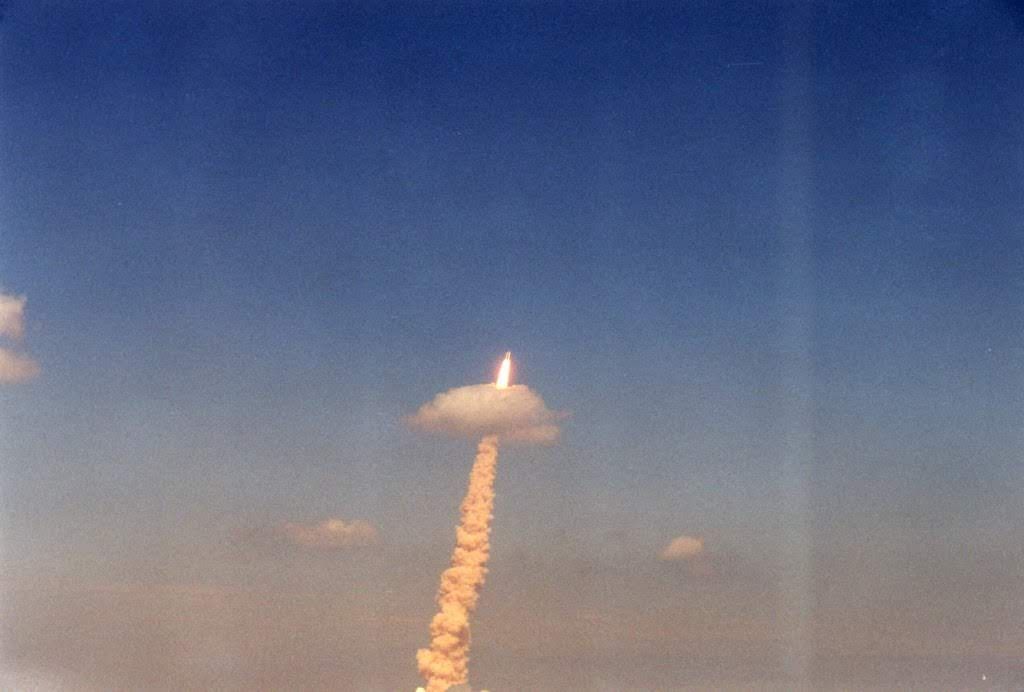
Space Shuttle Launch (2000)(3)
Another shot of a Space Shuttle launch from 2000 as seen from the Melbourne, Florida area. Here the Shuttle is just emerging from a cloud (or from behind one).


Tuesday, July 23, 2019
Space Shuttle Launch (2000)(2)
Another shot of a Space Shuttle launch from 2000. I believe this was taken from near the Eau Gallie Causeway in Melbourne, Florida.


Friday, July 19, 2019
Space Shuttle Launch (2000)(1)
This is one of the Space Shuttle launches in 2000. I forget which mission this was. I could see the shuttle launches from where I live but we got a little closer for this one.


Tuesday, July 16, 2019
Monday, July 15, 2019
Kennedy Space Center - Model Rockets (2000)
Thursday, July 11, 2019
Tuesday, April 30, 2019
SpaceX Falcon Heavy Arabsat 6A

https://supload.com/S14kLgA54 **SpaceX Falcon Heavy Arabsat 6A**
Wednesday, March 9, 2016
Engineers lose control of U.S. military weather satellite
The U.S. Air Force has been unable to send commands to the service’s newest weather satellite for nearly a month, and engineers are trying to determine if the spacecraft can be salvaged, officials said last week.
The polar-orbiting Defense Meteorological Satellite Program Flight 19, or DMSP F19, spacecraft stopped responding to orders from the ground Feb. 11, the Air Force said in a March 3 press release.
“At this time, it is not known what caused the anomaly or if the satellite will be recovered, and the anomaly is under investigation,” the Air Force said. “There are no other known issues with the satellite.”
Designed for a five-year service life, DMSP F19 launched April 3, 2014, from California atop a United Launch Alliance Atlas 5 rocket. It is the newest in the Air Force’s series of DMSP weather observatories designed to help forecasters predict storms, clouds, fog and dust storms that could inhibit global military operations.
Satellite operators in Suitland, Maryland, are still receiving telemetry from DMSP F19 after the Feb. 11 anomaly, but it is unclear whether engineers can recover the satellite and continue its mission.
The Air Force said the DMSP F17 satellite, launched in November 2006, has been reassigned as the primary DMSP spacecraft, taking over for the crippled DMSP F19.
“There is no impact to the strategic weather mission, and the DMSP constellation remains able to support warfighter requirements through resilient systems and processes,” the Air Force statement said. “The constellation continues to provide weather and atmospheric data to users as it has for the past five decades.”
Officials generated a 30-day plan to reestablish command and control capability aboard DMSP F19. It will take “some time” to determine whether the DMSP F19 satellite can recovered, the Air Force said.
A detachment from the Air Force’s 50th Operations Group stationed at Schriever Air Force Base, Colorado, oversees the DMSP satellites in conjunction with NOAA’s satellite operations center in Suitland.
Made by Lockheed Martin, the DMSP satellites have not been immune to technical faults in recent years.
DMSP F19 only partially deployed its power-generating solar array after its April 2014 launch, but officials said the glitch did not affect its mission.
The DMSP F13 satellite launched in 1995 exploded in orbit last year, spreading debris fragments and adding to the growing space junk problem in low Earth orbit. Engineers blamed the disintegration on a battery fault, and investigators said other DMSP satellites are susceptible to the same flaw that could lead to further explosions in orbit.
The retired NOAA 16 civilian weather satellite in polar orbit with largely the same design as the DMSP spacecraft also broke apart in space last year, shedding more debris in orbit. It is not clear whether the Lockheed Martin-built NOAA 16 satellite used the same suspect battery design as the DMSP spacecraft.
Lockheed Martin completed construction of the DMSP satellites a decade ago, and the Air Force pulls the spacecraft from storage to launch as needed. For example, the DMSP F19 satellite was finished in 1998 and stored in a clean room at Lockheed Martin’s Sunnyvale, California, plant before technicians readied it for liftoff in 2014.
Thursday, June 11, 2015
Elon Musk’s plan to put the Internet in space moves to launch pad
Last month, Musk petitioned the government to launch up to eight prototype satellites into space. They would be equipped with antennas that would send an Internet signal back down to the earth’s surface.
SpaceX said it wants to start testing out the technology in 2016. The FCC declined to comment on the application because it is currently under review.
You can already get an Internet signal from above. But it requires special hardware. It’s spotty, slow and ludicrously expensive.
SpaceX’s equipment would be closer to the ground than typical satellites, orbiting at around 750 miles above the surface. That allows for tighter light beams and faster Internet than geosynchronous satellites. The downside is a much smaller coverage area.
Eventually, Musk & Co. plan to launch 4,000 satellites in order to serve a meaningful number of customers. To keep costs down, the satellites will be tiny, cheap and disposable.
Tuesday, February 17, 2015
Private Mars One Colony Project Cuts Applicant Pool to 100 Volunteers
One hundred people are still in the running to become humanity’s first Mars explorers.
The Netherlands-based nonprofit Mars One, which aims to land four pioneers on the Red Planet in 2025 as the vanguard of a permanent colony, has whittled its pool of astronaut candidates down to 100, organization representatives announced Monday (Feb. 16).
More than 202,000 people applied to become Red Planet explorers after Mars One opened the selection process in April 2013. The latest cut came after Mars One medical director Norbert Kraft interviewed the 660 candidates who had survived several previous rounds of culling.
“The large cut in candidates is an important step towards finding out who has the right stuff to go to Mars,” Mars One co-founder and CEO Bas Lansdorp said in a statement. “These aspiring Martians provide the world with a glimpse into who the modern day explorers will be.”
The remaining pool consists of 50 men and 50 women who range in age from 19 to 60, Mars One representatives said. Thirty-nine come from the Americas (including 33 from the United States), 31 from Europe, 16 from Asia, seven from Africa and seven from Australia.
The remaining candidates will next participate in group challenges, to demonstrate their ability and willingness to deal with the rigors of Mars life. After another round of cuts, the finalists will be divided into four-person teams, which will train in a simulated Red Planet outpost.
Eventually, Mars One intends to select 24 astronauts (six four-person teams), who will become full-time employees of the organization and prepare for the Mars colonization mission.
Friday, June 22, 2012
Voyager approaches edge of solar system
Based on new data from the craft, NASA announced last week that Voyager 1 was nearing the “heliopause,” which scientists believe is the border between our solar system and interstellar space, says NASA research scientist Eric Christian in Greenbelt, Md.
via megalextoria.com
These things are amazing. - http://d0071efb.tinylinks.co
Wednesday, June 20, 2012
Solar panel shakes loose on Intelsat broadcast satellite
A stuck solar array on the Intelsat 19 broadcasting satellite dislodged itself last week, but engineers will not know how much of the craft's mission can be accomplished until its communications payload is activated.
The satellite's south solar array stayed folded against the spacecraft following its deployment from a Sea Launch Zenit 3SL rocket June 1.
Intelsat announced last week the solar panel unfurled June 12, soon after Intelsat 19 reached geostationary orbit about 22,300 miles over the equator.
via megalextoria.com
Subscribe to:
Posts (Atom)