
Wednesday, January 31, 2018

Brevard Renaissance Fair 2018 - The Craic Show - Part 3 (Douce Dame Jolie)
http://dai.ly/x6djko1
The Craic Show performs "Douce Dame Jolie" at the 2018 Brevard Renaissance Fair in Melbourne, Florida (2017-01-20).
Amazon Should Stick to Capitalism and Avoid the Crony Game
I explained back in 2013 that there is a big difference between being pro-market and being pro-business.
Pro-market is a belief in genuine free enterprise, which means companies succeed or fail solely on the basis of whether they produce goods and services that consumers like.
Pro-business, by contrast, is a concept that opens the door to inefficient and corrupt cronyism, such as bailouts and subsidies.
It basically means big business and big government get in bed together. And that’s going to mean bad news for taxpayers and consumers.
Washington specializes in this kind of cronyism. The Export-Import Bank, ethanol handouts, TARP, and Obamacare bailouts for big insurance firms are a few of my least-favorite examples.
But state politicians also like giving money to rich insiders.
State Governments Are Providing Incentives to Big Companies.
A report in the Washington Post reveals how states are engaged in a bidding war to attract Amazon’s big new facility, dubbed HQ2.
Here’s are excerpts from a column in the L.A. Times on crony capitalism for Apple and other large firms.
Let’s now circle back to Amazon and consider how it gets preferential treatment from the Post Office.
In this last example, the real problem is that we’ve fallen behind other nations and still have a government-run postal system.
The way to avoid perverse subsidies is privatization. That way, Amazon deliveries will be based on market prices and we won’t have to worry about a tilted playing field.
And that last point is critical.
Cronyism and Corporate Welfare Is an Economic Issue.
Yes, cronyism and corporate welfare are an economic issue. It is bad for long-run growth when political favors distort the allocation of capital.
 But an unlevel playing field is also a moral issue. It simply isn't fair nor right for politicians to give their buddies special advantages.
And it’s both economically harmful and morally harmful to create a system where the business community views Washington as a handy source of unearned wealth.
For what it’s worth, I also think it should be a legal issue. For those of us who believe in the rule of law, a key principle is that everyone should be treated equally. Heck, that principle is enshrined in the Constitution.
So I’ve always wondered why courts haven’t rejected special deals for specific companies because of the equal-protection clause?
Then again, maybe I shouldn’t wonder. After all, the Supreme Court twisted itself into a pretzel to miraculously rationalize Obamacare.
But none of this changes the fact that it’s time to wean big business off corporate welfare.
P.S. Just in case you harbor unwarranted sympathy for big companies, remember that these are the folks who are often keen to undermine support for the entire capitalist system.
Daniel J. Mitchell
Daniel J. Mitchell is a Washington-based economist who specializes in fiscal policy, particularly tax reform, international tax competition, and the economic burden of government spending. He also serves on the editorial board of the Cayman Financial Review.

Pro-market is a belief in genuine free enterprise, which means companies succeed or fail solely on the basis of whether they produce goods and services that consumers like.
Pro-business, by contrast, is a concept that opens the door to inefficient and corrupt cronyism, such as bailouts and subsidies.
It basically means big business and big government get in bed together. And that’s going to mean bad news for taxpayers and consumers.
Washington specializes in this kind of cronyism. The Export-Import Bank, ethanol handouts, TARP, and Obamacare bailouts for big insurance firms are a few of my least-favorite examples.
But state politicians also like giving money to rich insiders.
State Governments Are Providing Incentives to Big Companies.
A report in the Washington Post reveals how states are engaged in a bidding war to attract Amazon’s big new facility, dubbed HQ2.
Maryland Gov. Larry Hogan (R) will offer more than $3 billion in tax breaks and grants and about $2 billion in transportation upgrades to persuade Amazon.comRichard Florida, a professor at the University of Toronto, explains to CNN why this approach is troubling.to bring its second headquarters and up to 50,000 jobs to Montgomery County. …It appears to be the second-most generous set of inducements among the 20 locations on Amazon’s shortlist. Of the offerings whose details have become public, either through government or local media accounts, only New Jersey’s is larger, at $7 billion.

…there’s one part of Amazon’s HQ2 competition that is deeply disturbing — pitting city against city in a wasteful and economically unproductive bidding war for tax and other incentives.It’s not just a problem with Amazon.As one of the world’s most valuable companies, Amazon does not need — and should not be going after — taxpayer dollars… While Amazon may have the deck stacked in picking its HQ2 location, the mayors and elected leaders of these cities owe it to their tax payers and citizens to ensure they are not on the hook for hundreds of millions and in some cases as much as $7 billion in incentives to one of the world’s most valuable companies and richest men. …The truly progressive thing to do is to forge a pact to not give Amazon a penny in tax incentives or other handouts, thereby forcing the company to make its decision based on merit.
Here’s are excerpts from a column in the L.A. Times on crony capitalism for Apple and other large firms.
State and local officials in Iowa have been working hard to rationalize their handout of more than $208 million in tax benefits to Apple, one of the world’s richest companies, for a data facility that will host 50 permanent jobs. …the Apple deal shows the shortcomings of all such corporate handouts, nationwide.And here’s an editorial from Wisconsin about a bit of cronyism from the land of cheese.State and local governments seldom perform cost-benefit studies to determine their value — except in retrospect, when the money already has been paid out. They seldom explain why some industries should be favored over others — think about the film production incentives offered by Michigan, Louisiana, Georgia and, yes, Iowa, which never panned out as profit-makers for the states. …the handouts allow big companies to pit state against state and city against city in a competition that benefits corporate shareholders almost exclusively. Bizarrely, this process has been explicitly endorsed by Donald Trump. …politicians continue to shovel out the benefits, hoping to steer their economies in new directions and perhaps acquire a reputation for vision. Nevada was so eager to land a big battery factory from Tesla Motors’ Elon Musk that it offered him twice what Musk was seeking from the five states competing for the project. (In Las Vegas, this is known as “leaving money on the table.”) Wisconsin Gov. Scott Walker gave a big incentive deal to a furniture factory even though it was laying off half its workforce. He followed up last month with an astronomical $3 billion handout to electronics manufacturer Foxconn for a factory likely to employ a fraction of the workforce it forecasts.
The Foxconn deal…should be opposed by Democrats and Republicans, liberals and conservatives. There are no partisan nor ideological “sides” in this debate. The division is between those who want to create jobs in a smart and responsible way that yields long-term benefitsAmazon Gets Priority with the Postal Service.and those who propose to throw money at corporations that play states and nations against one another. The Foxconn deal represents the worst form of crony capitalism — an agreement to transfer billions of dollars in taxpayer funds to a foreign corporation. …Walker offered the company a massive giveaway — discussions included a commitment to hand the Taiwanese corporation nearly $3 billion in taxpayer funds (if it meets hazy investment and employment goals), at least $150 million in sales tax exemptions…the Legislative Fiscal Bureau, which analyzes bills with budget implications…pointed out that Foxconn would receive at least $1.35 billion and possibly as much as $2.9 billion in tax incentive payments even if it didn’t owe any Wisconsin tax… This is a horrible deal.
Let’s now circle back to Amazon and consider how it gets preferential treatment from the Post Office.
I don’t feel guilty ordering most of my family’s household goods on Amazon. …But when a mail truck pulls up filled to the top with Amazon boxes for my neighbors and me, I do feel some guilt. Like many close observers of the shipping business, I know a secret about the federal government’s relationship with Amazon: The U.S. Postal Service delivers the company’s boxes well below its own costs. Like an accelerant added to a fire, this subsidy is speeding up the collapse of traditional retailers in the U.S. and providing an unfair advantage for Amazon. …First-class mail effectively subsidizes the national network, and the packages get a free ride. An April analysis from Citigroup estimates that if costs were fairly allocated, on average parcels would cost $1.46 more to deliver. It is as if every Amazon box comes with a dollar or two stapled to the packing slip—a gift card from Uncle Sam. Amazon is big enough to take full advantage of “postal injection,” and that has tipped the scales in the internet giant’s favor. …around two-thirds of Amazon’s domestic deliveries are made by the Postal Service. It’s as if Amazon gets a subsidized space on every mail truck.Privatization Is the Key to Removing Subsidies.
In this last example, the real problem is that we’ve fallen behind other nations and still have a government-run postal system.
The way to avoid perverse subsidies is privatization. That way, Amazon deliveries will be based on market prices and we won’t have to worry about a tilted playing field.
And that last point is critical.
Cronyism and Corporate Welfare Is an Economic Issue.
Yes, cronyism and corporate welfare are an economic issue. It is bad for long-run growth when political favors distort the allocation of capital.
But an unlevel playing field is also a moral issue. It simply isn't fair nor right for politicians to give their buddies special advantages.And it’s both economically harmful and morally harmful to create a system where the business community views Washington as a handy source of unearned wealth.
For what it’s worth, I also think it should be a legal issue. For those of us who believe in the rule of law, a key principle is that everyone should be treated equally. Heck, that principle is enshrined in the Constitution.
So I’ve always wondered why courts haven’t rejected special deals for specific companies because of the equal-protection clause?
Then again, maybe I shouldn’t wonder. After all, the Supreme Court twisted itself into a pretzel to miraculously rationalize Obamacare.
But none of this changes the fact that it’s time to wean big business off corporate welfare.
P.S. Just in case you harbor unwarranted sympathy for big companies, remember that these are the folks who are often keen to undermine support for the entire capitalist system.
Reprinted from International Liberty.
Daniel J. Mitchell
Daniel J. Mitchell is a Washington-based economist who specializes in fiscal policy, particularly tax reform, international tax competition, and the economic burden of government spending. He also serves on the editorial board of the Cayman Financial Review.
This article was originally published on FEE.org. Read the original article.
Tuesday, January 30, 2018
NAKI Lunar Gun

The third party controller market seemed to peak in the 16-bit era but there were plenty of third party controllers in the 32-bit era and even today. This particular ad is for a company called NAKI that developed controllers and other accessories. However, the latest stuff I could find from them is for the PS2.
This ad is highlighting a gun controller by NAKI for the PlayStation, Sega Saturn, and Nintendo 64 called the Lunar Gun. What is unique about this particular gun is that there was also an optional accessory for it called the Red Sight Laser Target System. That’s a pretty fancy name for something that basically amounted to a laser pointer. In theory, it makes it easier to hit what you are aiming for because, just like a laser sight on a real gun, you just have to put the red dot on what you are trying to hit.
Overall, the Lunar Gun was a pretty good choice if you needed a light gun. It’s main competition was the Justifier and while that one is better known, the Lunar Gun has more options like auto-reload, easy (three round burst) and a laser sight among others. My one problem with it is philosophical. I’m not sure I could see buying an accessory for my accessory. I couldn’t find prices but i’m guessing the price of the Red Sight Laser Target System was not trivial making the combined price of the gun pretty hefty. It would have been nice if they could have just made a slightly more expensive gun and included the laser. They probably felt that they couldn’t have competed on price with the Justifier that way and that once they suckered you in with the gun then you would want to buy the laser anyway. No doubt the gun packaging includes advertising for it.
This ad is from the August 1997 issue of Electronic Gaming Monthly.
We May Finally See the End of Compulsory Union Dues
By the end of next month, public-sector employee unions will be up to their eyeballs in the orgy of obfuscation sure to accompany the U.S. Supreme Court’s consideration of a case that could once and for all strip organized labor of its power to skim dollars from the paychecks of virtually every government worker in the state.
The Case as It Stands
And at the end of the day, the torrent of words will distill down to two basic propositions. Either the union leaders:
The unions counter that wages in states that lack so-called “right-to-work” legislation tend to be higher than in those that do. But that reasoning assumes all the other economic variables in California and, say, Mississippi are otherwise comparable and right-to-work is the only possible explanation for the cost-of-living disparity.
The Realities of Compulsion
Moreover, it falsely assumes the average taxpayer considers it his or her patriotic duty to overpay for a commodity — in this case, labor — that can be obtained cheaper elsewhere. It’s a good deal for the handful of union workers who benefit from artificially inflated wages, but it’s no great honor for the rest of us — whose paychecks are typically the product of actual market forces rather than union coercion and collusion — to overcompensate a politically well-connected special interest.
What the unions never get around to telling you is that absolutely nothing in right-to-work legislation or the Janus ruling would compel workers to leave their union or prevent new recruits from joining. It simply leaves the choice to the individual, as it should be.
When unions demand mandatory dues and fees, they’re tacitly admitting the service they provide in return isn’t valued by enough workers to make it economically viable. Likewise, when they insist government employee wages would plummet in the absence of a union, they’re simply confirming the workers are already earning more than their labors are actually worth on the open market.
These are the kinds of hard economic truths that will be exposed when Janus is finally heard next month and the injustices that will be righted if the court this summer votes to ban mandatory dues and fees in the public sector.
No wonder the union spin machine is already working overtime.
Jeff Rhodes
Jeff Rhodes is the managing editor for the Freedom Foundation, a Pacific Northwest-based free-market think tank whose legal team has submitted two amicus briefs in support of the plaintiffs in Janus v. AFSCME.

The Case as It Stands
And at the end of the day, the torrent of words will distill down to two basic propositions. Either the union leaders:
- honestly believe they know better than the workers themselves what’s in their best interests; or
- couldn’t care less about what’s best for the workers, and this whole exercise is nothing more than a brazen attempt to preserve the monopoly over the public labor supply unions bought and paid for generations ago with someone else’s money.
The unions counter that wages in states that lack so-called “right-to-work” legislation tend to be higher than in those that do. But that reasoning assumes all the other economic variables in California and, say, Mississippi are otherwise comparable and right-to-work is the only possible explanation for the cost-of-living disparity.
The Realities of Compulsion
Moreover, it falsely assumes the average taxpayer considers it his or her patriotic duty to overpay for a commodity — in this case, labor — that can be obtained cheaper elsewhere. It’s a good deal for the handful of union workers who benefit from artificially inflated wages, but it’s no great honor for the rest of us — whose paychecks are typically the product of actual market forces rather than union coercion and collusion — to overcompensate a politically well-connected special interest.
What the unions never get around to telling you is that absolutely nothing in right-to-work legislation or the Janus ruling would compel workers to leave their union or prevent new recruits from joining. It simply leaves the choice to the individual, as it should be.
When unions demand mandatory dues and fees, they’re tacitly admitting the service they provide in return isn’t valued by enough workers to make it economically viable. Likewise, when they insist government employee wages would plummet in the absence of a union, they’re simply confirming the workers are already earning more than their labors are actually worth on the open market.
These are the kinds of hard economic truths that will be exposed when Janus is finally heard next month and the injustices that will be righted if the court this summer votes to ban mandatory dues and fees in the public sector.
No wonder the union spin machine is already working overtime.
Jeff Rhodes
Jeff Rhodes is the managing editor for the Freedom Foundation, a Pacific Northwest-based free-market think tank whose legal team has submitted two amicus briefs in support of the plaintiffs in Janus v. AFSCME.
This article was originally published on FEE.org. Read the original article.
Monday, January 29, 2018
Buzzard Bait (Color Computer)

Despite nearly matching the longevity of the Commodore 64, Tandy’s Color Computer line never really had the third party software support that the Commodore 64 and other 8-bit computers of the time had. The fact that Radio Shack did not really court third party development combined with the fact that the hardware was only sold at Radio Shack probably had something to do with that.
Buzzard Bait is one example of the games you would typically find for this system. As you can see, it is a blatant rip-off (er…clone) of the arcade game Joust. It actually isn’t terrible (except for the sound which was a limitation of the CoCo series). There were lots of clones of more popular arcade games on the Coco but the quality varied wildly. Some were decent like Buzzard Bait and some were terrible.
Buzzard Bait was released by a company called Tom Mix Software in 1983. Like much of the software for the CoCo, you could only find it easily via mail order but the company did have a BBS that you could order through so that’s pretty cool. It was available on both disk and cassette and given the fact that it wasn’t marketed through major retail establishments, original copies are probably pretty rare. I didn’t see one on eBay at a glance and that’s usually a pretty good indication. This is one you will probably need emulation to try. However, for a better conversions of Joust, you are better off checking out the official conversions for the Atari 8-bit, Atari 7800 and Atari ST.
Brevard Renaissance Fair 2018 - The Craic Show - Part 1 (Intro)
Brevard Renaissance Fair 2018 - The Craic Show - Part 1 (Intro)
The beginning of The Craic Show's opening set at the 2018 Brevard Renaissance Fair in Melbourne, Florida.
http://dai.ly/x6dhlwz
The beginning of The Craic Show's opening set at the 2018 Brevard Renaissance Fair in Melbourne, Florida.
http://dai.ly/x6dhlwz
How Believing in Socialism Can Make You Miserable
On my (Brittany's) college campus, the largest and most active club was the “Revolutionary Student Union,” also known as the school’s resident Marxists. Even then, I passionately disagreed with socialism. But one thing that struck me was how these students were not only wrong, but seemed deeply unhappy. They always walked into class scowling and were always grousing, not just about the evils of capitalism, but about intractable frustrations and perceived injustices in their personal and academic lives.
I often wondered if there was a connection between the dysfunction in their lives and their socialist ideology.
To these young revolutionaries, every frustration in their lives was someone else’s fault. If they weren’t getting the grades they felt they deserved, some bourgeois professor was to blame. If they didn’t have job prospects that matched their high regard for their own intellects, it must be the capitalist system holding them back. Their tendency was to scapegoat “class enemies,” not only for societal ills but for their own personal problems as well.
By shifting the blame to others, they relieved themselves of responsibility over their own problems. They wasted their time and energy complaining, wallowing in self-pity, and seeking redress, instead of taking ownership of their lives and fixing up their affairs. As a result, their frustrations only compounded.
This attitude also robbed them of one of the great pleasures in life: experiencing empathetic joy in the happiness of others. According to their zero-sum Marxist mindset, the prosperity of others came at the expense of their own prospects. So they resented anyone more successful than themselves. And they became so preoccupied with dragging other people down that they had little energy left over for lifting themselves up.
If my student comrades ever did manage to impose socialism on the country, it would cause deep and widespread misery. And yet plenty of misery in their own lives was already being generated by the mere idea of socialism residing only in their minds.
The Psychological Roots of Socialism
Yet, in spite of this, and in spite of all the economic logic and evidence that shows that classical liberalism and capitalism enriches and frees the whole of society, while socialism enslaves and impoverishes it, these young socialists would still cling rigidly to their ideology. Why?
According to Ludwig von Mises, it is not simply a matter of economic illiteracy and intellectual error in general. Rather, it is a psychological matter. He even went so far as to argue that the roots of socialism lie in neurosis.
As Mises explained, people often cling to resentment and scapegoating because it offers consolation, however fleeting:
And this compulsive, unhealthy attitude is what closes the class warrior’s mind and makes it impervious to new ideas. As Mises wrote, socialism often amounts to a defense mechanism against an inferiority complex:
Luckily, this kind of neurosis can be cured, but it requires effort on the part of the individual. As Mises wrote:
We are all responsible for improving our own lives, difficult and time-consuming as that quest may be. Renowned psychology professor Jordan B. Peterson has built his career and renown largely on helping individuals leave behind resentment and self-pity and take responsibility for their own lives. He argues that, far better than political agitation and contention, that offering that kind of help is the best way to help ideologues grow out of the neurotic tendencies that cause them to cleave to socialism and other toxic creeds. In a Q&A session, he counseled saying to such people:
Brittany Hunter
Brittany Hunter is an associate editor at FEE. Brittany studied political science at Utah Valley University with a minor in Constitutional studies.

I often wondered if there was a connection between the dysfunction in their lives and their socialist ideology.
To these young revolutionaries, every frustration in their lives was someone else’s fault. If they weren’t getting the grades they felt they deserved, some bourgeois professor was to blame. If they didn’t have job prospects that matched their high regard for their own intellects, it must be the capitalist system holding them back. Their tendency was to scapegoat “class enemies,” not only for societal ills but for their own personal problems as well.
By shifting the blame to others, they relieved themselves of responsibility over their own problems. They wasted their time and energy complaining, wallowing in self-pity, and seeking redress, instead of taking ownership of their lives and fixing up their affairs. As a result, their frustrations only compounded.
This attitude also robbed them of one of the great pleasures in life: experiencing empathetic joy in the happiness of others. According to their zero-sum Marxist mindset, the prosperity of others came at the expense of their own prospects. So they resented anyone more successful than themselves. And they became so preoccupied with dragging other people down that they had little energy left over for lifting themselves up.
If my student comrades ever did manage to impose socialism on the country, it would cause deep and widespread misery. And yet plenty of misery in their own lives was already being generated by the mere idea of socialism residing only in their minds.
The Psychological Roots of Socialism
Yet, in spite of this, and in spite of all the economic logic and evidence that shows that classical liberalism and capitalism enriches and frees the whole of society, while socialism enslaves and impoverishes it, these young socialists would still cling rigidly to their ideology. Why?
According to Ludwig von Mises, it is not simply a matter of economic illiteracy and intellectual error in general. Rather, it is a psychological matter. He even went so far as to argue that the roots of socialism lie in neurosis.
“…the root of the opposition to liberalism cannot be reached by resort to the method of reason. This opposition does not stem from the reason, but from a pathological mental attitude—from resentment and from a neurasthenic condition that one might call a Fourier complex, after the French socialist of that name”The socialist frame of mind can be summed up in one word: resentment. As Mises wrote:
“Resentment is at work when one so hates somebody for his more favorable circumstances that one is prepared to bear heavy losses if only the hated one might also come to harm. Many of those who attack capitalism know very well that their situation under any other economic system will be less favorable. Nevertheless, with full knowledge of this fact, they advocate a reform, e.g., socialism, because they hope that the rich, whom they envy, will also suffer under it.”Psychologist Jordan B. Peterson also characterizes socialism as both driven by resentment and fostering resentment. In a panel, he said of Marxism:
“There is the dark side of it, which means everyone who has more than you got it by stealing it from you. And that really appeals to the Cain-like element of the human spirit. Everyone who has more than me got it in a manner that was corrupt and that justifies not only my envy but my actions to level the field so to speak, and to look virtuous while doing it. There is a tremendous philosophy of resentment that I think is driven now by a very pathological anti-human ethos.”Those who have lost themselves in a downward spiral of resentment would rather fail than succeed if it meant that their class enemies would suffer along with them. The phrase “misery loves company” is particularly applicable to the socialist mindset.
As Mises explained, people often cling to resentment and scapegoating because it offers consolation, however fleeting:
“In the case of social failure, which alone concerns us here, the consolation consists in the belief that one’s inability to attain the lofty goals to which one has aspired is not to be ascribed to one’s own inadequacy, but to the defectiveness of the social order. The malcontent expects from the overthrow of the latter the success that the existing system has withheld from him.”It is for this reason that Mises says, “…for modern man, socialism has become an elixir against earthly adversity.”
And this compulsive, unhealthy attitude is what closes the class warrior’s mind and makes it impervious to new ideas. As Mises wrote, socialism often amounts to a defense mechanism against an inferiority complex:
“The neurotic clings to his ‘saving lie,’ and when he must make the choice of renouncing either it or logic, he prefers to sacrifice logic. For life would be unbearable for him without the consolation that he finds in the idea of socialism. It tells him that not he himself, but the world, is at fault for having caused his failure; and this conviction raises his depressed self-confidence and liberates him from a tormenting feeling of inferiority.”Only You Can Change Your Circumstances
Luckily, this kind of neurosis can be cured, but it requires effort on the part of the individual. As Mises wrote:
“One cannot send every person suffering from a Fourier complex to the doctor for psychoanalytic treatment; the number of those afflicted with it is far too great. No other remedy is possible in this case than the treatment of the illness by the patient himself.”And the starting point for conducting such self-therapy is for each individual to come to grips with the fact that resentment, envy, and scapegoating only brings oneself frustration, stagnation, and needless suffering.
We are all responsible for improving our own lives, difficult and time-consuming as that quest may be. Renowned psychology professor Jordan B. Peterson has built his career and renown largely on helping individuals leave behind resentment and self-pity and take responsibility for their own lives. He argues that, far better than political agitation and contention, that offering that kind of help is the best way to help ideologues grow out of the neurotic tendencies that cause them to cleave to socialism and other toxic creeds. In a Q&A session, he counseled saying to such people:
“...look, we would like it so much if you could thrive as an individual. Drop your cult-like affiliation. Step out of the shadows, the demonic shadows of your ideological possession, and step forward as a fully-developed person into the light.”The antidote to both socialism and debilitating resentment is individual reflection and action. If one makes an effort to look within and better themselves, then they will find that that resentment will begin to disappear, self-efficacy will grow, and their lives will improve. And dropping socialism will be a wonderful side-effect.
A Spanish version of this article is available.
Brittany Hunter
Brittany Hunter is an associate editor at FEE. Brittany studied political science at Utah Valley University with a minor in Constitutional studies.
This article was originally published on FEE.org. Read the original article.
Sunday, January 28, 2018

Brevard Renaissance Fair 2018 - The Pirate High Wire Show
Brevard Renaissance Fair 2018 - The Pirate High Wire Show
http://dai.ly/x6dhl2t
Pirates of the Colombian Caribbean High Wire Thrill Show at the 2018 Brevard Renaissance Fair in Melbourne, Florida.
http://dai.ly/x6dhl2t
Pirates of the Colombian Caribbean High Wire Thrill Show at the 2018 Brevard Renaissance Fair in Melbourne, Florida.
Friday, January 26, 2018
Yes, You Can Be for Lower Taxes and Smaller Deficits
One needn’t support the recently-enacted tax legislation to be disturbed by the tenor of much criticism of it. Many opponents, and indeed some press reporting, took for granted that if one voted for a significant tax cut after having expressed longstanding concerns about federal deficits, one must be an irredeemable hypocrite. But lower taxes and smaller deficits can coexist.
Some examples of the criticism: Neera Tanden wrote in NBC news of the “staggering hypocrisy” inherent in passing “shameful tax cut legislation” after sponsors had previously warned of a “forthcoming debt crisis.” Robert Schlesinger opined in US News & World Report that the legislation suggested “an incredible case of cognitive dissonance or simple breathtaking hypocrisy and/or duplicity.” Ezra Klein fumed at Vox that lawmakers who supported the bill were “nihilists.”
This refrain was repeated on editorial pages nationwide: you could be for deficit reduction, or alternatively, you could be for tax cuts. Only a nihilist hypocrite could possibly have taken both positions.
The Case for Lower Taxes and Smaller Deficits
Beyond its closed-mindedness, this outpouring of indignation was all premised on a mistaken foundational assumption. It is entirely possible to be for both lower taxes and smaller deficits. In fact, I would argue this was not only possible but that it represented the most responsible policy position given the projections lawmakers faced when the tax bill was debated. (Disclaimer: the following should not be misinterpreted as necessarily an endorsement of the specific tax legislation, nor of prioritizing tax relief over fiscal consolidation.)
When the tax bill was debated, lawmakers faced baseline budget projections that looked like this:

Everything on this graph is shown as a percentage of GDP, so in effect, this shows how both federal spending and (to a lesser extent) revenue collections are growing faster than our economic output. Beyond the time window shown here, the long-term fiscal picture looked even worse. Spending would continue to rise dramatically faster than our ability to finance it, threatening escalating deficits in the decades ahead.
The graph also shows that undertaxation is not the cause of this fiscal gap. Over the next decade, tax burdens were actually projected to be higher than the historical average and to increase gradually faster than our economic capacity.
This was not and is not a stable situation. Taxing and spending as a share of our economy cannot keep increasing forever. (Actually, there is a theoretical sense in which we can spend more than 100% of our economic output if all spending takes the form of domestic income transfers. In other words, we could theoretically tax people several times the amount of their income, provided that we simultaneously write government checks that give it all back to them.
However, this is neither practicable nor politically feasible. In the real world, we must moderate both our tax and spending growth. Fixing this problem within historical political norms would mean cutting future spending growth substantially – but importantly, also lowering some future tax growth, even as projected deficits are reduced.
In other words, the baseline budget picture was such that there was no contradiction between reducing projected deficits and lowering projected tax collections. Indeed, that is exactly what a solution consistent with historical experience would require.
The Case against Lower Taxes and Smaller Deficits
Now, there is a standpoint from which it would be inconsistent to claim support for both lower taxes and smaller deficits – specifically if one argued that projected spending growth must never be slowed. Some progressives seek not only to preserve currently projected spending growth but to add enormously to it.
In this mindset, deficits could only be closed if tax collections rise faster than projected. Importantly, this would still not produce a stable budget situation because tax collections would need to grow much faster than Americans’ ability to pay them. Nevertheless, some advocates effectively take this policy position.
But those who voted for the tax bill are not generally guilty of this. To the contrary, those members have repeatedly been assailed for their allegedly heartless determination to cut spending. House Speaker Paul Ryan has even been depicted — in one particularly revolting ad a few years ago — as dumping an innocent grandmother out of her wheelchair over a cliff, because of his efforts to address rising entitlement spending. And just a few months before their tax vote, lawmakers were attacked for supposedly taking away people’s health care because of their efforts to tackle hundreds of billions of dollars in projected spending growth under the ACA.
Credit and Criticism Where It's Due
It is legitimate to oppose legislation to slow the growth of federal spending, if one believes that spending is needed. But one cannot fairly attack legislators who try to address runaway spending growth, and then later assail those same legislators as hypocrites for widening the deficit.
Now, it is fair to criticize sponsors of deficit-widening legislation for denying they are increasing the debt. There has been a regrettable amount of such denial, where the public would have been better served to hear arguments as to why the benefits of tax cuts outweighed the downside of a debt increase.
One can simply assume growth-stimulation effects under which tax cuts do not add to long-term debt, but non-partisan scorekeepers widely reject them — in the same way they rejected assumptions crafted during the last administration to conclude additional stimulus spending could pay for itself. Advocates should acknowledge adverse fiscal consequences of any legislation under consideration, even as they argue for its passage.
The bottom line is this: prior to the tax legislation, lawmakers faced projections in which both tax burdens and spending patterns exceeded historical norms and were projected to rise still further, driven principally by growth in the major federal health entitlements and Social Security. The merits of this specific tax bill aside, a responsible and sustainable fiscal policy would reduce both projected spending and deficits substantially, while also slowing tax growth somewhat, and ensuring that neither taxes nor spending ultimately grow faster than our ability to finance them.
Recognizing these realities involves no hypocrisy, but attacking lawmakers for fiscal recklessness — just a few months after taking political advantage of their efforts to rein in part of the federal spending explosion — most certainly does.
Charles Blahous
Charles Blahous is a senior research fellow for the Mercatus Center, a research fellow for the Hoover Institution, a public trustee for Social Security and Medicare, and a contributor to e21.

Some examples of the criticism: Neera Tanden wrote in NBC news of the “staggering hypocrisy” inherent in passing “shameful tax cut legislation” after sponsors had previously warned of a “forthcoming debt crisis.” Robert Schlesinger opined in US News & World Report that the legislation suggested “an incredible case of cognitive dissonance or simple breathtaking hypocrisy and/or duplicity.” Ezra Klein fumed at Vox that lawmakers who supported the bill were “nihilists.”
This refrain was repeated on editorial pages nationwide: you could be for deficit reduction, or alternatively, you could be for tax cuts. Only a nihilist hypocrite could possibly have taken both positions.
The Case for Lower Taxes and Smaller Deficits
Beyond its closed-mindedness, this outpouring of indignation was all premised on a mistaken foundational assumption. It is entirely possible to be for both lower taxes and smaller deficits. In fact, I would argue this was not only possible but that it represented the most responsible policy position given the projections lawmakers faced when the tax bill was debated. (Disclaimer: the following should not be misinterpreted as necessarily an endorsement of the specific tax legislation, nor of prioritizing tax relief over fiscal consolidation.)
When the tax bill was debated, lawmakers faced baseline budget projections that looked like this:
Everything on this graph is shown as a percentage of GDP, so in effect, this shows how both federal spending and (to a lesser extent) revenue collections are growing faster than our economic output. Beyond the time window shown here, the long-term fiscal picture looked even worse. Spending would continue to rise dramatically faster than our ability to finance it, threatening escalating deficits in the decades ahead.
The graph also shows that undertaxation is not the cause of this fiscal gap. Over the next decade, tax burdens were actually projected to be higher than the historical average and to increase gradually faster than our economic capacity.
This was not and is not a stable situation. Taxing and spending as a share of our economy cannot keep increasing forever. (Actually, there is a theoretical sense in which we can spend more than 100% of our economic output if all spending takes the form of domestic income transfers. In other words, we could theoretically tax people several times the amount of their income, provided that we simultaneously write government checks that give it all back to them.
However, this is neither practicable nor politically feasible. In the real world, we must moderate both our tax and spending growth. Fixing this problem within historical political norms would mean cutting future spending growth substantially – but importantly, also lowering some future tax growth, even as projected deficits are reduced.
In other words, the baseline budget picture was such that there was no contradiction between reducing projected deficits and lowering projected tax collections. Indeed, that is exactly what a solution consistent with historical experience would require.
The Case against Lower Taxes and Smaller Deficits
Now, there is a standpoint from which it would be inconsistent to claim support for both lower taxes and smaller deficits – specifically if one argued that projected spending growth must never be slowed. Some progressives seek not only to preserve currently projected spending growth but to add enormously to it.
In this mindset, deficits could only be closed if tax collections rise faster than projected. Importantly, this would still not produce a stable budget situation because tax collections would need to grow much faster than Americans’ ability to pay them. Nevertheless, some advocates effectively take this policy position.
But those who voted for the tax bill are not generally guilty of this. To the contrary, those members have repeatedly been assailed for their allegedly heartless determination to cut spending. House Speaker Paul Ryan has even been depicted — in one particularly revolting ad a few years ago — as dumping an innocent grandmother out of her wheelchair over a cliff, because of his efforts to address rising entitlement spending. And just a few months before their tax vote, lawmakers were attacked for supposedly taking away people’s health care because of their efforts to tackle hundreds of billions of dollars in projected spending growth under the ACA.
Credit and Criticism Where It's Due
It is legitimate to oppose legislation to slow the growth of federal spending, if one believes that spending is needed. But one cannot fairly attack legislators who try to address runaway spending growth, and then later assail those same legislators as hypocrites for widening the deficit.
Now, it is fair to criticize sponsors of deficit-widening legislation for denying they are increasing the debt. There has been a regrettable amount of such denial, where the public would have been better served to hear arguments as to why the benefits of tax cuts outweighed the downside of a debt increase.
One can simply assume growth-stimulation effects under which tax cuts do not add to long-term debt, but non-partisan scorekeepers widely reject them — in the same way they rejected assumptions crafted during the last administration to conclude additional stimulus spending could pay for itself. Advocates should acknowledge adverse fiscal consequences of any legislation under consideration, even as they argue for its passage.
The bottom line is this: prior to the tax legislation, lawmakers faced projections in which both tax burdens and spending patterns exceeded historical norms and were projected to rise still further, driven principally by growth in the major federal health entitlements and Social Security. The merits of this specific tax bill aside, a responsible and sustainable fiscal policy would reduce both projected spending and deficits substantially, while also slowing tax growth somewhat, and ensuring that neither taxes nor spending ultimately grow faster than our ability to finance them.
Recognizing these realities involves no hypocrisy, but attacking lawmakers for fiscal recklessness — just a few months after taking political advantage of their efforts to rein in part of the federal spending explosion — most certainly does.
Reprinted from Economics 21.
Charles Blahous
Charles Blahous is a senior research fellow for the Mercatus Center, a research fellow for the Hoover Institution, a public trustee for Social Security and Medicare, and a contributor to e21.
This article was originally published on FEE.org. Read the original article.
Thursday, January 25, 2018

Wednesday, January 24, 2018
Brevard Renaissance Fair 2018 - Shelli Buttons
Shelli Buttons entertains the crowd at the 2018 Renaissance Fair in Melbourne, Florida. Aerial silks, juggling, fire, balancing, comedy and more.
Raising Millionaires’ Taxes Will Drive Them Away
Thanks to a frenzied December on Capitol Hill, 2017 will be known as the year of tax reform. But political developments in several blue states may mean that tax relief is significantly clawed back. Massachusetts and New Jersey are currently considering “millionaires’ taxes,” which would significantly increase top rates and spark a “race to the top” for revenue at a time when the federal government is actively lowering rates.
To states such as New Jersey and Massachusetts with red-hot liberal resentment over tax reform, a millionaires’ tax might seem like necessary progressive corrective action. Hidden behind the rhetoric, though, is a flimsy case for states trying to raise taxes on the wealthy. Instead of helping out the middle class, a millionaires’ tax will result in an exodus from the state, squeezing out opportunities for working Americans.
Tax Migration
State lawmakers with blue electorates often experience generous program funding promises that conflict with balanced-budget requirements. When faced with expanding spending and shrinking revenues, large tax increases are the go-to policy option. Prominent millionaires respond to these proposals by threatening to leave, and research shows that the well-to-do regularly follow through on these promises. Despite inter-state migration by upper-income groups being lower than average, nearly all of the migration that does happen in top brackets has to do with tax changes.
Researchers at Stanford University and the Treasury Department estimate that a 10 percent increase in taxes causes a 1 percent bump in migration, assuming no change in any other policy. This implies that typical levels of tax migration would still result in a net increase of revenue for a state looking to raise taxes on top earners. But it does mean that the bounty is not as great as some state lawmakers would like to imagine. Shifts in executive compensation sources make the payoff to state governments even smaller.
The ultimate destination for the remaining pool of money that does get into state coffers depends on the state. New York State’s experience offers a cautionary tale of what happens when transparency and accountability take a back seat to special interests. In 2009, then-Governor Paterson and state lawmakers urged a temporary 8.97 percent tax on individuals earning over $1 million (or couples earning over $2 million) to shore up funding through the end of the Great Recession of 2008 and 2009.
This new rate proved to be anything but temporary and is still on the books (albeit slightly lowered to 8.82 percent), following a two-year extension signed into law last year. The $3.5 billion annual revenue pads wasteful spending in Albany, as costs balloon for expensive infrastructure projects and waste at Albany agencies. Meanwhile, lawmakers have proven incapable of clamping down on record shortfalls.
Tried and Failed
California’s experience with a millionaires’ tax is only slightly less terrible. A 1 percent surtax on incomes above $1 million, implemented in 2004, is specifically designated for the Mental Health Services Act (MHSA), which funds counseling and rehab services for at-risk, low-income populations. But despite transparency over the funding, per-person program costs have ballooned and the state has presented no data attesting to the efficacy of the program.
This does not mean that there are no praiseworthy program results; some statistical findings suggest that increased mental health efforts have led to a decline in emergency room usage and decreases in other government spending. But if the program recoups around 85 percent of costs, as some studies suggest, then a millionaires’ tax is not necessary.
If California clamped down on some of the rampant waste found in infrastructure line-items, payments for mental health would be possible and set the state up for long-run budgetary savings. Better yet, Sacramento could fund specific programs via “charitable donations” as a way for taxpayers to get around the new state and local deduction cap.
If New Jersey and Massachusetts approve new millionaires’ taxes, it is difficult to predict how much will be raised and where these funds will ultimately wind up. But if New York and California are any guide, income surtaxes will be destructive. When it comes to higher taxation, interstate migration is just the tip of the iceberg. Higher-tax states, for instance, see less innovative activity and scientific research according to an analysis by economists at the Federal Reserve and UC Berkeley. Any benefits of millionaires’ taxes do not make up for the economic and social toll caused by fewer innovative activities and correspondingly lower job creation.
In the midst of game-changing federal reforms and widespread blue resentment, scapegoating the rich is a proven political strategy. But millionaires’ taxes make for terrible governance and dubious benefits.

To states such as New Jersey and Massachusetts with red-hot liberal resentment over tax reform, a millionaires’ tax might seem like necessary progressive corrective action. Hidden behind the rhetoric, though, is a flimsy case for states trying to raise taxes on the wealthy. Instead of helping out the middle class, a millionaires’ tax will result in an exodus from the state, squeezing out opportunities for working Americans.
Tax Migration
State lawmakers with blue electorates often experience generous program funding promises that conflict with balanced-budget requirements. When faced with expanding spending and shrinking revenues, large tax increases are the go-to policy option. Prominent millionaires respond to these proposals by threatening to leave, and research shows that the well-to-do regularly follow through on these promises. Despite inter-state migration by upper-income groups being lower than average, nearly all of the migration that does happen in top brackets has to do with tax changes.
Researchers at Stanford University and the Treasury Department estimate that a 10 percent increase in taxes causes a 1 percent bump in migration, assuming no change in any other policy. This implies that typical levels of tax migration would still result in a net increase of revenue for a state looking to raise taxes on top earners. But it does mean that the bounty is not as great as some state lawmakers would like to imagine. Shifts in executive compensation sources make the payoff to state governments even smaller.
The ultimate destination for the remaining pool of money that does get into state coffers depends on the state. New York State’s experience offers a cautionary tale of what happens when transparency and accountability take a back seat to special interests. In 2009, then-Governor Paterson and state lawmakers urged a temporary 8.97 percent tax on individuals earning over $1 million (or couples earning over $2 million) to shore up funding through the end of the Great Recession of 2008 and 2009.
This new rate proved to be anything but temporary and is still on the books (albeit slightly lowered to 8.82 percent), following a two-year extension signed into law last year. The $3.5 billion annual revenue pads wasteful spending in Albany, as costs balloon for expensive infrastructure projects and waste at Albany agencies. Meanwhile, lawmakers have proven incapable of clamping down on record shortfalls.
Tried and Failed
California’s experience with a millionaires’ tax is only slightly less terrible. A 1 percent surtax on incomes above $1 million, implemented in 2004, is specifically designated for the Mental Health Services Act (MHSA), which funds counseling and rehab services for at-risk, low-income populations. But despite transparency over the funding, per-person program costs have ballooned and the state has presented no data attesting to the efficacy of the program.
This does not mean that there are no praiseworthy program results; some statistical findings suggest that increased mental health efforts have led to a decline in emergency room usage and decreases in other government spending. But if the program recoups around 85 percent of costs, as some studies suggest, then a millionaires’ tax is not necessary.
If California clamped down on some of the rampant waste found in infrastructure line-items, payments for mental health would be possible and set the state up for long-run budgetary savings. Better yet, Sacramento could fund specific programs via “charitable donations” as a way for taxpayers to get around the new state and local deduction cap.
If New Jersey and Massachusetts approve new millionaires’ taxes, it is difficult to predict how much will be raised and where these funds will ultimately wind up. But if New York and California are any guide, income surtaxes will be destructive. When it comes to higher taxation, interstate migration is just the tip of the iceberg. Higher-tax states, for instance, see less innovative activity and scientific research according to an analysis by economists at the Federal Reserve and UC Berkeley. Any benefits of millionaires’ taxes do not make up for the economic and social toll caused by fewer innovative activities and correspondingly lower job creation.
In the midst of game-changing federal reforms and widespread blue resentment, scapegoating the rich is a proven political strategy. But millionaires’ taxes make for terrible governance and dubious benefits.
Reprinted from Economics 21.
Ross Marchand
This article was originally published on FEE.org. Read the original article.
Tuesday, January 23, 2018
Bubsy II

Bubsy II is the aptly named sequel to Bubsy and was released in 1994. Bubsy II, like its predecessor, is a 2D side-scrolling platform game of the type common in the 8 and 16-bit eras. Gameplay in the second game was much the same as it was in the first. Bubsy II was available originally for the Super Nintendo, Sega Genesis and Game Boy.

The Super Nintendo and Sega Genesis versions are virtually identical so either is a good choice if you are looking for this game. The Game Boy version is quite a bit different with completely different level design. Given the motion blur, this isn't really the kind of game I would choose to play on that system anyway. Bubsy II generally got good reviews (except for the Game Boy version) though there were complaints it wasn't different enough from the first games. There were some improvements, including a two player mode and the game is generally better than the first though level design could have been better. The main appeal of these games was Bubsy's personality anyway.

Bubsy II (along with the original) was released in 2015 on Steam. This version uses an emulation of the Super Nintendo version so it is identical in every way that matters. If you are not an owner of the original hardware then this offers an easy way to play. If you do have original hardware, the cartridges aren't difficult to find or too expensive either.

Monday, January 22, 2018

Dark Caracal: Good News and Bad News

Yesterday, EFF and Lookout announced a new report, Dark Caracal, that uncovers a new, global malware espionage campaign. One aspect of that campaign was the use of malicious, fake apps to impersonate legitimate popular apps like Signal and WhatsApp. Some readers had questions about what this means for them. This blog post is here to answer those questions and dive further into the Dark Caracal report.
First, the good news: Dark Caracal does not mean that Signal or WhatsApp themselves are compromised in any way. It only means that attackers found new, insidious ways to create and distribute fake Android versions of them. (iOS is not affected.) If you downloaded your apps from Google’s official app store, Google Play, then you are almost certainly in the clear. The threat uncovered in the Dark Caracal report referred to “trojanized” apps, which are fake apps that pretend to look like real, trusted ones. These malicious spoofs often ask for excessive permissions and carry malware. Such spoofed versions of Signal and WhatsApp were involved in the Dark Caracal campaign.
The malicious actors behind Dark Caracal got these fake, malicious apps onto people’s phones by spearphishing. Several types of phishing emails directed people—including military personnel, activists, journalists, and lawyers—to go to a fake app store-like page, where fake Android apps waited. There is even evidence that, in some cases, Dark Caracal used physical access to people’s phones to install the fake apps. Again, if you downloaded your apps from the official app store, you can rest easy that this has likely not affected you.
And now the bad news: Dark Caracal has wide-reaching implications for how state-sponsored surveillance and malware works. Most people do not have to worry about this very specific threat. But for the small minority of users who may be directly targeted by nation-states or other skilled, motivated adversaries—and for the malware researchers who try to track those adversaries down—the Dark Caracal report uncovers a new infrastructure that makes it even harder to attribute attacks and malware campaigns to a particular nation or actor. More details are available in the report.Dark Caracal is also a reminder that most modern hacking requires the unwitting participation of the user. The most dangerous thing in the online environment is not necessarily complex, headline-grabbing vulnerabilities, but well-crafted phishing messages and fake apps that trick users into handing over log-in credentials and granting excessive permissions. Keep an eye out for links, attachments, and apps pretending to be something they’re not, and make sure your friends, neighbors, and others in your community are informed too.
Source: Dark Caracal: Good News and Bad News | Electronic Frontier Foundation
Friday, January 19, 2018
Ultravision Video Arcade System

Here we have an advertisement from the November 1982 issue of Electronic Fun. It features the incredible Ultravision! It is portable (somewhat) and features a built in television with tuner, two joysticks, computer functionality (with optional keyboard), and Atari VCS (2600) and ColecoVision compatibility (with optional modules) in addition to its own unique games.
Never heard of it? That’s probably because it was never released. Although there were ads in several magazines featuring the system, unique games, as well as Atari 2600 compatible games, only one game was ever released by the Miami based company and it was for the Atari 2600. That was Condor Attack, a rather poor rip-off of Demon Attack. They apparently also finished Karate because that one ended up being published years later by Froggo in the later days of the Atari 2600. It was also not a great game. The system was never released and none of the several announced games native to the system ever showed up even in prototype form.
The stats made it sound pretty nifty. Only 10 pounds and it could run on AC or DC power so you could run it off of a car battery for portability. It was supposed to have computer functionality as well though I couldn’t find any stats on what kind of CPU (presumably a 6502 derivative) or other hardware it had. I suspect this was at least partially the victim of the video game crash.
A Federal Gas Tax Will Only Fuel Bureaucracy
The Trump administration will release its long-awaited infrastructure plan in coming weeks. The plan is expected to include $200 billion over 10 years of federal funding. Where will the money come from? The president has pondered raising the federal gas tax.
Revenues from the 18.4 cent-per-gallon federal gas tax go into the Highway Trust Fund and are then dished out to the states. But 98 percent of U.S. streets and highways are owned by state and local governments, and the owners should do the funding. States that need to improve their highways can increase their own gas taxes, sales taxes, issue debt, add user charges, or pursue public-private partnerships.
There is no advantage in raising federal highway revenues rather than the states raising their own. The states can tackle their own infrastructure challenges, and about half of them have raised their transportation taxes in the past five years.
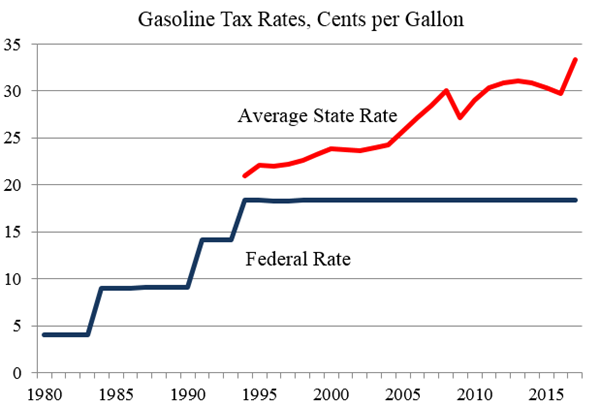
Supporters of a federal gas tax hike say that the tax has not been raised since 1993, and its real value has been eroded by inflation. That is true. But the federal gas tax rate more than quadrupled between 1983 and 1993 from 4 cents to 18.4 cents, as shown in the chart below. The 4-cent rate would be 9.8 cents in today’s dollars, so the real gas tax rate has risen substantially since the early 1980s.
The chart shows that the states have steadily raised their own gas taxes in recent years. API discusses state gas taxes here, and they emailed me data back to 1994. (I’ve interpolated a few missing years). The state average — currently 33 cents — includes both gasoline excise taxes and other taxes on gasoline.
I hope Trump does not go down the road of gas tax increases. Pumping more money through federal bureaucracies would fuel more top-down planning and inefficiency. Funding for highways and other infrastructure should be handled by state and local governments and the private sector.
More on infrastructure here and here.
Chris Edwards
Chris Edwards is the director of tax policy studies at Cato and editor of DownsizingGovernment.org.

Revenues from the 18.4 cent-per-gallon federal gas tax go into the Highway Trust Fund and are then dished out to the states. But 98 percent of U.S. streets and highways are owned by state and local governments, and the owners should do the funding. States that need to improve their highways can increase their own gas taxes, sales taxes, issue debt, add user charges, or pursue public-private partnerships.
There is no advantage in raising federal highway revenues rather than the states raising their own. The states can tackle their own infrastructure challenges, and about half of them have raised their transportation taxes in the past five years.
Supporters of a federal gas tax hike say that the tax has not been raised since 1993, and its real value has been eroded by inflation. That is true. But the federal gas tax rate more than quadrupled between 1983 and 1993 from 4 cents to 18.4 cents, as shown in the chart below. The 4-cent rate would be 9.8 cents in today’s dollars, so the real gas tax rate has risen substantially since the early 1980s.
The chart shows that the states have steadily raised their own gas taxes in recent years. API discusses state gas taxes here, and they emailed me data back to 1994. (I’ve interpolated a few missing years). The state average — currently 33 cents — includes both gasoline excise taxes and other taxes on gasoline.
I hope Trump does not go down the road of gas tax increases. Pumping more money through federal bureaucracies would fuel more top-down planning and inefficiency. Funding for highways and other infrastructure should be handled by state and local governments and the private sector.
More on infrastructure here and here.
Reprinted from Cato At Liberty.
Chris Edwards
Chris Edwards is the director of tax policy studies at Cato and editor of DownsizingGovernment.org.
This article was originally published on FEE.org. Read the original article.

Canada’s Prime Minister Only Pretends to Support Free Trade
The lack of free trade hurts poor people the most. Therefore, we should welcome Canadian Prime Minister Justin Trudeau’s comments in support of free trade, right? Well, not so fast.
During Trudeau’s visit to China in December, the Canadian Press published an article titled, "World at 'pivot point,' needs to embrace free trade: Trudeau":
Trudeau’s position seems to be that free trade is economically beneficial and protectionism is economically harmful. I agree, but if we pay close attention, we see that the Prime Minister is merely paying lip service to free trade.
Defining Free Trade
Free trade is a simple concept which exploits the division of labor to the fullest possible extent. Two parties want to trade with each other. They want to exchange goods for goods, or goods for money, or labor for money. If no one interferes with this voluntary exchange between the two parties, then free trade exists. If a third party — the government — intervenes and uses force to prohibit the exchange or to impose conditions on the exchange, then free trade does not exist. In today’s world, free trade does not exist.
Many countries negotiate “free trade agreements,” but this is a misnomer. The essence of these “agreements” is to serve corporate interests through the establishment of rules that reduce competition. These are lengthy, complex documents that contemplate “managed trade,” not “free trade.” The largest beneficiaries are multinational corporations, and the biggest losers are consumers who pay higher prices. The division of labor is suppressed, and political power becomes more centralized.
Bill Curry, writing for the Globe and Mail before the US dropped out of the Trans-Pacific Partnership (TPP), referred to the TPP as an agreement which “would create a free-trade zone among 12 nations around the Pacific, making it the world’s largest.” However, further along in the article, we read this: “TPP countries get duty-free access to 3.25 percent of Canada’s dairy market and 2.1 percent of its poultry market.”
So, more than 95 percent of Canada’s dairy and poultry markets remain unfree. I am not sure why Curry defines this as free trade, but that is how the TPP is commonly described.
Similarly, Canada’s dairy and poultry markets are highly protected under NAFTA, which Trudeau wants to “save from demise.” The Prime Minister has a strange conception of free trade.
Protectionism
If a firm is unable to sell its products at a price that consumers are willing to pay, and which allows the firm to be profitable, then the firm is wasting resources — human labor and raw materials. I have written about this here. In the realm of free trade, lower-priced imports send a market signal to inefficient domestic producers. The signal says, “You must improve efficiency, lower your costs etc., or you will go out of business,” thereby conserving resources for someone else who can utilize them more efficiently.
However, producers hate these market signals, and they lobby the government for tariff protection. This penalizes consumers whose choices are limited to buying the expensive domestic product, or the formerly cheap import which is now expensive because of the tariff.
The government claims it must approve tariff requests from these inefficient producers in order to “save” domestic jobs while simultaneously avoiding discussion about the economic cost of this policy. Studies often reveal this cost to be exorbitant when the “additional markup” all consumers are forced to pay in a particular year is divided by the total number of workers whose jobs have been saved. The cost per job saved is often considerably higher than the worker’s annual salary.
For example, according to calculations by the Peterson Institute for International Economics, the total cost to American consumers from higher prices resulting from safeguard tariffs on Chinese tires in 2011 was at least $900,000 for each job “saved,” where the annual average salary for a tire builder was $40,070. Studies in other industries have also revealed an exorbitant cost for each job saved.
Furthermore, as the Peterson Institute tells us, tariffs have a ripple effect elsewhere in the economy:
Get Government Out of the Way
Governments do not trade with each other — individuals do. If a government really wants to facilitate free trade, a legal document that runs hundreds, or even thousands of pages, is unnecessary. A one-page document with two sentences would suffice: “People are allowed to trade freely. The government’s role will be limited to enforcing the terms of the contract which the private parties themselves have voluntarily negotiated."
I have seen no evidence that Prime Minister Trudeau is sincere about “embracing free trade.” He appears to be a typical politician, subservient to special interest groups while attempting to bamboozle the public with an illusion of free trade.
Following a 23-year career in the Canadian financial industry, Lee Friday has spent many years studying economics, politics, and social issues. He operates a news site at www.LondonNews1.com

During Trudeau’s visit to China in December, the Canadian Press published an article titled, "World at 'pivot point,' needs to embrace free trade: Trudeau":
The world is at a "pivot point" and will fail unless countries embrace free trade and elevate their citizens who have been left behind by globalization, Prime Minister Justin Trudeau warned Wednesday.Trudeau expressed concern about people starting “to turn inwards” and “close off” because “we will all lose.” He is referring to protectionism, and I suspect his comments are largely directed toward the United States. Much has been written about the NAFTA negotiations and Donald Trump’s desire for more protectionist tariffs.
...Trudeau came to the Fortune Global Forum, a Davos-style gathering of the world's business elite, to sell Canada as a good place for foreign investment, but he went off script and delivered a stern warning about the dangers of allowing protectionism and inequality to flourish.
"We are at a pivot point in the world right now, where we decide whether we work together in an open and confident way and succeed or whether we all falter separately and isolated," he said.
"As that anxiety spreads, people start to turn inwards. They start to close off. They start to get fearful," he added. "If that continues to happen, make no mistake about it, we will all lose."
Trudeau didn't mention the Donald Trump administration in Washington, but he's already spoken out in China on the need to save the North American Free Trade Agreement [NAFTA] from demise...
Trudeau’s position seems to be that free trade is economically beneficial and protectionism is economically harmful. I agree, but if we pay close attention, we see that the Prime Minister is merely paying lip service to free trade.
Defining Free Trade
Free trade is a simple concept which exploits the division of labor to the fullest possible extent. Two parties want to trade with each other. They want to exchange goods for goods, or goods for money, or labor for money. If no one interferes with this voluntary exchange between the two parties, then free trade exists. If a third party — the government — intervenes and uses force to prohibit the exchange or to impose conditions on the exchange, then free trade does not exist. In today’s world, free trade does not exist.
Many countries negotiate “free trade agreements,” but this is a misnomer. The essence of these “agreements” is to serve corporate interests through the establishment of rules that reduce competition. These are lengthy, complex documents that contemplate “managed trade,” not “free trade.” The largest beneficiaries are multinational corporations, and the biggest losers are consumers who pay higher prices. The division of labor is suppressed, and political power becomes more centralized.
Bill Curry, writing for the Globe and Mail before the US dropped out of the Trans-Pacific Partnership (TPP), referred to the TPP as an agreement which “would create a free-trade zone among 12 nations around the Pacific, making it the world’s largest.” However, further along in the article, we read this: “TPP countries get duty-free access to 3.25 percent of Canada’s dairy market and 2.1 percent of its poultry market.”
So, more than 95 percent of Canada’s dairy and poultry markets remain unfree. I am not sure why Curry defines this as free trade, but that is how the TPP is commonly described.
Similarly, Canada’s dairy and poultry markets are highly protected under NAFTA, which Trudeau wants to “save from demise.” The Prime Minister has a strange conception of free trade.
Protectionism
If a firm is unable to sell its products at a price that consumers are willing to pay, and which allows the firm to be profitable, then the firm is wasting resources — human labor and raw materials. I have written about this here. In the realm of free trade, lower-priced imports send a market signal to inefficient domestic producers. The signal says, “You must improve efficiency, lower your costs etc., or you will go out of business,” thereby conserving resources for someone else who can utilize them more efficiently.
However, producers hate these market signals, and they lobby the government for tariff protection. This penalizes consumers whose choices are limited to buying the expensive domestic product, or the formerly cheap import which is now expensive because of the tariff.
The government claims it must approve tariff requests from these inefficient producers in order to “save” domestic jobs while simultaneously avoiding discussion about the economic cost of this policy. Studies often reveal this cost to be exorbitant when the “additional markup” all consumers are forced to pay in a particular year is divided by the total number of workers whose jobs have been saved. The cost per job saved is often considerably higher than the worker’s annual salary.
For example, according to calculations by the Peterson Institute for International Economics, the total cost to American consumers from higher prices resulting from safeguard tariffs on Chinese tires in 2011 was at least $900,000 for each job “saved,” where the annual average salary for a tire builder was $40,070. Studies in other industries have also revealed an exorbitant cost for each job saved.
Furthermore, as the Peterson Institute tells us, tariffs have a ripple effect elsewhere in the economy:
The additional money that US consumers spent on tires reduced their spending on other retail goods, indirectly lowering employment in the retail industry. On balance, it seems likely that tire protectionism cost the US economy around 2,531 jobs, when losses in the retail sector are offset against gains in tire manufacturing. Adding further to the loss column, China retaliated by imposing antidumping duties on US exports of chicken parts, costing that industry around $1 billion in sales.NAFTA contains numerous protectionist measures favoring special interest groups at the expense of the general public. Prime Minister Trudeau knows this, and he wants to “save NAFTA from demise.” All his talk about the evils of protectionism is nothing more than political rhetoric.
Get Government Out of the Way
Governments do not trade with each other — individuals do. If a government really wants to facilitate free trade, a legal document that runs hundreds, or even thousands of pages, is unnecessary. A one-page document with two sentences would suffice: “People are allowed to trade freely. The government’s role will be limited to enforcing the terms of the contract which the private parties themselves have voluntarily negotiated."
I have seen no evidence that Prime Minister Trudeau is sincere about “embracing free trade.” He appears to be a typical politician, subservient to special interest groups while attempting to bamboozle the public with an illusion of free trade.
Lee Friday
Following a 23-year career in the Canadian financial industry, Lee Friday has spent many years studying economics, politics, and social issues. He operates a news site at www.LondonNews1.comThis article was originally published on FEE.org. Read the original article.
Thursday, January 18, 2018
Syphon Filter (PlayStation)

Syphon Filter, released in 1999, was the first in a series of games released for the PlayStation and later the PlayStation 2 and PlayStation Portable. Syphon Filter is a 3rd person shooter in which stealth and puzzle solving are important. The plot centers around a series of biological outbreaks caused by an international terrorist. Your job is to solve various mysteries related to these outbreaks and to track down those responsible.

Despite being developed by a relatively inexperienced game studio and almost being canceled on multiple occasions, Syphon Filter ended up being a success, receiving positive reviews and selling well. It spawned two direct sequels as well as a couple of spinoffs though the reception seems to trail off after the first two games. The game is clearly influenced by games like GoldenEye and Metal Gear Solid but those are good games to get inspiration from.

In addition to the PlayStation version, an Android port was eventually released in 2011. The original was also popular enough to spawn a couple of sequels and spinoffs. Syphon Filter 2 and 3 were both released on the PlayStation with the spinoffs Syphon Filter: Dark Mirror and Syphon Filter: Logan's Shadow initially released for the PSP. Logan's Shadow was also ported to the PlayStation 2. The original Syphon Filter for the PlayStation is probably the best one to have, or perhaps Syphon Filter 2 (or both if you decide you like the first one you try but you might as well start with the first).
The above ad is from the March 1999 issue of the Official U.S. PlayStation Magazine.
EZCosmos

This ad appeared in the Fall 1990 issue of Sierra News Magazine. I though that was kind of odd given that this does not seem to be a Sierra product but I guess they didn’t have any astronomy related programs that would have competed. I never used EZCosmos but I used to love the idea of these astronomy programs. It was like having the universe (part of it anyway) inside your computer. As relatively limited as it was, I loved Sky Travel for the Commodore 64.
EZCosmos is a DOS program developed by Future Trends Software and there were at least three version. Eventually it was acquired by a company called Software Bisque and incorporated into an astronomy program called TheSky for Windows. This company and software still exists today and is available in several editions for iOS, OSX, Windows, Linux and Raspbian. It has come a long way since its original DOS incarnation.
From the ad:
“Journey through space and time, exploring the vistas of the universe. EZCosmos reveals the entire celestial sphere for any date, time and location from 4000 B.C. to A.D. 10000. You can choose your location from one of 560 cities around the world, or you can input your own lat/lon to see the sky from anywhere on Earth.
Explore the vastness of the universe. EZCosmos displays more than 10000 celestial objects, including the sun, moon, planets, stars, constellation lines and deep space objects. Use the arrow keys or your mouse to position the box cursor on any object, or find the object and its location simply by typing in its name.
Discover the wonders of the universe. Zoom in on binary stars. Verify historical observations. Watch solar eclipse animations. Restrict the skyplot do display just the navigational stars. EZCosmos is informative, educational, useful and fun.”
Wednesday, January 17, 2018
Civilization and Private Property Are Inseparable
As Americans transitioned to 2018, I saw many articles about New Year’s resolutions. But while I saw a great deal of inconsistency between personal resolutions to do good for others and political resolutions to harm others to finance feathering one’s own nest, I didn’t find much that would improve both Americans’ personal and political behavior. That is why it occurred to me that perhaps what we need are some old years' resolutions to recommit ourselves us the wisdom we have often forgotten.
That thought triggered a memory of something that would fit the bill. It comes from Leonard Read, in “To Each His Own,” published fifty years ago in his Accent on the Right (1968). Its focus was that the biggest problems of government come from violations of commandments to not covet and not steal because coveting is the impetus behind harming others to benefit yourself and stealing is the action triggered by that coveting.
The prevention of such violations is a central task of government, which can advance the general welfare by more effectively protecting all of our property from invasions by others (better enabling all of the voluntary relationships property rights make possible). This is illustrated by the enumerated functions of American government (e.g., national defense is the protection of you and your property from foreigners; police, courts, and prisons provide similar protection from your neighbors). But unfortunately, government has become a “respectable” way to violate what it supposedly defends.
Consider what Leonard Read had to say about the importance of those two commandments for the existence of any real civilization, as well as advances in it.
Remembering that understanding, and recommitting to Read’s insight that “To each his own is a fundamental maxim for civilized men!” would make an excellent old year’s resolution for the new year.
Gary M. Galles
Gary M. Galles is a professor of economics at Pepperdine University. His recent books include Faulty Premises, Faulty Policies (2014) and Apostle of Peace (2013). He is a member of the FEE Faculty Network.

That thought triggered a memory of something that would fit the bill. It comes from Leonard Read, in “To Each His Own,” published fifty years ago in his Accent on the Right (1968). Its focus was that the biggest problems of government come from violations of commandments to not covet and not steal because coveting is the impetus behind harming others to benefit yourself and stealing is the action triggered by that coveting.
The prevention of such violations is a central task of government, which can advance the general welfare by more effectively protecting all of our property from invasions by others (better enabling all of the voluntary relationships property rights make possible). This is illustrated by the enumerated functions of American government (e.g., national defense is the protection of you and your property from foreigners; police, courts, and prisons provide similar protection from your neighbors). But unfortunately, government has become a “respectable” way to violate what it supposedly defends.
Consider what Leonard Read had to say about the importance of those two commandments for the existence of any real civilization, as well as advances in it.
THOU shalt not steal! To know that stealing is wrong…implies knowledge of an alternative that is right…to each his own, usually referred to as private ownership. The ancient taboo against stealing presupposes that an individual has a right to the fruits of his own labor.Leonard Read saw the twin sins of coveting and theft as the greatest threats to civilization. The latter, motivated by the former, undermines the fundamental basis of the voluntary arrangements that create civilization — private property. As a result, he recognized that the essential function of government was to maintain the principle of “to each his own,” and that any time government fails to defend that principle from others’ invasions, or itself commits such infringements, it impedes rather than advances civilization.
Recognizing as evil the taking of that which belongs to another certainly antedated The Decalogue by many centuries.
There is every reason to believe that the observance of this taboo, this respect for the principle of private ownership, marked the dawn of civilization. Whether this thou-shalt-not is honored or breached primarily determines the rise or fall of civilization.
True, “thou shalt not covet” is even more basic than “thou shalt not steal”; if no one coveted the possessions of another, there would be no thievery.
To refrain from stealing is the genesis of civilizations! Only two points need to be understood…for this assertion to ring true. First, civilizations rise and fall with the rise and fall of individual freedom. Second, individual freedom rises and falls to the degree that private ownership — the absence of stealing — is respected and adhered to. Individual freedom is out of the question wherever and whenever private ownership does not prevail!
Creative outbursts — the mark of civilization — bear a direct correlation with increase in individual freedom…the record speaks for itself.
This private ownership thesis rests, fundamentally, on the defensible assumption that one person has as much right to his life as any other. If an individual has a right to his life, it logically follows that he has an equal right to sustain his life, the sustenance of life being the fruit of one’s own labor or what can be obtained for it in peaceful exchange. Livelihood is but the extension of life.
Thus, to steal is to take life. Not to steal is to respect life; it is to endorse and to hold sacrosanct the institution of private ownership.
It is self-evident that no civilization could be born without the observance of this taboo. The institution of private ownership — to each his own — has spawned all civilizations!...Were [thievery] the general practice, we would quickly descend into another dark age. A resort to law would be useless; the gendarmerie also would be thieves!
While the institution of private ownership has been given lip service over the centuries, by the people and governments alike, actual observance has been more of form than of substance…Few among us understand that private ownership can be universally endorsed in principle and completely obliterated in practice. Nor is it widely understood that the forcible taking of income, beyond that required for the principled functions of government, has the same eroding effects on private ownership as stealing. Legalizing the compulsory transfer of control still amounts to the destruction of private ownership.
It takes no mental giant to realize that individual freedom and, thus, the flowering of civilization are possible only where private ownership prevails. Merely imagine owning absolutely nothing required for your own livelihood. Your life would be in the hands of others.
Remembering that understanding, and recommitting to Read’s insight that “To each his own is a fundamental maxim for civilized men!” would make an excellent old year’s resolution for the new year.
Gary M. Galles
Gary M. Galles is a professor of economics at Pepperdine University. His recent books include Faulty Premises, Faulty Policies (2014) and Apostle of Peace (2013). He is a member of the FEE Faculty Network.
This article was originally published on FEE.org. Read the original article.

Tuesday, January 16, 2018

How a Bitcoin System is Like and Unlike a Gold Standard
Many commentators have compared Bitcoin to gold as an investment asset. “Can Bitcoin Be Gold 2.0,” asks a portfolio analyst. “Bitcoin is increasingly set to replace gold as a hedge against uncertainty,” suggests a Cointelegraph reporter.
Economists, by contrast, are more interested in considering how a monetary system based on Bitcoin compares to a gold-standard monetary system. In a noteworthy journal article published in 2015, George Selgin characterized Bitcoin as a “synthetic commodity money.” Monetary historian Warren Weber in 2016 released an interesting Bank of Canada working paper entitled “A Bitcoin Standard: Lessons from the Gold Standard,” which analyzes a hypothetical international Bitcoin-based monetary system on the supposition that “the Bitcoin standard would closely resemble the gold standard” of the pre-WWI era. More recently, University of Chicago economist John Cochrane in a blog post has characterized Bitcoin as “an electronic version of gold.”
In what important respects are the Bitcoin system and a gold standard similar? In what other important respects are they different?
Similarities and Differences
Bitcoin is similar to a gold standard in at least two ways. (1) Both Bitcoin and gold are stateless, so either can provide an international base money that is not the creature of any national central bank or finance ministry. (2) Both provide a base money that is reliably limited in quantity (this is the grounding for Selgin’s characterization), unlike a fiat money that a central bank can create in any quantity it likes, “out of thin air.”
Bitcoin and the gold standard are obviously different in other ways. Gold is a tangible physical commodity; bitcoin is a purely digital asset. This difference is not important for the customer’s experience in paying them out, as ownership of (or a claim to) either asset can be transferred online, or in person by phone app or card.
The “front ends” of payments are basically the same nowadays. The “back ends” can be different. Gold payments can go peer-to-peer without third-party involvement only when a physical coin or bar is handed over. Electronic gold payments require a trusted vault-keeping intermediary. Bitcoin payments operate on a distributed ledger and can go peer-to-peer electronically without the help of a financial institution. In practice, however, many Bitcoin transactions use the services of commercial storage and exchange providers like Coinbase.
The most important difference between Bitcoin and gold lies in their contrasting supply and demand mechanisms, which give them very different degrees of purchasing power stability. The stock of gold above ground is slowly augmented each year by gold mines around the world, at a rate that responds to, and stabilizes, the purchasing power of gold. Commodity (non-monetary) demands also respond to the price of gold and dampen movements in its value. The rate of Bitcoin creation, by contrast, is entirely programmed. It does not respond to its purchasing power, and there are no commodity demands.
Difference in Supply Mechanisms
Let’s consider supply in more detail. Secularly, annual production of gold has been a small percentage (typically 1% to 4%) of the existing stock, but not zero. Because the absorption of gold by non-monetary uses from which it is not recoverable (like tooth fillings that will go into graves and stay there, but unlike jewelry) is small, the total stock of gold grows over time. Historically this has produced a near-zero secular rate of inflation in gold standard countries.
The number of BTC in circulation was programmed to expand at 4.0 percent in 2017, but the expansion rate is programmed to fall progressively in the future and to reach zero in 2140. At that point, assuming that real demand to hold BTC grows merely at the same rate as real GDP, Bitcoin would exhibit mild secular growth in its purchasing power, or equivalently we would see mild deflation in BTC-denominated prices of goods and services. (Warren Weber’s paper similarly derives this result.) This kind of growth-driven deflation is benign, but the difference is small in real economic welfare consequences between a money stock that steadily grows 3% per year and one that grows 0%.
The key difference in the supply mechanisms is in the induced variation in the rate of production of monetary gold in response to its purchasing power, by contrast to the non-variation in BTC. A rise in the purchasing power of BTC does not provoke any change in the quantity of BTC in the short run or in the long run. In Econ 101 language, the supply curve for BTC is always vertical. (The supply curve is, however, programmed to shift to the right over time, ever more slowly, until it stops at 21 million units).
By contrast, a non-transitory rise in the purchasing power of gold brings about some small increase in the quantity of monetary gold in the short run by incentivizing owners of non-monetary gold items (jewelry and candlesticks) to melt some of them down and monetize them (assuming open mints) in response to the rising opportunity cost of holding them and to the owners’ increased wealth. The short-run supply curve is not vertical. Still more importantly, this rise will bring about a much larger increase in the longer run by incentivizing owners of gold mines to increase their output. The “long-run stock supply curve” for monetary gold is fairly flat. (I walk through the stock-flow supply dynamics in greater detail in chapter 2 of my monetary theory text.) The purchasing power of gold is mean-reverting over the long run, a pattern seen clearly in the historical record.
Because its quantity is pre-programmed, the stock of BTC is free from supply shocks, unlike that of monetary gold. Supply shocks from gold discoveries under the gold standard were historically small, however. The largest on record was the joint impact of the Californian and Australian gold rushes, which (according to Hugh Rockoff) together created only 6.39 percent annual growth in the world stock of gold during the decade 1849-59, resulting in less than 1.5 percent annual inflation in gold-standard countries over that decade. For reference, the average of decade-averaged annual growth rates over 1839-1919 was about 2.9 percent.
Predicting Supply
As a result of the long-run price-elasticity of gold supply combined with the smallness and infrequency of supply shocks, the purchasing power of gold under the classical gold standard was more predictable, especially over 10+ year horizons, than the purchasing power of the post-WWII fiat dollar has been under the Federal Reserve.
As I have written previously: “Under a gold standard, the price level can be trusted not to wander far over the next 30 years because it is constrained by impersonal market forces. Any sizable price level increase (fall in the purchasing power of gold) caused by a reduced demand to hold gold would reduce the quantity of gold mined, thereby reversing the price level movement. Conversely, any sizable price level decrease (rise in the purchasing power of gold) caused by an increased demand to hold gold would increase the quantity mined, thereby reversing that price level movement.”
Bitcoin lacks any such supply response. There is no mean-reversion to be expected in the purchasing power of BTC, and thus its purchasing power is much harder to predict at any horizon.
Describing gold supply, Warren Weber writes: “Changes in the world stock of gold were determined by gold discoveries and the invention of new techniques for extracting gold from gold-bearing ores.” This is not well put. Changes in the world stock of monetary gold come about every year from normal mining. Gold strikes and technical improvements in extraction brought about changes in the growth rate (not the level) of the stock.
Historically, the changes in the growth rate were not dramatic by comparison to changes in the postwar growth rates of fiat monies. As often as not, the changes in gold stock growth rates were equilibrating, speeding the return of the purchasing power of gold to trend from above trend. As Rockoff noted, some important gold strikes (like the Klondike in the 1890s) and some important technical breakthroughs (like the cyanide process of 1887) were induced by the high purchasing power of gold at the time, which gave added incentive for prospecting and research.
The phrase from John Cochrane quoted above is part of a sentence that reads in its entirety: “It's an electronic version of gold, and the price variation should be a warning to economists who long for a return to gold.” From the consideration of the mean reverting character of the purchasing power of gold, by contrast to Bitcoin’s lack of such a character, we can see that the second half of Cochrane’s statement is incorrect.
The inelastic supply mechanism that produces price variation in Bitcoin should give pause to those who predict that Bitcoin will become a commonly accepted medium of exchange. It says nothing about the purchasing power of gold under a gold standard.
Larry White
Lawrence H. White is a senior fellow at the Cato Institute, and professor of economics at George Mason University since 2009. An expert on banking and monetary policy, he is the author of The Clash of Economic Ideas (Cambridge University Press, 2012), The Theory of Monetary Institutions (Basil Blackwell, 1999), Free Banking in Britain (2nd ed., Institute of Economic Affairs, 1995), and Competition and Currency (NYU Press, 1989).

Economists, by contrast, are more interested in considering how a monetary system based on Bitcoin compares to a gold-standard monetary system. In a noteworthy journal article published in 2015, George Selgin characterized Bitcoin as a “synthetic commodity money.” Monetary historian Warren Weber in 2016 released an interesting Bank of Canada working paper entitled “A Bitcoin Standard: Lessons from the Gold Standard,” which analyzes a hypothetical international Bitcoin-based monetary system on the supposition that “the Bitcoin standard would closely resemble the gold standard” of the pre-WWI era. More recently, University of Chicago economist John Cochrane in a blog post has characterized Bitcoin as “an electronic version of gold.”
In what important respects are the Bitcoin system and a gold standard similar? In what other important respects are they different?
Similarities and Differences
Bitcoin is similar to a gold standard in at least two ways. (1) Both Bitcoin and gold are stateless, so either can provide an international base money that is not the creature of any national central bank or finance ministry. (2) Both provide a base money that is reliably limited in quantity (this is the grounding for Selgin’s characterization), unlike a fiat money that a central bank can create in any quantity it likes, “out of thin air.”
Bitcoin and the gold standard are obviously different in other ways. Gold is a tangible physical commodity; bitcoin is a purely digital asset. This difference is not important for the customer’s experience in paying them out, as ownership of (or a claim to) either asset can be transferred online, or in person by phone app or card.
The “front ends” of payments are basically the same nowadays. The “back ends” can be different. Gold payments can go peer-to-peer without third-party involvement only when a physical coin or bar is handed over. Electronic gold payments require a trusted vault-keeping intermediary. Bitcoin payments operate on a distributed ledger and can go peer-to-peer electronically without the help of a financial institution. In practice, however, many Bitcoin transactions use the services of commercial storage and exchange providers like Coinbase.
The most important difference between Bitcoin and gold lies in their contrasting supply and demand mechanisms, which give them very different degrees of purchasing power stability. The stock of gold above ground is slowly augmented each year by gold mines around the world, at a rate that responds to, and stabilizes, the purchasing power of gold. Commodity (non-monetary) demands also respond to the price of gold and dampen movements in its value. The rate of Bitcoin creation, by contrast, is entirely programmed. It does not respond to its purchasing power, and there are no commodity demands.
Difference in Supply Mechanisms
Let’s consider supply in more detail. Secularly, annual production of gold has been a small percentage (typically 1% to 4%) of the existing stock, but not zero. Because the absorption of gold by non-monetary uses from which it is not recoverable (like tooth fillings that will go into graves and stay there, but unlike jewelry) is small, the total stock of gold grows over time. Historically this has produced a near-zero secular rate of inflation in gold standard countries.
The number of BTC in circulation was programmed to expand at 4.0 percent in 2017, but the expansion rate is programmed to fall progressively in the future and to reach zero in 2140. At that point, assuming that real demand to hold BTC grows merely at the same rate as real GDP, Bitcoin would exhibit mild secular growth in its purchasing power, or equivalently we would see mild deflation in BTC-denominated prices of goods and services. (Warren Weber’s paper similarly derives this result.) This kind of growth-driven deflation is benign, but the difference is small in real economic welfare consequences between a money stock that steadily grows 3% per year and one that grows 0%.
The key difference in the supply mechanisms is in the induced variation in the rate of production of monetary gold in response to its purchasing power, by contrast to the non-variation in BTC. A rise in the purchasing power of BTC does not provoke any change in the quantity of BTC in the short run or in the long run. In Econ 101 language, the supply curve for BTC is always vertical. (The supply curve is, however, programmed to shift to the right over time, ever more slowly, until it stops at 21 million units).
By contrast, a non-transitory rise in the purchasing power of gold brings about some small increase in the quantity of monetary gold in the short run by incentivizing owners of non-monetary gold items (jewelry and candlesticks) to melt some of them down and monetize them (assuming open mints) in response to the rising opportunity cost of holding them and to the owners’ increased wealth. The short-run supply curve is not vertical. Still more importantly, this rise will bring about a much larger increase in the longer run by incentivizing owners of gold mines to increase their output. The “long-run stock supply curve” for monetary gold is fairly flat. (I walk through the stock-flow supply dynamics in greater detail in chapter 2 of my monetary theory text.) The purchasing power of gold is mean-reverting over the long run, a pattern seen clearly in the historical record.
Because its quantity is pre-programmed, the stock of BTC is free from supply shocks, unlike that of monetary gold. Supply shocks from gold discoveries under the gold standard were historically small, however. The largest on record was the joint impact of the Californian and Australian gold rushes, which (according to Hugh Rockoff) together created only 6.39 percent annual growth in the world stock of gold during the decade 1849-59, resulting in less than 1.5 percent annual inflation in gold-standard countries over that decade. For reference, the average of decade-averaged annual growth rates over 1839-1919 was about 2.9 percent.
Predicting Supply
As a result of the long-run price-elasticity of gold supply combined with the smallness and infrequency of supply shocks, the purchasing power of gold under the classical gold standard was more predictable, especially over 10+ year horizons, than the purchasing power of the post-WWII fiat dollar has been under the Federal Reserve.
As I have written previously: “Under a gold standard, the price level can be trusted not to wander far over the next 30 years because it is constrained by impersonal market forces. Any sizable price level increase (fall in the purchasing power of gold) caused by a reduced demand to hold gold would reduce the quantity of gold mined, thereby reversing the price level movement. Conversely, any sizable price level decrease (rise in the purchasing power of gold) caused by an increased demand to hold gold would increase the quantity mined, thereby reversing that price level movement.”
Bitcoin lacks any such supply response. There is no mean-reversion to be expected in the purchasing power of BTC, and thus its purchasing power is much harder to predict at any horizon.
Describing gold supply, Warren Weber writes: “Changes in the world stock of gold were determined by gold discoveries and the invention of new techniques for extracting gold from gold-bearing ores.” This is not well put. Changes in the world stock of monetary gold come about every year from normal mining. Gold strikes and technical improvements in extraction brought about changes in the growth rate (not the level) of the stock.
Historically, the changes in the growth rate were not dramatic by comparison to changes in the postwar growth rates of fiat monies. As often as not, the changes in gold stock growth rates were equilibrating, speeding the return of the purchasing power of gold to trend from above trend. As Rockoff noted, some important gold strikes (like the Klondike in the 1890s) and some important technical breakthroughs (like the cyanide process of 1887) were induced by the high purchasing power of gold at the time, which gave added incentive for prospecting and research.
The phrase from John Cochrane quoted above is part of a sentence that reads in its entirety: “It's an electronic version of gold, and the price variation should be a warning to economists who long for a return to gold.” From the consideration of the mean reverting character of the purchasing power of gold, by contrast to Bitcoin’s lack of such a character, we can see that the second half of Cochrane’s statement is incorrect.
The inelastic supply mechanism that produces price variation in Bitcoin should give pause to those who predict that Bitcoin will become a commonly accepted medium of exchange. It says nothing about the purchasing power of gold under a gold standard.
Reprinted from Alt-M.
Larry White
Lawrence H. White is a senior fellow at the Cato Institute, and professor of economics at George Mason University since 2009. An expert on banking and monetary policy, he is the author of The Clash of Economic Ideas (Cambridge University Press, 2012), The Theory of Monetary Institutions (Basil Blackwell, 1999), Free Banking in Britain (2nd ed., Institute of Economic Affairs, 1995), and Competition and Currency (NYU Press, 1989).
This article was originally published on FEE.org. Read the original article.
Subscribe to:
Comments (Atom)