steem

Showing posts with label Apple. Show all posts

Wednesday, May 20, 2026

Compute! (December 1981)

Compute! was one of the earliest home computer magazines. Early in its history, it focused on 6502 based machines. In 1981 that meant the Commodore CBM/PET, Apple II, Atari and OSI. The December 1981 issue includes:

Compute! (December 1981)

Monday, August 19, 2024

VideoGames & Computer Entertainment (February 1993)

VideoGames & Computer Entertainment (February 1993)

VideoGames & Computer Entertainment was my favorite magazine in the years that it was published (late 1980s to early 1990s). It was really sort of the successor to the original Electronic Games magazine, at least until Electronic Games was actually rebooted. The February 1993 issue includes:
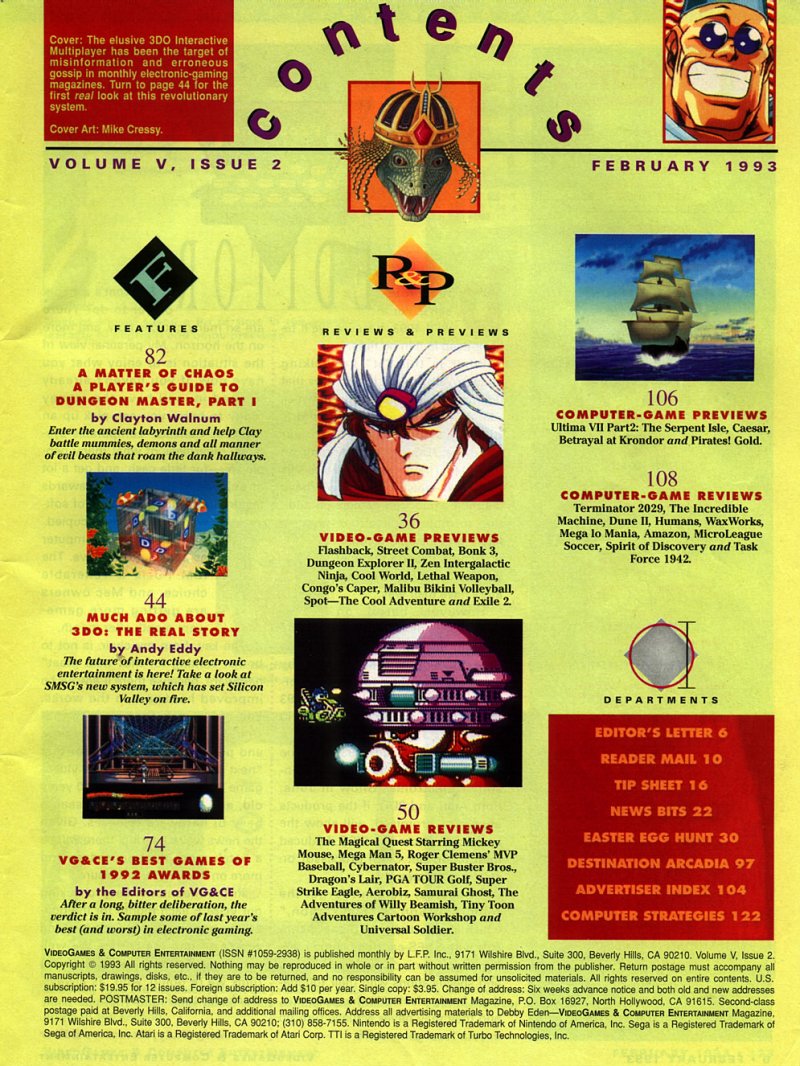
Features

  • A Matter of Chaos: Player's Guide to Dungeon Master, Part I - VG&CE had some pretty great game guides. However, you had to be disciplined about looking at them because they could ruin the game for you. This one covers the first part of Dungeon Master for the Super NES.

  • Much Ado About 3DO: The Real Story - It's a shame the 3DO didn't have more success. This article is a first look at the machine with some technical details and a look at its capabilities.

Table of Contents from the February 1993 issue of VideoGames & Computer Entertainment

Previews & Reviews

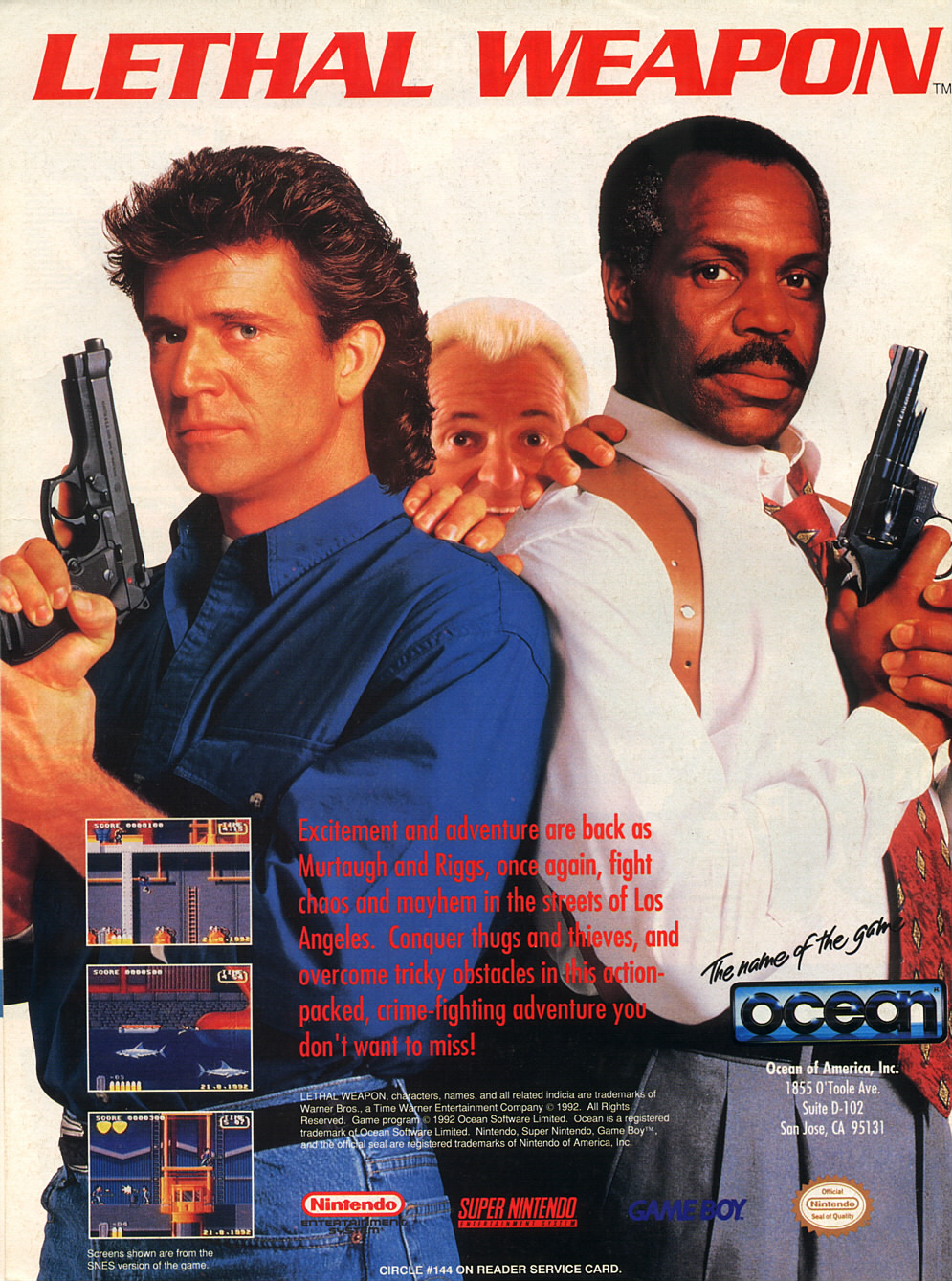
  • Video-Game Previews - Brief previews of Flashback (Genesis), Bonk 3 (TurboGrafx-16), Street Combat (Super NES), Dungeon Explorer II (TurboGrafx-16), Zen Intergalactic Ninja (NES and Game Boy), Lethal Weapon (NES and Game Boy), Cool World (Super NES and Game Boy), Congo's Caper (Super NES), Malibu Bikini Volleyball (Atari Lynx), Spot - The Cool Adventure (Game Boy), and Exile 2 (TurboGrafx-16).

  • Video-Game Reviews - Reviews of The Magical Quest Starring Mickey Mouse (Super NES) - Capcom made some great Disney licensed games and this was one of them, Mega Man 5 (NES) - and there would still be one more Mega Man game on the NES, Roger Clemens' MVP Baseball (Genesis), Cybernator (Super NES), Buster Bros. (TurboGrafx-16 CD), Dragon's Lair (Super NES) - a platform game not really like the arcade version, PGA Tour Golf II (Genesis), Super Strike Eagle (Super NES), Aerobiz (Super NES), Samurai Ghost (TurboGrafx-16), The Adventures of Willy Beamish (Sega CD), Tiny Toon Adventures Cartoon Workshop (NES), and Universal Soldier (Super NES) - another bad licensed game.

  • Computer-Game Previews - Short previews of Ultima VII Part 2: The Serpent Isle, Caesar - I think I actually have this one somewhere though I've never played it, Betrayal at Krondor - my roommate in college spent many hours on this game, and Pirates! Gold.

Departments

  • Editor's Letter - A look at what's ahead in 1993 including the 3DO, Atari Jaguar, the PlayStation (which at the time was essentially an SNES console with CD-ROM), and more.

  • Reader Mail - Letters from readers about RPGs, Nintendo's 32-bit CD-ROM system, portable systems, and more.

  • Tip Sheet - Hints and tips for Night Trap (Sega CD), The Guardian Legend (NES), and Cosmic Fantasy 2 (TurboGrafx-CD).

  • News Bits - Radio Shack debuts a new interactive CD player called the Memorex MD-2500 VIS, Nintendo cleared of antitrust charges, classic games re-released for the NES (Zelda, Zelda II, Punch-out, Metroid) for $29.99 each, Sunsoft licenses The Pirates of Dark Water, Atari drops price of Lynx to $79.99, and more.


Back cover of the February 1993 issue of VideoGames & Computer Entertainment

Read more: https://www.megalextoria.com/wordpress/index.php/2024/08/19/videogames-computer-entertainment-february-1993/

Tuesday, May 28, 2024

Compute! (March 1981)

Compute! (March 1981)

Compute! was a popular multi-format magazine that covered various computers throughout its long life which started in 1979 and lasted until the 1990s. Throughout its early life, it strictly covered computers based on the 6502 processor. The March 1981 issue includes:
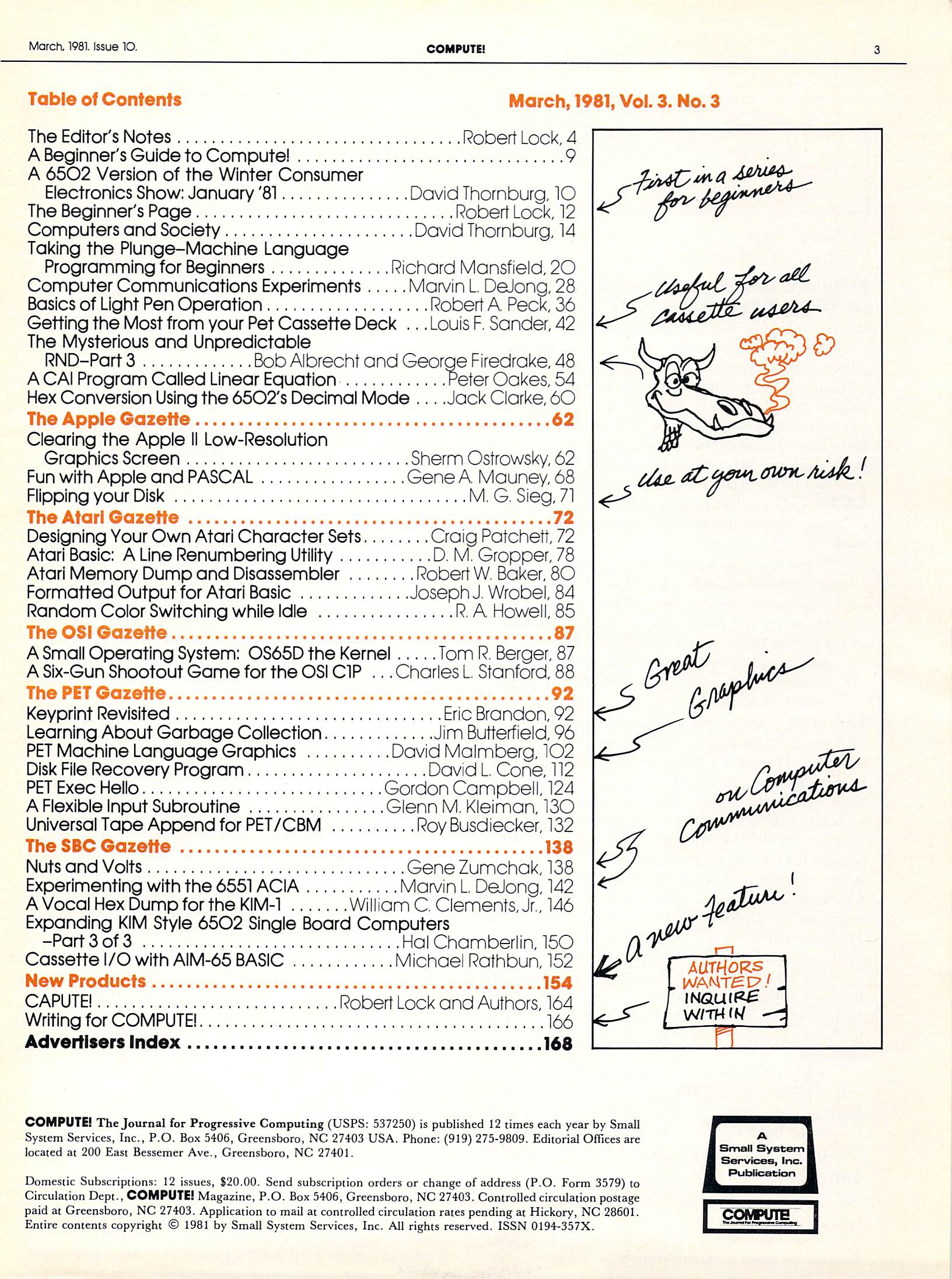
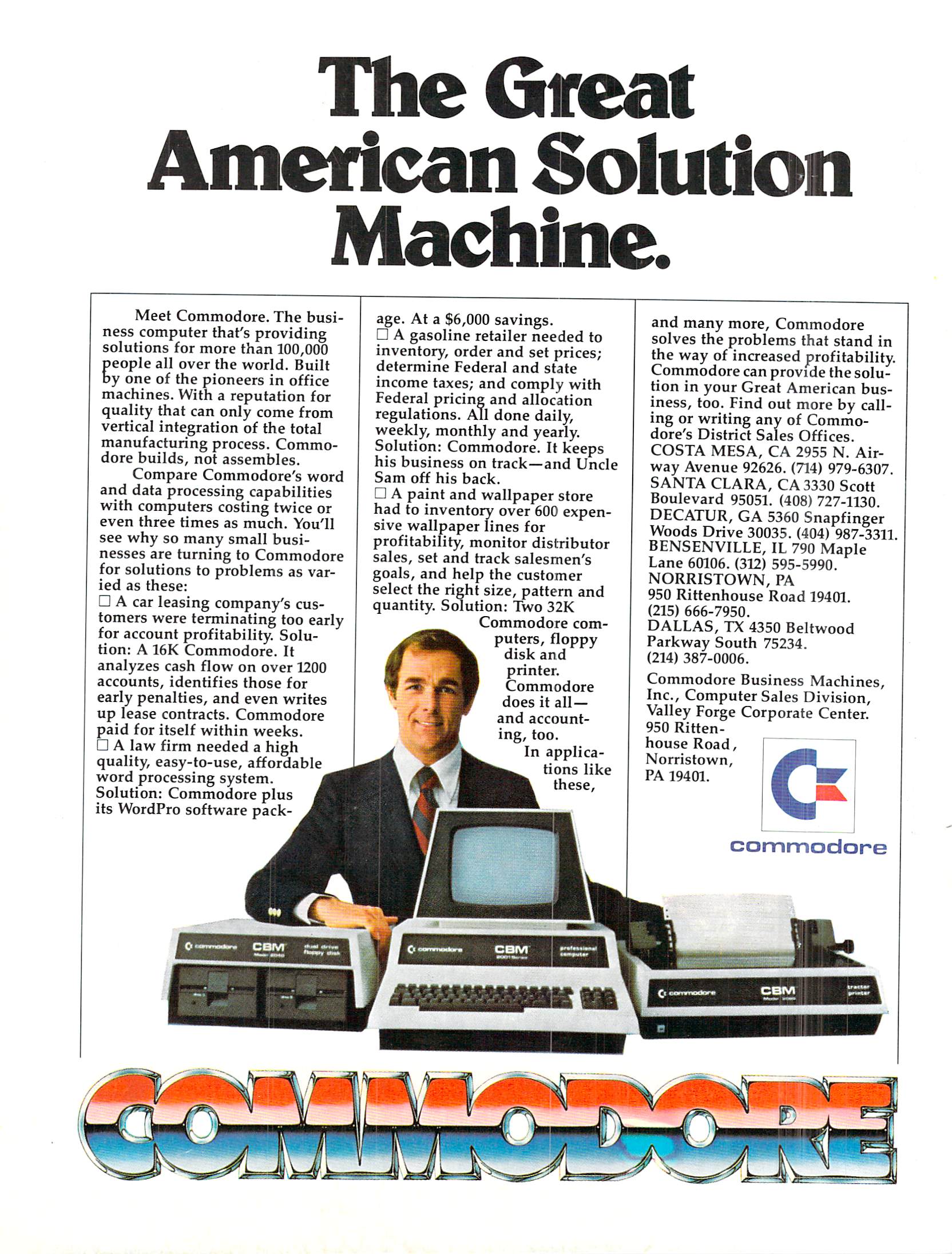
Table of Contents

  • The Editor's Notes - The editor opines on software piracy vs. the right to back-up software that you buy.

  • A 6502 Version of the Winter Consumer Electronics Show: January '81 - News related to 6502 based computers at the Winter CES. The biggest product introduced that year was the Commodore VIC-20.

  • The Beginner's Page - Some beginner information about BASIC, operating systems, ROM, RAM and storage media.

  • Computers and Society - A look at communications between user and computer via programming languages. LOGO and PILOT are emphasized while BASIC and PASCAL are also mentioned.

  • Taking the Plunge - Machine Language Programming for Beginners - An introductory guide to machine language on the PET though it is applicable to other machines of the time as well. The differences between BASIC, machine language and assembly code are discussed.

  • Computer Communications Experiments - An article on building an RS-232C interface which can be used for modems and other things.

The Apple Gazette

  • Clearing the Apple II Low-Resolution Graphics Screen - Several BASIC methods for clearing the screen.

  • Fun with Apple and PASCAL - A type-in PASCAL arcade style shooter game for the Apple II (basically shoot at the falling shapes).


Table of Contents from the March 1981 issue of Compute!

The Atari Gazette

  • Designing Your Own Atari Character Sets - Creating custom character sets on the Atari 8-bit.

  • Atari Basic: A Line Renumbering Utility - A type-in utility for renumbering the lines of a BASIC program. This was important sometimes because you could run out of line numbers. Every line of code in basic started with a line number. If you needed to add code in between two lines then there would have to be available numbers to do so. If you were unwise enough to make every line number consecutive, that could be problematic. It was common practice to number lines by 10s (first line is 10 second is 20, etc.). However, you never know when you might need more extra line numbers in between.

  • Atari Memory Dump and Dissassembler - A type-in program that will both dump the contents of memory locations to disk or disassemble lines of code.

The OSI Gazette

  • A Small Operating System: OS65D the Kernel - The final part in a series on the OS65D operating system.

  • A Six-Gun Shootout Game for the OSI C1P - A type-in BASIC game that sounds a bit like Outlaw on the Atari 2600.

The PET Gazette

  • Learning About Garbage Collection - Garbage collection (memory reclamation) was necessary on PET machines with certain ROM revision in order to reclaim memory used by strings. Here are a couple of short routines to do that.

  • PET Machine Language Graphics - A machine language graphics subroutine for the PET that provides a variety of graphics functions.

  • Disk File Recovery Program - A type-in program for the PET that can recover accidentally deleted files.

  • PET Exec Hello - A type-in program for automatically executing commands when booting from disk.

The SBC Gazette

  • Experimenting with the 6551 ACIA - Information for interfacing, operating and controlling a 6441 ACIA with a 6502. The 6551 is used primarily for communications.

  • A Vocal Hex Dump for the KIM-1 - A program designed to work with a speech synthesizer to speak the data in a given memory location.

  • Expanding KIM Style 6502 Single Board Computers - Part 3 of 3 - The final part in a series on expanding the KIM (and KIM-style) single board computers. Basically a series on how to use the bus expansion connector of these machines.

New Products

  • New Products - Commodore releases disaster relief software used during the fire at the MGM Grand Hotel on November 22, 1980, Personal Software Inc. releases MicroChess and Checker King for the Atari 400/800, Cimarron Corp. announces Legal Time Accounting (accounts receivable and matter tracking for the legal profession) for the Commodore 8032, Microcomputer Software Inc. releases The Landlord apartment management software for the Apple II, Microware releases Scientific Plotter graph producing software for the Apple II, Axlon announces 32K RAM expansion for the Atari 400/800, and much more.


Back cover of the March 1981 issue of Compute!

Read more: http://www.megalextoria.com/wordpress/index.php/2024/05/28/compute-march-1981/

Wednesday, January 3, 2024

Compute! (October 1981)

Compute! (October 1981)

Compute! is a home computer magazine that got its start all the way back in 1979. Later on, it tended to be less technical than something like Byte but by today's standards, all computer magazines were somewhat technical when this issue was published in October 1981. At the time, Compute! covered computers based on the 6502 processors such as the Commodore PET, Apple II, Atari 400/800, VIC-20 and others. This issue includes:

Columns

  • The Editor's Notes - Atari reduces prices in the wake of the introduction of the VIC-20 (they would ultimately lose the price war later on vs. the Commodore 64), IBM enters the personal computer market, Atari wins school contract in Minnesota, and more.

  • Computers and Society - Appropriate applications for home computers.

  • Readers Feedback - A commentary on the maturing of the computer industry and Computer Aided Instruction.

  • Ask the Readers - A question answered about the Apple II and TV interference and questions asked about video terminal options for an OSI computer, the 3040 Floppy Disk Unit for the PET, and more.

  • Basically Useful BASIC: Automatic DATA Statements For CBM and Atari - A type-in program that converts machine language code into BASIC DATA statements.

  • The Beginner's Page - Organizing and processing data with computers.

  • VIC-20 News - The latest released for the new VIC-20 including the VIC Graphics Printer from Axiom, a new disk drive (this would become the 1540), various memory expansion cartridges, an RS-232 adapter for connecting a modem, plus lots of software including Blackjack, Slither/Superslither, Biorhythm Compatibility, Space Math, Car Chase, Blue Meanies from outer Space, Programmer's Aid (adds new BASIC commands), and more.

The Apple Gazette

  • Budgeting On the Apple - A type in program for the Apple II that helps with budgeting tasks.

  • Named GOSUBs - A machine language routine that allows you to use named GOSUBs (instead of just line numbers) in BASIC programs.

  • A Tape "EXEC" For Applesoft: Loading Machine Language Programs Part II - A program that allows you to load both a BASIC program and ML routines it uses from tape.


Table of Contents from the October 1981 issue of Compute!

The Atari Gazette

  • Cassette Boot-Tape Generation From DOS 2.0S Binary Load File - A technique for creating a bootable tape on the Atari 400/800.

  • Beware The RAMTOP Dragon - A technique for creating protected memory areas...especially from Atari's memory management.

  • Documented Atari Bugs - A detailed description of bugs in Atari OS and BASIC software.

  • Graph It On The Atari - A type in program for creating plots and graphs.

  • Extending Player Missile Graphics - A machine language program for enhancing the capabilities of Atari's Player Missile Graphics (sprites).

  • Atari 400/800 Variable Name Utility - A type in program that will display the contents of the variable name table which lets you know which variable names are already in use.

The Pet Gazette

  • Practical Pet Printing Primer for Perplexed Programmers - A type-in program that helps you to print out program listings in a reasonable format.

  • Odds And Ends: A Fat Forty Bug - Illustration of a bug that sometimes occurs when running BASIC 4.0 programs on a PET with 12-inch screens that was originally written for 4-inch screens.

  • Machine Language: What's Your Sign? - Using signed vs. unsigned numbers.

  • Train Your Pet To Run VIC Programs - A technique for getting VIC BASIC programs to run on the PET.

  • Converting To Fat-40 - A tutorial for converting programs written for 9/10-inch PET 4032 to the 12-inch 40-column PET 4032.

  • High Resolution Bar Graphs For The Pet - A type-in program for creating bar graphs on the PET

The SBC Gazette

  • AIM 65 BASIC Floating Point Arithmetic From Machine Language - How to use floating point numbers on the SBC.

  • A General Purpose BCD-To-Binary Routine - A type-in program that will convert a BCD number with any number of digits to a binary number.


Back cover of the October 1981 issue of Compute!

Read more: https://www.megalextoria.com/wordpress/index.php/2024/01/03/compute-october-1981/

Monday, August 14, 2023

MacAddict (May 1998)

MacAddict (May 1998)

The best way to describe MacAddict would be to compare it to boot/Maximum PC for the PC. It was a magazine for enthusiasts. If I had been aware of it at the time, this magazine probably would have made me want to buy a Mac. Sadly, it transformed into MacLife at some point which was perhaps more polished but also boring and almost...antiseptic for lack of a better word. MacAddict was so much better. the May 1998 issue includes:

Highlights

  • Become a Mac Handyman - A guide to troubleshooting, repairing and upgrading your Mac. Includes tips on solving software issues, installing PCI, PDS and NUBUS cards, installing RAM, and much more.

  • This Old Mac - I especially loved this series on upgrading and using older Macs. This month the PowerBook 100 is covered which was six years old at the time. The PowerBook 100 is a 16-MHz 68000 based machine. At the time, it could still be made useful for e-mail, word processing and other basic tasks. The RAM could be upgraded to 8MB but RAM upgrades were expensive and 4MB could be enough for those basic tasks. Alternatively, upgrading from 4MB to 6MB was a cheaper alternative then going to 8MB. The hard drive could also be upgraded from the standard 20MB or 40MB drive up to at least 1GB. External drives were also an option. If only modern MacBooks were as upgradeable. Other potential upgrade options include a modem (up to 9600bps external or 2400bps internal), upgraded System Software (up to 7.5.5), and there was plenty of Internet software available including MacPPP, MacTCP, NCSA Mosaic 1.0.3, MacWeb, Eudora, LeeMail, Pegasus, NewWatcher, Fetch, Anarchie, AOL 2.1, and more.


Table of Contents from the May 1998 issue of MacAddict

How To

  • Switch to HFS+ - HFS+ was a new file system that came with MacOS 8.1. This tutorial guides you through upgrading from MacOS 8 and HFS to MacOS 8.1 and HFS+.

  • Know It All about Finder Views - A guide to configuring how Finder displays files and file info.


Table of Contents from the May 1998 issue of MacAddict (continued)

Every Month

  • Editor's Note - Lamenting the end of the Newton MessagePad.

  • Letters - Letters from readers about the PowerMac 6100, Steve Jobs,
  • Get Info - The latest Mac related news including new G3 vs. Pentium II benchmarks, better support from Iomega (including for Zip, Jaz and Ditto drives), IBM experiments with 1 GHz PowerPC chip, and more.

  • Cravings - A look at some of the latest tech gear, including the Kodak DCS 520 Digital Camera ($14,995 for 1728x1168 resolution), DirectCD (using CDs like floppies), DaynaStar FastHub 8 (an 8-port 100 Megabit hub for $269), Action Files (file manager/finder), and Lapdog (a lapdesk for your PowerBook).

  • Reviews
    • Dreamweaver 1.0 - a WYSIWYG HTML editor
    • Microsoft Internet Explorer
    • Elastic Reality 3.1 - morphing/warping graphics software)
    • Multi-Ad Creator 2 - a tool for creating small documents such as ads and brochures
    • Claris Home Page - an HTML editor
    • Mac Picasso with 3D Overdrive - a 2D video card with an optional 3D module based on the 3Dfx chipset...for $550
    • ...and more!


Back cover of the May 1998 issue of MacAddict

Read more: https://www.megalextoria.com/wordpress/index.php/2023/08/14/macaddict-may-1998/

Thursday, April 27, 2023

MacAddict (November 1996)

MacAddict (November 1996)

I was never really a Mac person. Mainly because I always felt they were overpriced and later on I enjoyed building my own PCs anyway. There also weren't as many games available for the Mac which was a consideration for me. However, if you were a Mac fan back in the late 90s then MacAddict was an excellent magazine. It reminds me of Boot/Maximum PC for the PC. Sadly, it eventually degraded into MacLife, a much more generic and boring magazine. The November 1996 issue of MacAddict includes:

Hightlights

  • 5 Steps to 3D Animation - A guide to developing your own animation. Their 5 steps include developing a concept, modeling the character, making the scene, animating the character, and post production. Some of the software demonstrated include Infini-D, QuickDraw 3.0, Adobe Premiere, and others.


  • Power Computing PowerBase 200 vs. Compaq Presario 8710
  • Us & Them - A comparison of Mac vs. PC. Here they compare a Power Computing PowerBase 200 to a Compaq Presario 8710. The Mac (clone) includes a 200MHz PowerPC 603e CPU, 32MB of RAM, 512k of L2 cache, an 8x CD-ROM drive, a 2.2GB hard drive, on board 3D accelerator including 2MB EDO RAM, and 3 PCI slots for $3,221. The Compaq includes a 200MHz Pentium CPU, 32MB of RAM, 512k L2 cache, 8X CD-ROM drive, 2.5GB hard drive, On-board 3D video with 2MB EDO RAM and 3 PCI slots for $3,299. They try to argue that the Mac is price competitive but this is a Mac clone which was allowed by apple for about 30 seconds and this is a very specific PC. There were other options with equivalent or better hardware that could be had cheaper. Apple choices were far more limited. Still an interesting comparison.

  • Every Trick in the Bookmark - A guide to organizing your bookmarks in Netscape Navigator and Microsoft Internet Explorer.


Table of Contents from the November 1996 issue of MacAddict

How To

  • Create Web Graphics - A guide to creating graphics and images for web pages. This includes tips for aligning and sizing images, using GIFs, spacing, when to use JPEGs, and more.


Table of Contents from the November 1996 issue of MacAddict (continued)

Every Month

  • Editor's Note - A guide to e-mail etiquette and a suggestion to do without e-mail for a day or two.

  • Get Info - A look at BeOS, an alternative OS that works with PowerPC based Macs (and other hardware); new Magneto-Optical drives (these used to seem so futuristic); some news about the upcoming OS 8; a look at AOL 3.0; and more.

  • Cravings - A look at interesting new gadgets, software and hardware, including Lightwave 3D, Tarpon (a ruggedized PDA based on the Newton), Xclaim VR (a graphics accelerator), PhotoTools 1.0, CD/Maxtet 1600 (a device that connects 16 hot swappable 8x CD-ROM drives to your Mac), and Photoshop 4.0.

  • Reviews - Reviews of Claris Home Page & golive Pro, Chromatica, QX-Tools 2.0/PageTools 2.0, Killer Transitions 1.0, Street Atlas 3.0, Phone Search 2.0, MovieStar 1.5, Movie Cleaner, Web-Motion, Myrmidon, Spell Catcher 1.5.6, RAM Doubler 2.0, QuicKeys 3.5, KeyQuencer, Zork Nemesis, AMBER: Journeys Beyond, Gabriel Knight II, Voyeur II, Close Combat, IndyCar Racing II, Don't Quite Your Day Job, Catz, Sacred and Secular, Berlitz Think & Talk Spanish 2.0, Michael Jackson's World Beer Hunter, The Ultimate 3D Skeleton, Origins of Mankind, Better Homes and Gardens Remodeling Your Home, Practice Makes Perfect Spanish, Mortimer and the Riddles of the Medallion, and more.


Back cover of the November 1996 issue of MacAddict

Read more: https://www.megalextoria.com/wordpress/index.php/2023/04/27/macaddict-november-1996/

Thursday, April 13, 2023

Compute! (July 1982)

Compute! (July 1982)

Compute! was one of the earliest home computer magazines. By 1982 it had already been published for a couple of years and was covering computers such as the Atari 400/800, Commodore PET, VIC-20, Apple II and others. The July 1982 issue includes:

Features

  • Gold Rush! - A type-in game for the VIC-20 and Atari 400/800 in which you must mine gold while avoiding cave-ins.

  • IRA Planner - A type-in BASIC program to help you plan and calculate the future value of your IRA.

  • Maze Race - A type-in BASIC maze race game in which you can race the computer or a human opponent to the center of the maze.

Education and Recreation

  • Recursive BASIC Subroutines - A tutorial on using recursive programming in BASIC programs using the Towers of Brahma problem as an example.

  • Screen Graphics - A tutorial on manipulating screen graphics with specific examples for Atari and Commodore computers.

  • Answer Selection With Joysticks - A BASIC program for the VIC-20 and Atari computers that demonstrates how to use the Joystick to select items on the screen.

  • Apple Game Paddles - Think you're a hardcore gamer? Gamers in the early 80s built their own controllers.

Reviews

  • Caverns of Mars - An action game for the Atari 400/800 in which you must fly your way through the tunnels of Mars battling Martians along the way.

  • Two Programs from the VIC Six Pack - Reviews of Car Chase, a game in which you race a car around a square while collecting dots and avoiding the other car; and Blue Meanies From Outer Space, a game somewhat similar to Space Invaders.

  • SoftBox: CP/M for PET/CBM - A CP/M emulator for the PET. It's essentially a CP/M computer that plugs between the PET and disk drive that allows you to use the monitor, keyboard and disk drives of your PET.


Table of Contents from the July 1982 issue of Compute!

Columns and Departments

  • The Editor's Notes - A brief look at the Chicago Consumer Electronics Show and National Computer Conference in Houston. Highlights included a bunch of new computers from Commodore, including the BX256, B128, "P" Series, Commodore 64, and Commodore MAX.

  • Ask the Readers - A conversation with readers about extending languages, Atari computer lock-ups, Fast-Find for the Commodore PET and VIC-20, using the GET BASIC command on Atari computers, and more.

  • Computers and Society - Achieving computer literacy with PILOT and LOGO, making music with computers, and more.

  • The Beginner's Page: Making Files Work - File handling in BASIC using the Commodore PET/VIC-20, Atari 400/800 and Apple II.

  • Friends of the Turtle - Fractal graphics using Apple LOGO and Atari PILOT.

  • The World Inside the Computer - Kids and computers.

The Journal

  • A Direct Access File Editor - A type-in BASIC file editing tool for the PET/CBM and Atari disk users.

  • MicroDOS - A technique for optimizing your Atari DOS disks to reduce disk storage and memory requirements.

  • Whither VIC - A look at the brief history of the VIC so far (about a year old at the time) and its immediate future.

  • Super QuadraPET - A type-in program for partitioning memory on the PET and moving programs between those partitions.

  • Apple DOS Changer - A BASIC program that will rename potentially destructive DOS commands (like INIT which erases a disk). Useful in a classroom setting.

  • Atari Video Graphics and the New GTIA - In 1982 Atari computers got a graphics upgrade with the new GTIA chip. It included a new sixteen color mode, the ability to generate 256 colors, and much more.

  • All About PET/CBM Character Sets - An article describing all of the currently existing PET/CBM character sets in detail.

  • Language Lab - A type-in program to help you learn a foreign language on your Atari 400/800.


Back cover of the July 1982 issue of Compute!

Read more: https://www.megalextoria.com/wordpress/index.php/2023/04/13/compute-july-1982/

Tuesday, January 24, 2023

Compute! (May 1981)

Compute! (May 1981)

Compute! was one of the earliest and longest running multi-format computer magazines published in the U.S. In the early days, it covered the Atari 400/800, Apple II and Commodore PET as well as various kit computers. The May 1981 issue includes:

  • The Editor's Notes - A look at some of the things seen at the West Coast Computer Faire, including the Votrax Type-'N-Talk text to speech synthesizer, the Commodore Super-PET, A 256K memory expansion from Axlon for the Atari 800, and more.

  • The Readers' Feedback - Praise for the magazine, small business programs for the Atari, improving magazine distribution, and more.

  • Computers and Society - Addressing computer phobia.

  • Computer Aided Instruction, Boon or Bust? - Analyzing the effects of computers in the classroom. Still a novel idea at the time.

  • They Mysterious and Unpredictable RND - The last part in a series on random numbers. This part presents solutions for finding maximum and minimum numbers in a sample of random numbers, simulating dice rolls and a number of other exercises.

  • Land of the Lost - A Program For a Cassette Filing System - A type-in menu-driven program to create labels for cassettes (the dominant home computer storage medium of the time).


Table of Contents from the May 1981 issue of Compute!

The Apple Gazette

  • Using Named GOSUB and GOTO Statements in Applesoft BASIC - A simple way to create named subroutines vs. just using line numbers.

  • Commas, Colons, and Quote Marks Too - Writing BASIC programs that can accept commas, colons and quotation marks as part of their input.

The Atari Gazette

  • A Cure for Atari BASIC or, Make Your Atari a Bit Wiser - An assembly language program that adds the ability to do bitwise operations in Atari BASIC.

  • Copy Your Atari Screen to Your Printer - A short BASIC program that will dump the contents of the screen to a printer.

  • Hardware Information at Last! - Three new Atari technical manuals, including Atari 400/800 Technical User Notes, Atari 400/800 Operating System, and Atari 400/800 Disk Operating System.

  • Using Strings for Graphics Storage - A method for using BASIC strings to create graphics on the Atari.

  • Atari Machine I/O - Three machine language routines for processing input.

The OSI Gazette

  • Through the Fill-The-Buffer Routine with Gun and Camera - Some technical info on how the "Fill-the-Buffer" routine (FTB) of OS BASIC works.

  • FOOTU: FOO Revisited - Converting FOO (a racing game for the OSI) to run on OSI systems with BASIC-in-ROM.

The PET Gazette

  • A Fast Visible Memory Dump - A program for creating a graphical memory dump to a printer.

  • Machine Language: Getting to the Machine Language Program - Methods for combining BASIC programs with machine language routines.

  • A Thirteen Line BASIC Delete - A short BASIC program that allows you to delete any group of lines form an existing program.

  • Calculated Bar-graph Routines on the Pet - How to calculate the length of bars in a bar graph so that they can be properly printed.

  • The Revised Pet/CBM Personal Computer Guide - A look at the changes in the newest revision of the Osborne/McGraw-Hill Pet/CBM Personal Computer Guide.

The SBC Gazette

  • Nuts and Volts - Information about building your own microcontrollers.

  • A Kim-1 Music File in Microsoft Basic: Part 1

  • New Products - Atari sponsors contest for new software; the BYTEWRITER-1 dot matrix printer from Microtek; Hayes releases the Smartmodem, a 300 baud modem that set the standard for years to come for $279; and more.


Back cover of the May 1981 issue of Compute!

Read more: https://www.megalextoria.com/wordpress/index.php/2023/01/24/compute-may-1981/

Monday, May 16, 2022

Compute! (March 1982)

Compute! (March 1982)

Compute! was an early multi-format computer magazine that prospered from the early 1980s until the early 1990s. In 1982, computers such as the Commodore PET, VIC-20, Atari 400/800 and Apple II were covered among others. The March 1982 issue includes:

Features

  • The Winter of Our Content: A Report on the January Consumer Electronics Show - There was an impressive line-up of new products revealed at this CES including the Commodore Ultimax, Commodore 64, Bally Astrocade plus the official home version of Pac-Man was released among many other items.

  • Twenty Questions Revisited - A type-in program for a computerized version of twenty questions.

  • Energy Workbook - A type-in program to help you determine the best improvements you can make to your home to increase energy efficiency.

  • Two Short Programs of CAI for Teaching BASIC - I was trying to work out what CAI even stands for. Computer Aided Intelligence maybe?

  • Infinite Precision Multiply - Normally, the Commodore PET has 9 digits of precision for mathematical operations. This program gets around that limitation.

Education and Recreation

  • Family: A Simulation in Genetics - A type-in program for the PET that demonstrates heredity with a hypothetical Martian couple.

  • Large Alphabet for the VIC - Generating a double size character set on the VIC-20.

  • Concentration - A type-in game based on the classic card game, Concentration.

  • Comment Your Catalog - A program to add comments to disk directory listings on you Atari 8-bit computer.

  • Starfight3 - Involves Klingons and the Enterprise. Sounds suspiciously like Star Trek to me? For the VIC-20.


Table of Contents from the March 1982 issue of Compute!

Reviews

  • Votrax Type 'N Talk: TNT - A simple to program speech synthesizer that works with various computers via an RS-232 interface...for $375.

  • Olympia's ES 100 KRO Typewriter/Printer - An typewriter that also works as a printer (or is it the other way around?). It isn't cheap though at $1680.

  • RPL: A FORTH Sequel? - RPL is a FORTH-like computer programming language. Versions for PET/CBM machines are looked at here.

  • Ricochet - An odd combo of checkers and pool by Automated Simulations (which would later become Epyx) for the Apple II, Atari 8-bit and TRS-80.

Columns/Departments

  • The Editor's Notes - Editorial commentary on the new format of the magazine, the importance of reader feedback, and more.

  • Ask The Readers - Various question and answers about Atari BASIC, support for the 6502 processor, programming, and more.

  • Computers And Society - The merging of technology and art from lasers, to cameras to computers.

  • The Beginner's Page: How Computers Remember - A discussion of computer memory and how it works.

  • Basically Useful BASIC: Tabulation - A subroutine for justifying text the way you want in BASIC.

  • Learning With Computers: Word Processing In The Classroom - Even as early as 1982 computers were being used in the classroom and word processing was one of the first truly useful applications. This article discusses using word processors to make the physical act of writing easier so more attention can be paid to the creative aspects.

  • Friends Of The Turtle - Drawing using Atari PILOT.

The Journal

  • Disk Checkout For 2040, 4040, and 8050 Disks - Part 1 of 2. This part discusses manipulating disks/disk drives via machine language.

  • Organizing Data Storage - Sequential vs. Random files.

  • Machine Language Sort Utility - An efficient, machine language sorting routine. Why machine language? The fastest BASIC sort of 200 records in this test was 8 minutes but only 3 seconds for Machine Language.

  • Dynamic Renumber - A program to renumber your BASIC programs.

  • Disk Data Structures: An Interactive Tutorial - The details on how data is structured on a disk.

  • Apple Addresses - Addressing memory in machine language, BASIC floating point and BASIC integer on Apple II computers.

  • More VIC Maps - A discussion on VIC-20 memory maps continued from the previous issue.

  • EPROM Reliability - A detailed analysis for determining EPROM reliability focusing on the 2708 EPROM.

  • Random Music Composition On The PET - A type-in program for generating random music on the PET with various parameters that can be easily changed.

  • Ghost Programming - A method for running many BASIC programs that normally require 24 or 32K of RAM on an Atari with only 16K.


Back cover of the March 1982 issue of Compute!

Read more: https://www.megalextoria.com/wordpress/index.php/2022/05/16/compute-march-1982/

Thursday, April 29, 2021

Pronto, The Home Banking System (1984)

Pronto, The Home Banking System (1984)

Haha, all you newbs who think online banking got started with the Internet era...

Pronto was the name of an online banking system from Chemical Bank. They called it "The Home Banking System". While the ad above from 1984 is promoting software for Apple and IBM PC computers, it actually got its start on Atari computers in 1982. This was considered to be the first personal computer based banking system.

This reminds me vaguely of the first time I saw my friend's Commodore 64. This would have been some time in 1985 and I asked him what this brown boxy looking thing next to the Commodore was. He told me it was something you could use to break into banks and stuff. It was a modem. I'm pretty sure I didn't use a computer to access a bank until my bank started offering online services some time well after the year 2000. I don't remember when it was actually but it wasn't THAT long ago.

While sounding vaguely familiar, I wasn't even sure who Chemical Bank was. Apparently, it was founded in 1823 as the New York Chemical Manufacturing Company by Balthazar P. Melick. Anybody else think that Balthazar is a bad-ass name or is that just me? At the end of 1995 it was the 3rd largest bank in the U.S. At that time, Chemical acquired Chase Manhattan to create the largest financial institution in the U.S. and started using that name.

Anyway, Chemical's initial online banking system wasn't terribly popular. Part of the reason was the high subscription fees. By 1984 it was "only" $12 a month but I believe it was even higher earlier on. This service carried on in one form or another until 1989 when it was discontinued. But in the early 1980s, they were decades ahead of their time.

The ad above is from the June 1984 issue of Family Computing. Check out this New York Times article from December 7th, 1983 on this system.

Wednesday, February 17, 2021

The Bottom Line (Apple II)


The Bottom Line (Apple II)

This particular ad is from the premiere issue of inCider from January 1983. inCider was a magazine dedicated to the Apple II line of computers. Back in the day, there were tons of computer mail order places advertised in computer magazines. I'm more familiar with those specializing in Commodore 64 related items but many of these places sold systems of all types. "The Bottom Line" is not one I recognize but this is a few years before I got my first computer and obviously in this ad thay are pushing Apple II related items.

The price for the Apple compatible Franklin Ace 1000 was $1549. That includes a disk drive and amber monitor. That sounds like a lot (and it was) but it's a bargain compared to the price of real Apple equipment at the time. But who wants an amber monitor? Not much good for games...

It's amazing how much a dot matrix printer cost. The Star Micronics Gemini-10, quite a popular printer at the time, was $419.88 in 1983. That number already sounds expensive but adjusted for inflation, that would be somewhere in the neighborhood of $1,300 today.

Modems weren't much better. An abysmally slow 300 Baud modem was $239. A more respectable 1200bps would cost you $569. And that was about as fast as you could get at the time.

But for a real demonstration of just how far prices for technology have fallen, take a look at the hard drive prices. A whopping 5 MB would cost you at least $2000. That's more like $5,400 in today's dollars. For some more fun, take a look at the RAM prices...

Tuesday, February 9, 2021

VideoGames & Computer Entertainment (January 1990)


VideoGames & Computer Entertainment (January 1990)

VideoGames & Computer Entertainment was my favorite video games magazine at the end of the 1980s and early 1990s. The January 1990 issue includes:

Features
  • Is It Live, Or Is It...Cyberspace? - This innovative "looking glass" project pushes computer technology in wild directions - and may affect how we play video games in the future.

  • Going For The Dragons: Wonder Boy III Strategy Guide, Part I - This detailed strategy guide will help you smooth over the rough spots as you take Wonder Boy through his third adventure on the Sega Master System.

  • Life In War Times: P.O.W. Strategy Guide - Are you feeling claustrophobic? Our maps, hints and tips should help you free yourself from the enemy prison camp and call your troops to pick you up.

  • Destination Arcadia - This new column debuts with coverage of the 1989 AMOA show in Las Vegas and an in-depth look at Atari's Escape From the Planet of the Robot Monsters.

  • Chris Crawford: The Designer's Designer - Crawford is not only a designer of high-quality games, but he's also an outspoken critic of the industry. Peek in on a candid conversation with him about his views and visions.

  • Roundball Software: The Latest In Computerized Basketball - Droves of electronic dribbling simulations have hit the shelves, and our experts open up their archives to show you how it started, what's out now and what to look for.

  • Puzzling It Out: Games For Thinkers - If you're in the mood for an electronic brainteaser, this survey of mind-boggling games will set you on the right track.

  • Computer-Game Strategies - In this issue, Frank guides you through Beyond the Black Hole, California Games and Firepower.
Reviews
  • Video-Game Reviews - Rastan, Guardian Legend, Magic Johnson's Fast Break, Clash at Demon Head, Bad Dudes, Sky Shark, Rescue, Ghouls 'N' Ghosts, and Magic of Scheherezade.

  • Computer-Game Reviews - Heavy Barrel, Beyond the Black Hole, Dark Side, Gold Rush and Genghis Khan: A Study of Regal Principle.
Departments
  • Editor's Letter
  • Reader Mail
  • News Bits
  • Easter Egg Hunt
  • Yea & Nay
  • Inside Gaming
  • Advertiser Index
  • Game Doctor
...and more!

Thursday, June 25, 2020

MacLife (February 2010)


MacLife (February 2010)

It's hard for me to think of these Macs as "retro" but this issue of MacLife is over 10 years old now. A decade is a long time in the computer world. This issue includes:

Features

  • 50 Killer Mac Apps Under $50 - We present the staff's picks for the 50 must-have apps under 50 bucks that will realign your universe. Or at least make your day-to-day much more efficient, productive, and pleasant.

  • Shop Different - iTunes may have revolutionized the way we buy music, but it's not the only fish in the song-buying sea. We examining and rate nine other MP3 stores to gauge how they stack up.

  • Appstravaganza - Where all the best iPhone stuff comes to party.

  • Odd Jobs - How Amos Winbush secured venture capital funding and launched a successful business, all from is iPhone.

Departments

  • Online at maclife.com - Get the dish on all the latest Mac rumors and news in articles, how-tos, and videos and podcasts on MacLife.com.
  • Consider - In search of the perfect laptop bag.
  • Share - Buggy things and family scenes.
  • Start - What's really behind all the hubbub on net neutrality? Hint: follow the money.
  • Win - Check out a smattering of the 10 can't-live-without iPhone apps offered up by this month's winners. Plus, show us your coolest vintage Apple gear and enter to win a Mysterious Box of Mystery.

Create

  • Ask - Need to transfer photos from your iPod, make backup copies of software discs, send video messages to your grandma, or email your iTunes playlist to a friend? You ask, we show you the way.
  • Make a Bootable Rescue SD Card - If your new Mac has a built-in SD card slot, you can make the smallest rescue disk ever.
  • Back Up Your Gmail - Keep a local copy of your Gmail messages - thanks to Mail, Automater, and iCal.

Reviews

  • Droid
  • MacHighway Easy
  • PHS300 Personal WiFi Hotspot
  • Bluetooth Comfort Laser Mouse and Compact Optical Mouse
  • InfoSafe
  • OWC Mercury On-The-Go Pro "Triple"
  • Store 'n' Go USB Drive for Mac OS X
  • Sanyo Xacti HD2000A
  • Pentax Optio P80
  • SuperDuper!
  • BusyCal

Listen

  • Quiet Comfort f15
  • iTunes Dupes Barrier
  • Winshield/Vent Car Mount with Sound Amplified Cradle for iPhone
  • iBlink

Play

  • Warhammer Online: Age of Reckoning
  • Machinarium
  • The Movies Superstar Edition

...and more!

Wednesday, April 1, 2020

MacLife (January 2010)


It's hard for me to think of anything Apple as retro unless we are talking about the Apple II. Or at least Power PC or older Macs. But 10 years is a long time in computer years. The January 2010 issue of MacLife includes the following:

Features

  • The Apple of Their Eyes - What will apple unveil as the next spectacular, gamechanging One More Thing? we asked five Apple experts to weigh in and dream big - and then brought their ideas to life.

  • Coach. Mentor. Assistant...iPhone - Your iPhone can help you become more organized, learn new skills, improve your health, and much more. we show you how the device can crack its virtual whip to help you become a better person.

  • Fresh Choice - Apple surprised us with new hardware releases. After rigorous testing, we tell you what the new specs and updated features mean - and render our final verdicts.

  • Appstravaganza - Where all the best iPhone stuff comes to party.

Departments

  • Online at MacLife.com - Get the disk on all the latest Mac rumors and news in articles, how-tos, and videos and podcasts on MacLife.com.

  • Consider - A guy can dream, can't he?

  • Share - Go on, get it off your chest.

  • Start - Now that Apple has jumped the good ship Expo, will opportunistic CES be the go-to trade show for Mac-heads? And if so, will they need to don a tie?

  • Win - Last month we asked for a list of your 10 must-have, can't-live-without-them Mac apps. This month we want to see your ideas for the next earth-shattering Apple product coming down the pike, and we will reward the winning visionary with an incipio prize pack.

Create

  • Ask - Troubleshoot your Bluetooth connection, color your Mac, burn slideshows to DVD, assign multiple birthdays to one Address Book contact, and put your podcasts in their place.

  • Hide Your Facebook Shame - Keep your friends close and your acquaintances slightly less close by invoking Facebooks's privacy features, including the woefully underused Limited Profile.

  • Auto-Add Songs to iTunes from Any Computer - Quickly, painlessly, and wirelessly transfer songs and videos back to your main iTunes library from any Mac or PC, on any network.

Reviews

  • Yubz Talk Mobile - phone handset
  • Motion 4 - 3D motion graphics app
  • infoWallet - information organizer
  • FlexTime - timer
  • WildCharger pad - wireless charger
  • Photoshop Elements 8 for Mac - photo editor
  • Bento 3 - personal database

Listen

  • Mix - boom box
  • Logic Studio - music suite
  • djay - digital DJ app
  • WD TV Live - set-top media player
  • iPod nano Case Roundup

Play

  • BioShock - first-person shooter
  • Foursquare and Gowalla - iPhone games
  • Guitar Hero World Tour - rhythm game

...and more!

Monday, February 10, 2020

The Best Of Hardcore Computing (1984)


The Best Of Hardcore Computing (1984)


Hardcore Computing started life primarily as a magazine that provided information on circumventing disk based copy protection (mostly for the Apple II) though it did contain some other, mostly technical, content. This "Best Of" issue from 1984 includes all such information published by the magazine up until that point in organized, condensed, updated and corrected form. Contents include:
  • Getting into DOS with DISKEDIT
  • An inside look at disk formats using DISKVIEW
  • Deprotecting disks with SUPER IOB
  • A quick and easy way to UNLOCK HYPERSPACE WARS
  • Taking a peek at BOOT CODE TRACING
  • List of Publisher abbreviations and INTRODUCTION TO 'PARMS'
  • The Compleat Guide to LOCKSMITH PARAMETERS
  • Step-by-step guide to making backups using NIBBLEs AWAY II PARAMETERS
  • Technical notes and making backups using BACK-IT-UP II+ PARAMETERS
  • How to make backups using COPY II PLUS PARAMETERS
  • Curing those Auto-Start ROM blues HARDWARE SOLUTIONS
  • A MENU HELLO PROGRAM
  • USING BOTH SIDES OF YOUR DISKETTES
  • Advanced Playing Techniques, or how to get INSIDE CASTLE WOLFENSTEIN
  • Learn to use and understand Strings wtih TEXT INVADERS
  • Getting into Hi-res with ZYPHYR WARS
  • CHECKSOFT/CHECKBIN
...and more!

Monday, January 13, 2020

VersaWriter (Apple II)

VersaWriter is a drawing tool that was released for the Apple II and other computers sometime in 1983. It consists of software and a tablet with an articulating arm to aid in drawing or tracing. All of this could have been yours for the low price of $299. Accounting for inflation, that would be more than $770 today.

The software that went along with VersaWriter was fairly sophisticated despite being written (mostly?) in BASIC. You could use this for art, drafting type drawing, diagrams and tracing other things easily. Unfortunately, the very high price of this product meant that few could afford it. As far as artistic uses, there were other far cheaper products that worked just as well and if you were doing professional drafting or something similar I would imagine there were better prodcuts for that as well. In other words, the market for this product was probably very small.

Although this ad emphasizes the Apple II, it also mentions availability for the Atari 8-bit and DOS based PCs. I’m not sure if there are any price differences but if there were it was likely a higher PC price. The ad also mentions additional software products other than what comes with the tablet that adds additional functionality. There are three Expansion Packs mentioned, the last of which adds animation capabilities. However, I don’t know if these were all released.

There isn’t much use for this product today except as a historical curiosity. I imagine that this item complete with software and hardware is probably quite rare so it may be of interest to collectors. The above ad is from the October 1983 issue of Micro: The 6502 Journal.

Wednesday, January 8, 2020

Micro: The 6502 Journal (October 1977)


Micro: The 6502 Journal (October 1977)


Micro: The 6502 Journal was an early computer magazine, or really technical journal, dedicated to computers and computer kits based on the 6502 CPU. These included the likes of the KIM-1, Commodore PET, Apple II, Atari 8-bit and later on the VIC-20 and Commodore 64 among others. The first issue from October/November 1977 features the brand new Apple II on the cover and the contents include:
  • Cheap Memory for the KIM-1 - by Byron Salzsieder - has an expanded KIM-1, KIMSI, and is currently waiting for delivery of a Micromind.
  • Terminal Interface Monitor (TIM) for the 6500 Family - by Oliver Hold - "The Computer Doctor" for Microcomputers, Inc., microcomputer teacher and consultant, micro-systems designer.
  • We're Number One! - An Editorial
  • Inside the Apple II - by Arthur Feruzzi - a confirmed "computer nut" who owns a number of 6502 microcomputers - assembled, kit and homebrew.
  • Rockwell International and the 6502 - by Arthur Ferruzzi - currently designing some special purpose micro-systems, 6502 based, of course.
  • The PET's IEEE-488 Bus: Blessing or Curse? - by Charles Floto - Editor of Buss and Yankee Bits and freelance writer and photography whose work has appeared in Byte, Personal Computing, and Kilobaud.
  • 6502 Related Companies - by Mike Rowe - prefers hexadecimal notation since he has eight fingers on each hand.
  • Hypertape and Ultratape - by Robert M. Tripp - Editor of MICRO, author of PLEASE and other software and hardware for the KIM-1.
  • KIM-Based Degree Day Dispatcher - by Mike Rowe - Computer consultant for the Starship Enterprise.
  • Computer Controlled Relays - by Robert M. Tripp - Microprocessor consultant and lecturer.
  • 6502 Bibliography - by William Dial - Retired Research Chemist with a KIM-1 and several 6502-based OSI boards.
  • 6502 Reference Car
...and more!

Monday, December 9, 2019

Big K (July 1984)


Big K (July 1984)
Big K was a 1980s computer gaming magazine that was published in the U.K. In addition to the typical games coverage, it also provided type-in programs for various computer platforms. The July 1984 issue includes: Games Programs
  • Duel for CBM 64
  • Daffy Cafe for Spectrum
  • Fighter for Oric
  • Tunnels of Zarnon for Spectrum
  • Peeked at the Post for CBM 64
  • Hare Lifts for VIC-20
Utility Programs
  • Character Definer for BBC
  • Padlocked for BBC
Software Reviews
  • Review pages
Hardware
  • 68000 Assembler
  • Coleco Adam Review
  • Spectrum Disc Drive Review
  • Music, Maestro, Please
Features
  • Mersey Byte Special
  • Steven Jobs Interview
  • Confessions of a Computer Snob
  • Richard Taylor's Spectrum Graphics
  • Atari Graphics
Regulars
  • On-line News
  • Zip Code
  • Charts
  • He Wrote One
  • Classic Games of Our Time
  • Dorkslayer
  • Arcade Alley
  • Letterbase
Competition
  • Win a CGL MS Starter Pack
...and more!

Monday, November 25, 2019

Compute! (March 1987)


Compute! (March 1987)

Compute! was, in my opinion, the best multi-format computer magazine of the 1980s. I still preferred the Commodore 64 specific magazines but if you were looking for coverage of multiple computers, this was a great magazine. The March 1987 issue includes: Features
  • Commodore's New, Expandable Amiga 2000: A Hands-On Report
  • New Peripheral Technologies
    • An introduction to Hard Disk Drives
    • The New High-Quality Dot-Matrix Printers
    • The Big Picture: Advances in Screen Display
  • A Buyer's Guide to Printers
  • Euchre
Reviews
  • Little Computer People
  • Certificate Maker and Walt Disney Cart & Party Shop
  • Roadwar 2000
Columns and Departments
  • The Editor's Notes
  • Readers' Feedback
  • Computers and Society: Demons and Events, Part 2
  • Microscope
  • Telecomputing Today: Packet-Switching Rule Changes
  • The World Inside the Computer: When Buying a Computer: Don't Ask Me!
  • The Beginner's Page: Getting Started with a Printer
  • ST Outlook: Who Is That Man, and Why is He Smiling?
  • AmigaView: The Sidecar Arrives
  • IBM Personal Computing: Two Winners and a Laser
  • INSIGHT: Atari - Corrected File Conversions
The Journal
  • 3-D Surfaces for Amiga
  • Fixing Atari Revision-B BASIC
  • Custom Characters for Atari XL and XE
  • Applecoder
  • 128 File Viewer
  • Filedump for IBM PC/PCjr
  • DOS Calc
  • Diskcheck: Apple Sector Editor for DOS 3.3
  • 128 Editing Functions for Commodore 64
  • Amiga Banner Printer
  • Using PUT and GET on the PC/PCjr
  • Superplotter
...and more!

Friday, August 30, 2019

Who Framed Roger Rabbit? (Commodore 64, Apple II, Atari ST, Amiga, DOS)


Who Framed Roger Rabbit? (Commodore 64, Apple II, Atari ST, Amiga, DOS)


Who Framed Roger Rabbit? is a game based on the movie of the same name. Versions of this game were released for a wide variety of platforms. There were really three different games produced by three different companies. The first was released in 1988 for various home computers including the Commodore 64, Apple II, Amiga, a and DOS. The second was produced by Rare and released by LJN for the NES in 1989. The final version was released by Capcom for the Game Boy in 1991. The ad above is for the first version of the game.
Who Framed Roger Rabbit? is a pretty mediocre action/arcade game. Considering the fact that this is a game based on a movie license, it's terrific. Most such games are truly abysmal and this one is at least okay. This game consists of four levels, each of which has a specific goal and is really a subgame unto itself. These roughly follow the plot of the movie. In terms of gameplay, there is not a huge difference between the various versions though the Amiga and Atari ST versions will have the best graphics.
If you want to play this variation of the game, you will have to track down an original or resort to emulation. It has never been nor is it likely to be re-released. In order, I would chose the Amiga, Atari ST or Commodore 64 version of the game. Originals aren't too hard to find on eBay though it's anyone's guess how long original disks will continue to function. Alternatively, disk images for emulators are also easily found. The ad above is from the October 1988 issue of Computer Gaming World. The screen shots above are from the Commodore 64 version of the game.