steem

Thursday, April 11, 2024

New Study Calls into Question Whether DEI Programs Really Boost Corporate Earnings


It’s safe to say that diversity, equity, and inclusion is one of the more controversial ideas of our time (and a multibillion-dollar industry).

Some such as Elon Musk argue that DEI — which definitionally speaking means addressing structural inequalities in society — constitutes blatant racism. Others contend that DEI is simply about creating more equitable and harmonious workplaces, and offers clear financial benefits to companies, as well. “Study after study has proved that diverse companies perform better than their more homogeneous counterparts,” Inc. reported in 2023. “Companies that don’t foster an inclusive environment or prioritize diversity initiatives do so at their own peril.”

“Proved” is a heavy (and inaccurate) word here, but Inc. isn’t wrong about the abundance of evidence showing that DEI initiatives make companies more profitable. From 2015–23, McKinsey & Company, a multinational strategy and management consulting firm, released four separate studies showing that DEI initiatives boost corporate earnings. Unfortunately for DEI advocates, the research appears to be bunk.

A new study published in Econ Journal Watch, a semiannual peer-reviewed academic journal, shows that researchers were unable to replicate the results of all four McKinsey studies.

“[O]ur results indicate that despite the imprimatur often given to McKinsey’s 2015, 2018, 2020, and 2023 studies, McKinsey’s studies neither conceptually … nor empirically … support the argument that large US public firms can expect on average to deliver improved financial performance if they increase the racial/ethnic diversity of their executives,” professors John R. M. Hand and Jeremiah Green found.

This is not the only research that shows DEI initiatives are not the panacea for corporate earnings supporters claim them to be. Writing in the Harvard Business Review, Robin J. Ely, a professor of business administration at Harvard, and David A. Thomas, the president of Morehouse College, point out that “the rallying cries for more diversity in companies” are not supported “by robust research findings.” Ely and Thomas add, “We say this as scholars who were among the first to demonstrate the potential benefits of more race and gender heterogeneity in organizations.”

The idea that all these studies showing clear financial benefits to DEI are rubbish might be shocking to some readers, but it’s a familiar academic pattern. For well over a decade, scholars and media have publicly worried about the “replication crisis” in science. It turns out that an astonishing number of findings in various fields — from psychology and economics to sociology, medicine, and beyond — fail to hold up when other researchers attempt to replicate the findings, as Vox has explained.

None of this is to say that diversity and inclusion are inherently bad, of course.

I value diversity and am an inclusive person, and I encourage others to be the same. It’s the means we choose to achieve diversity and inclusion that are the problem, as well as that word wedged in between them: equity. To many, advancing social equity is a paramount value. Because of this, many support illiberal means (in the classical sense) to achieve this end—including supporting policies that actively discriminate on the basis of race.

Coleman Hughes, a fellow at the Manhattan Institute and author of The End of Race Politics, recently appeared on The View and offered a better approach. “My argument is that we should try our very best to treat people without regard to race, both in our personal lives and our public policy,” Hughes told the hosts (who accused him of being “co-opted” by the Right). Hughes is right to say that this is the North Star we should be aiming for: the equal treatment of all people regardless of race or class.

The great orator and abolitionist Frederick Douglass saw that such a view is the true path to progress. “In a composite nation like ours, as before the law, there should be no rich, no poor, no high, no low, no white, no black, but common country, common citizenship, equal rights, and a common destiny,” Douglass noted in a speech in 1867.

The ethos of DEI runs counter to this, which is precisely why both the concept and industry should be scrapped. A good place to start would be to dispense with the fiction that DEI programs are a rainbow leading to a pot of gold in corporate profits.

This article originally appeared in the Washington Examiner.

Source: New Study Calls into Question Whether DEI Programs Really Boost Corporate Earnings – FEE


New Study Calls into Question Whether DEI Programs Really Boost Corporate Earnings

Wednesday, April 10, 2024

ANALOG Computing (November 1984)

ANALOG Computing (November 1984)

ANALOG Computing was probably the most popular Atari 8-bit computer magazine published in the U.S. It covered all of Atari's 8-bit computers through its life including the Atari 400, Atari 800, Atari 600XL, Atari 800XL, Atari 1200XL, Atari 65XE, Atari 130XE and more. It also occasionally had Atari ST coverage though it was always primarily an 8-bit magazine. The November 1984 issue includes:

Features

  • AtariCon Report - A report on the first international Atari users convention which was held August 24th and August 25th 1984 in Southfield, Michigan.

  • Bopotron! - A type-in platform game in which you must control a robot running around a spaceship trying to keep all of the power packs charged.

  • Circuit Database - A type-in program designed to store and organize circuit diagrams.

  • XL-DOS - A type-in modification of Atari's DOS 2.0S for XL computers to make it faster and more efficient.

  • Cassette Compressor - A type-in program for compressing programs on cassette and making them load faster.


Table of Contents from the November 1984 issue of ANALOG Computing

Reviews

  • A Software Cornucopia - Reviews of Pengo (Atari), Infidel (Infocom), Mr. Robot and his Robot Factory (Datamost), Flak (Funsoft), and Questron (Strategic Simulations, Inc.).

  • Archon II: Adept - An in-depth review of Archon II: Adept, from Electronic Arts.

Columns

  • Rader Comment - Letters from readers about the Ape-Face printer interface, Micro-Puzzler, plotting 3D images, and more.

  • Griffin's Lair - Reviews of educational programs including Seastalker from Infocom, Dragon's Keep: Troll's Tale from Sierra On-Line, and Tonk in the Land of Buddy-Bots from Mindscape.

  • New Products - A brief look at new Atari related products including the Hush 80S printer, Gumball from Broderbund, Getting Started with the Atari 600XL (book), the Anchor Signalman Mark XII 1200bps modem ($399), Pitfall II and H.E.R.O. from Activision, Quest of the Space Beagle from Avalon Hill, and more.


Back cover of the November 1984 issue of ANALOG Computing

Read more: https://www.megalextoria.com/wordpress/index.php/2024/04/10/analog-computing-november-1984/

Friday, April 5, 2024

Spying on the Social Media Posts of Sports Fans and Banning Them From Stadiums for Wrongthink Isn’t Social Progress


Tears welled in the eyes of Linzi Smith as she explained, her voice shaking, why she can no longer attend Premier League soccer games at the stadium 10 minutes from her home to root for Newcastle United.

“I struggle to even come near the ground,” Smith told Toby Young of the Free Speech Union in a recent interview. “I get upset when I talk about it. I just don’t understand where it’s come from. I don’t know why someone’s gotten so offended by me just speaking my mind.”

Smith, a 34-year-old woman from Newcastle and a lifelong soccer fan, said she received an email from team security in November that her membership was suspended pending an investigation for an alleged hate crime. The investigation stemmed from tweets Smith had posted on X that she was told “could be seen as transphobic.”

Smith, who is gay and helps her mother run a tea shop to pay the bills, assumed the matter would soon be cleared up since she had not engaged in anything she considered “hate speech.”

She assumed wrongly. For tweets stating that transgender women are not really women, Smith was banned for the remainder of the season and the following two, a decision she described as “devastating.”

“I avoid the city now, especially if it’s match day,” she told Young. “I won’t even come down here and drink … every time I’m around here now, I’m just sick to my stomach, and I’m afraid of who’s around and who’s watching me.”

The fear Smith describes is understandable. Her life was upturned by social media comments. She was investigated and summarily found guilty (without being able to defend herself) by a soccer league.

The idea that the Premier League is monitoring the social media posts of fans in search of “wrongthink” and launching independent investigations is startling, and it led some to brand the league’s intelligence unit “the Stasi spy agency.”

“As a historian of the Gulag and the Soviet secret police, this is one of the most chilling things I could ever have imagined seeing in the U.K.,” Giles Udny, an English writer, said of Smith’s case. “No exaggeration — it is straight out of the NKVD/KGB/FSB playbook.”

Just how many fans have been similarly targeted is unclear, though the Free Speech Union told MailOnline it is likely “hundreds of fans, possibly thousands.”

And though comparisons to the Stasi and NKVD are imperfect — both organizations were formal police units operated by socialist states — there’s no question that the word chilling is appropriate.

In the United States, free expression is a right codified in the First Amendment of the Constitution, which states that “Congress shall make no law … abridging the freedom of speech.” But it’s a value that existed well before the legal document was ratified and represents the foundation of a moral and tolerant people.

“Laws alone cannot secure freedom of expression,” Albert Einstein observed in Ideas and Opinions. “In order that every man may present his views without penalty, there must be a spirit of tolerance in the entire population.”

The effort to classify political dissent as “hate speech” and punish heretics for their supposed crimes is one of the most pernicious threats at work in the world today. It is a force rooted in dogmatism, not truth, and a thirst for control over others.

Historically, efforts to control speech have been employed by those with power to cement their own control. Those with power tend to be those in government and those closest to it, and it is they (and their supporters) who get to decide what speech qualifies as “hate” and “misinformation.”

The view that dangerous, hateful, or fascist speech should be disallowed — No Free Speech for Fascists, the title of a 2021 book declares — is itself a deeply fascistic view. This is evidenced in no small part by the fact that the most notable fascist states of the 20th century despised free expression and free speech, which undermined their stated and actual goals (unity and control, respectively).

The fact that many governments, including the United States, are now outsourcing their policing of language to private companies and institutions that share their views on what constitutes “hate speech” and “misinformation” is not a sign of progress. It’s but a pivot by authoritarians in their effort to control what is seen as true and false.

“The really frightening thing about totalitarianism is not that it commits ‘atrocities’ but that it attacks the concept of objective truth,” George Orwell once observed.

Few could agree with this statement more than Linzi Smith, who is now banned from cheering for Newcastle United at St James’ Park after expressing her opinion that a biological man is not a woman.

This article first appeared in The Washington Examiner.

Source: Spying on the Social Media Posts of Sports Fans and Banning Them From Stadiums for Wrongthink Isn’t Social Progress


Spying on the Social Media Posts of Sports Fans and Banning Them From Stadiums for Wrongthink Isn’t Social Progress

Thursday, April 4, 2024

Byte (November 1983)

Byte (November 1983)

Byte was subtitled "The Small Systems Journal" and it generally covered computers that were used at home or in a business environment. In the early 1980s, there was a wide variety. In November 1983, it wasn't yet quite clear that the standard set by IBM for the PC would be the one to dominate though it was definitely starting to take hold. In fact, this issue focuses on the PC and includes:

Columns

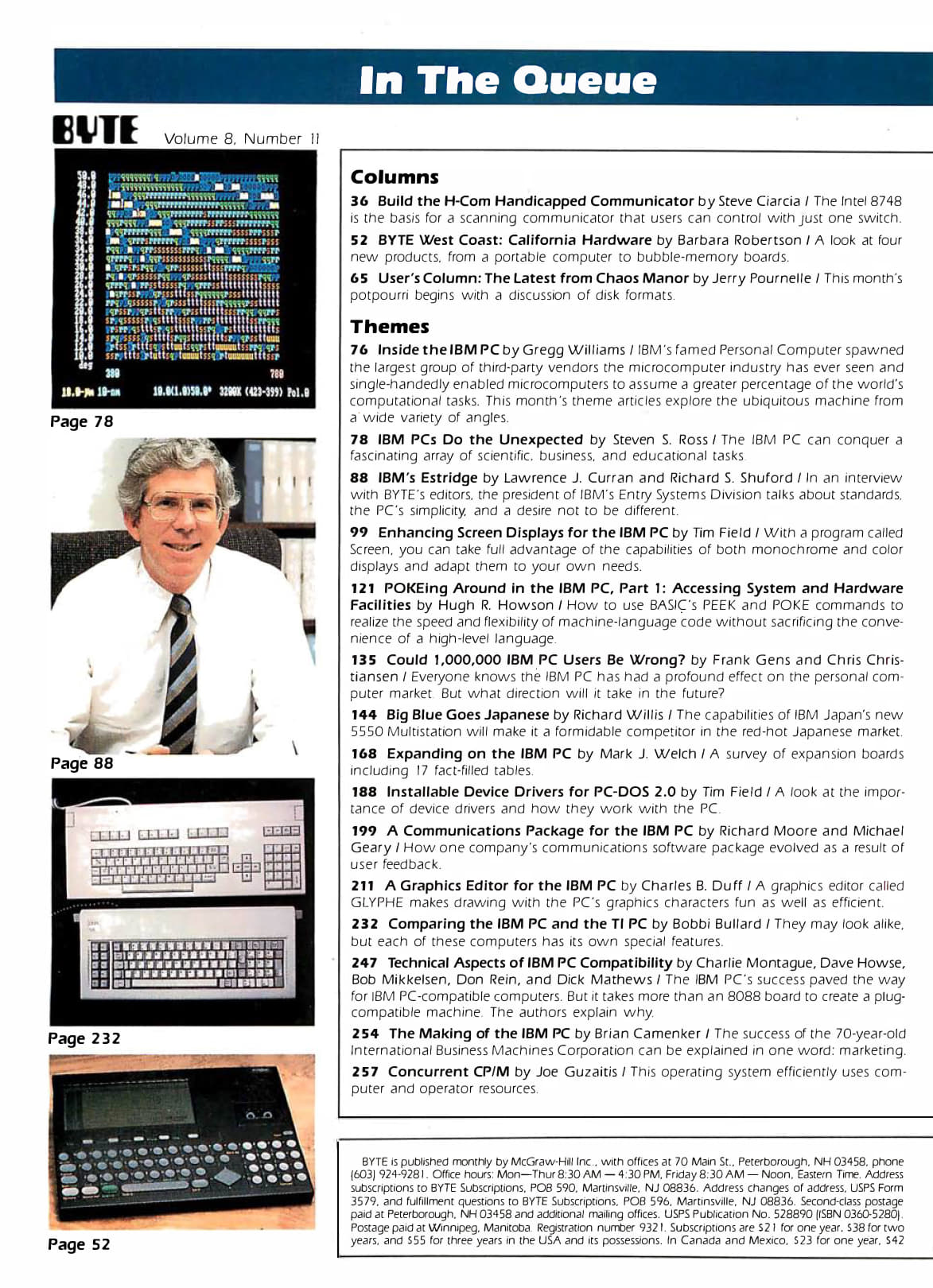
  • Build the H-Com Handicapped Communicator - Details on how to build a scanning communicator designed for those unable to talk. Includes both code and hardware design.

  • BYTE West Coast: California Hardware - A look at new hardware including a portable computer called the Workslate which features a built-in 300bps modem and 16-line x 46 character display, a 128KB bubble memory expansion card for the PC from Intel, another 128KB bubble memory board from Helix, and the Cygnet Communications Cosystem which works with an IBM PC to automatically send and retrieve e-mail, provide automated database access and more.

Themes

  • IBM PCs Do the Unexpected - A look at some of the unique applications for the IBM PC including emulating a Cray-1 to help study how energy is transferred from the sea to the atmosphere, custom medical software developed in COBOL, as an electronic therapist, and more.

  • IBM 's Estridge - An interview with the president of IBM's Entry Systems Division. This was a new division headquartered in Boca Raton, Florida that was responsible for, among other things, the IBM PC.

  • Enhancing Screen Displays for the IBM PC - A type-in program that provides a set of enhancements that makes it easier to configure color and monochrome monitors on the PC to your needs.

  • POKEing Around in the IBM PC, Part 1 : Accessing System and Hardware Facilities - The first in a two-part series about directly accessing memory and hardware via POKE and PEEK commands in BASIC.

  • Could 1,000,000 IBM PC Users Be Wrong? - A look of the future of IBM and the PC (including the upcoming PCjr). At the time, Apple was still leading in shipments of "business-oriented desktop systems costing between $1000 and $10,000" (with Tandy/Radio Shack in 3rd) but the PC was expected to take the lead by the end of the year.

  • Big Blue Goes Japanese - IBM introduces the IBM 5550 or Multistation 5550 in Japan. This is basically an IBM PC for Japan (an other parts of Asia) that was capable of processing Kanji and other complex character sets.

  • Expanding on the IBM PC - A look at some of the expansion boards available for the IBM PC. Included here are CP/M boards, networking, RAM disk, clock, memory expansion, drive controllers, multi interface boards (parallel and serial ports), graphics, print-spooler/buffer boards, speech synthesizers, EPROM programmers, and much more.

  • Installable Device Drivers for PC-DOS 2.0 - Supporting device drivers was a new capability in PC-DOS 2.0 which shipped with the XT.

  • A Communications Package for the IBM PC - A look at how the Transend communications software evolved during design.


Table of Contents from the November 1983 issue of Byte

Reviews

  • The IBM PC XT and DOS 2.0 - A review of the brand new IBM PC XT and DOS 2.00 that shipped with it. Differences between the XT and original PC included a 10 MB hard drive in place of one of the two floppy drives, removal of the cassette port, 128K standard RAM (as opposed to 64K) - expandable up to 256K on the motherboard, eight expansion slots (up from five), standard serial port, and more.

  • The Corona PC - A PC compatible that featured an 8088 CPU @ 5MHz, monochrome monitor, 128KB of RAM and a single floppy drive for $2595. It was also available with two floppy drives ($2995) or with one floppy and a 10Mb hard drive ($4495).

  • A Look at the HP Series 200 Model 16 - Also known as the HP 9816, this machine includes 256K or 512K of RAM, 270KB 3.5" floppy drive, and a 68000 CPU, and BASIC which it was designed to work with though a version of Pascal is also available.

Features

  • Japan and the Fifth Generation - A look at Japan's efforts to develop artificial intelligence. While the topic of AI has become especially hot in recent years, it has long been a goal since the earliest days of the PC or computers in general.

  • Speech Images on the IBM PC - A look at an experimental speech input card that plots the "voice print".

  • Lmodem: A Small Remote-Communication Program - A relatively simple type-in smart-terminal program for CP/M based systems written in BDS C.

  • The Software Tools: Unix Capabilities on Non-Unix Systems - A look at a package that provides many Unix-like tools on a variety of non-Unix systems. These include tools such as diff, ls, ar, sort, find, field, sedit, format, and many others.


Table of Contents from the November 1983 issue of Byte (continued)

Nucleus

  • Editorial: Growth vs. Quality - The struggle to maintain quality and the PC market explodes.

  • MICROBYTES - Brief news bits including: tons of new PC compatibles expected to be shown at COMDEX, new integrated software packages from Ovation and Fox & Geller, $40 Modula-2 compiler available for the IBM PC, CAD software unveiled for the PC XT, new proposed ST412HP SCSI interface standard for hard disks, and more.

  • Letters - Letters from readers about prodcut descriptions provided by manufacturers, the Lisa computer, public domain software, the 8086 and backwards compatibility, and more.

  • Programming Quickies - Short programs including a program to pass/merge and scan a command line in CP/M, fast loading files from disk with Apple DOS 3.3, implementing subscripts and superscripts on the Atari 400/800, adding array capabilities to dBASE II, and more.
  • Technical Forums - Type-in programs for creating simple contour plots, performing an address calculation sort, and more.


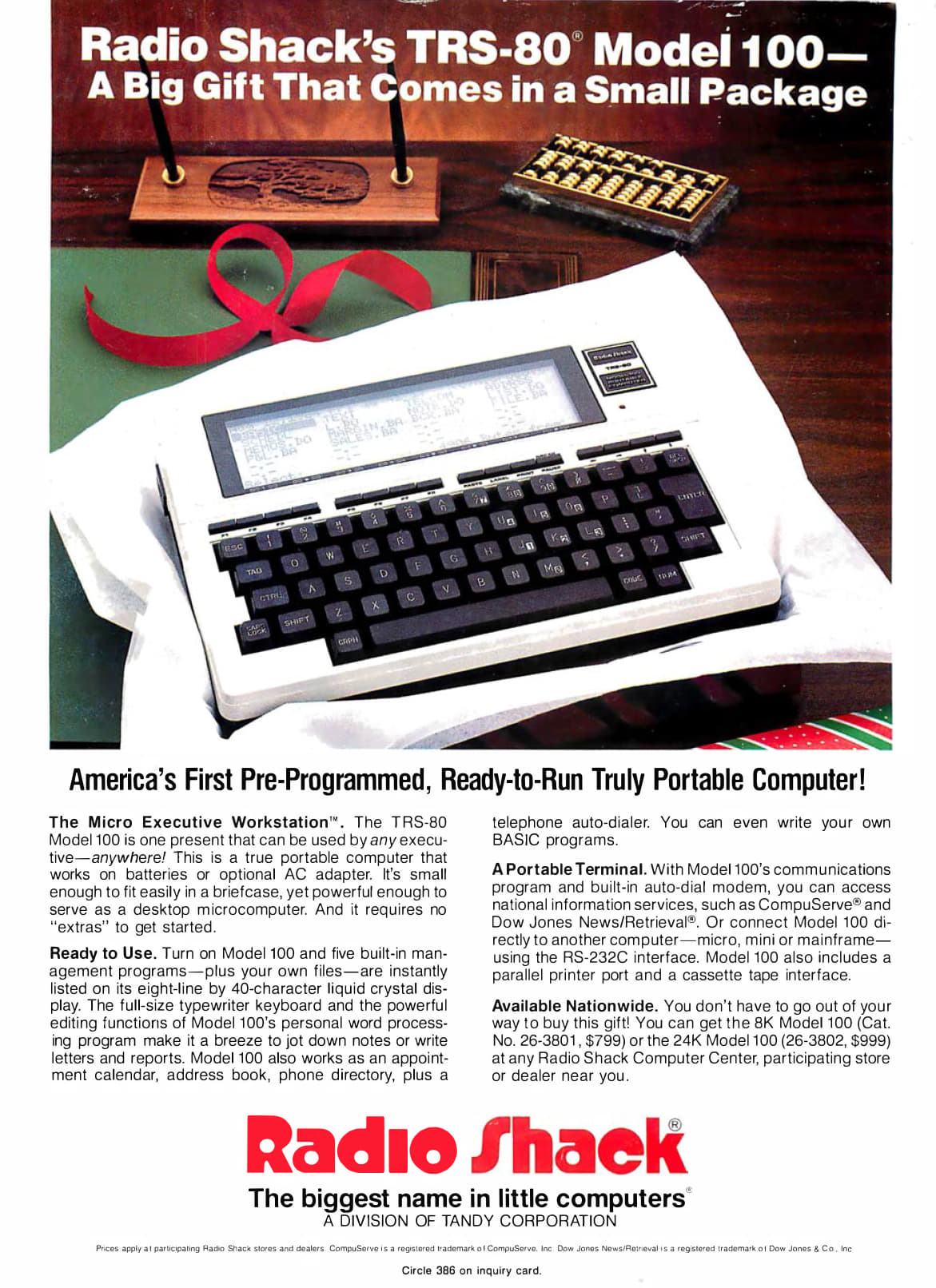
Back cover of the November 1983 issue of Byte

Read more: https://www.megalextoria.com/wordpress/index.php/2024/04/04/byte-november-1983/