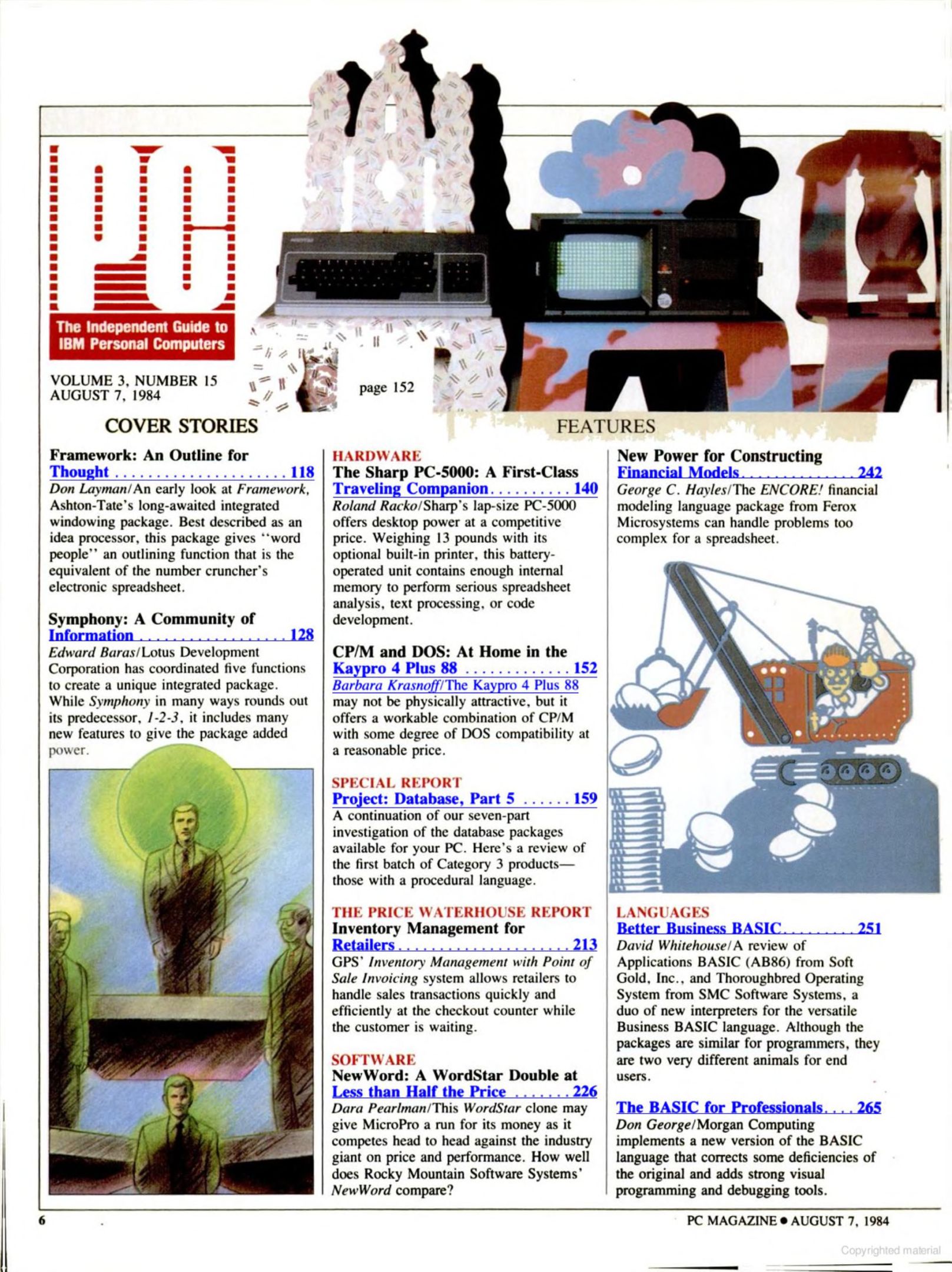
Framework: An Outline for Thought - A windowing software package that provides outlining functions.
Symphony: A Community of Information - An integrated software package from Lotus that provides spreadsheet, telecommunications, word processing and more.
Features
The Sharp PC-5000 - A "lap-size" portable computer. For about $2000 you get a DOS compatible machine with 128KB of RAM and an 8-line 80-column display. Options include 3.5" disk drives, 5.25" disk drives, built-in printer, 128K bubble memory cartridge, 64K RAM cartridges and more.
CP/M and DOS: At Home in the Kaypro 4 Plus 88 - Kaypro's latest portable Z-80 based computer. This one featured a co-processor board with an additional 256K that could be used to run DOS programs. All for $2500.
Project: Database, Part 5 - The 5th in a seven part series on database packages. This part covers Formula II, Manager Version 4.0, Dataease, The Sensible Solution, probase, Metafile Version 7.0, and Pro-Matic.
Inventory Management for Retailers - A look at GPS's Inventory Management with Point of sale Invoicing system.
NewWord: A WordStar Double at Less than Half the Price - NewWord is a word processor that basically functioned as a WordStar clone. It's big advantage was price at "only" $249.
Table of Contents from the August 7th, 1984 issue of PC Magazine
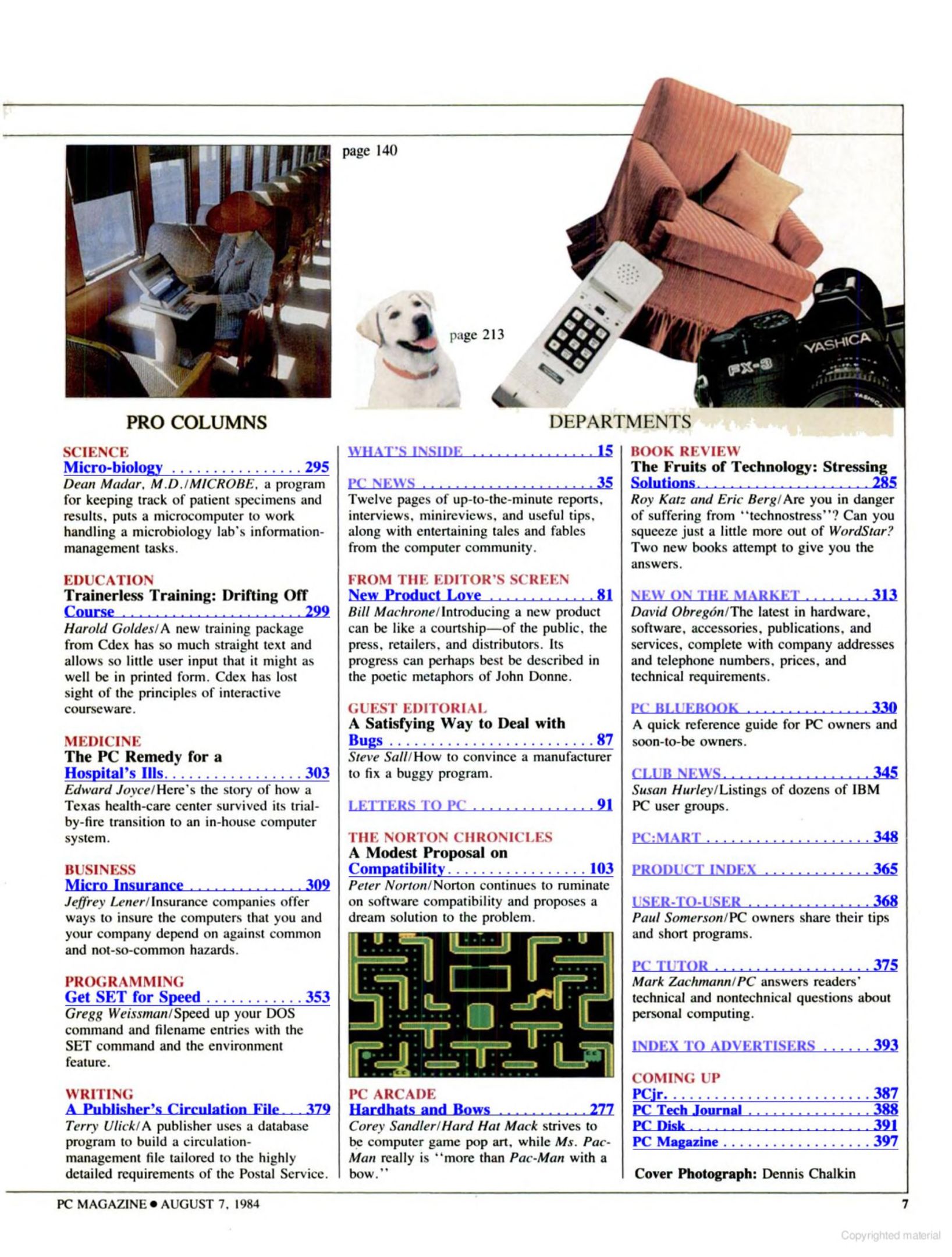
Pro Columns
Micro-Biology - A programs that functions as a database designed to keep track of patient specimens and results.
Trainerless Training: Drifting Off Course - A interactive PC training course from Cdex that isn't very interactive.
The PC Remedy for a Hospital's Ills - A case study of a Texas health-care center transitioned to an in-house computer system.
Micro Insurance - A look at various types of computer insurance that are available.
Table of Contents from the August 7th, 1984 issue of PC Magazine (continued)
Departments
PC News - Compaq's new PC compatible machine, IBM cuts prices, Canon introduces PC compatible machine, Atari discusses 1090XL expansion system, and much more.
A Satisfying Way to Deal with Bugs - Convincing manufacturers to fix buggy programs.
A Modest Proposal on Compatibility - Using an install program and customized screen drivers to improve software compatibility.
PC Arcade: Hardhats and Bows - Reviews of Hard Hat Mack and Ms. Pac-Man.
Back cover of the August 7th, 1984 issue of PC Magazine
Tears welled in the eyes of Linzi Smith as she explained, her voice shaking, why she can no longer attend Premier League soccer games at the stadium 10 minutes from her home to root for Newcastle United.
“I struggle to even come near the ground,” Smith told Toby Young of the Free Speech Union in a recent interview. “I get upset when I talk about it. I just don’t understand where it’s come from. I don’t know why someone’s gotten so offended by me just speaking my mind.”
Smith, a 34-year-old woman from Newcastle and a lifelong soccer fan, said she received an email from team security in November that her membership was suspended pending an investigation for an alleged hate crime. The investigation stemmed from tweets Smith had posted on X that she was told “could be seen as transphobic.”
Smith, who is gay and helps her mother run a tea shop to pay the bills, assumed the matter would soon be cleared up since she had not engaged in anything she considered “hate speech.”
She assumed wrongly. For tweets stating that transgender women are not really women, Smith was banned for the remainder of the season and the following two, a decision she described as “devastating.”
“I avoid the city now, especially if it’s match day,” she told Young. “I won’t even come down here and drink … every time I’m around here now, I’m just sick to my stomach, and I’m afraid of who’s around and who’s watching me.”
The fear Smith describes is understandable. Her life was upturned by social media comments. She was investigated and summarily found guilty (without being able to defend herself) by a soccer league.
The idea that the Premier League is monitoring the social media posts of fans in search of “wrongthink” and launching independent investigations is startling, and it led some to brand the league’s intelligence unit “the Stasi spy agency.”
“As a historian of the Gulag and the Soviet secret police, this is one of the most chilling things I could ever have imagined seeing in the U.K.,” Giles Udny, an English writer, said of Smith’s case. “No exaggeration — it is straight out of the NKVD/KGB/FSB playbook.”
Just how many fans have been similarly targeted is unclear, though the Free Speech Union told MailOnline it is likely “hundreds of fans, possibly thousands.”
And though comparisons to the Stasi and NKVD are imperfect — both organizations were formal police units operated by socialist states — there’s no question that the word chilling is appropriate.
In the United States, free expression is a right codified in the First Amendment of the Constitution, which states that “Congress shall make no law … abridging the freedom of speech.” But it’s a value that existed well before the legal document was ratified and represents the foundation of a moral and tolerant people.
“Laws alone cannot secure freedom of expression,” Albert Einstein observed in Ideas and Opinions. “In order that every man may present his views without penalty, there must be a spirit of tolerance in the entire population.”
The effort to classify political dissent as “hate speech” and punish heretics for their supposed crimes is one of the most pernicious threats at work in the world today. It is a force rooted in dogmatism, not truth, and a thirst for control over others.
Historically, efforts to control speech have been employed by those with power to cement their own control. Those with power tend to be those in government and those closest to it, and it is they (and their supporters) who get to decide what speech qualifies as “hate” and “misinformation.”
The view that dangerous, hateful, or fascist speech should be disallowed — No Free Speech for Fascists, the title of a 2021 book declares — is itself a deeply fascistic view. This is evidenced in no small part by the fact that the most notable fascist states of the 20th century despised free expression and free speech, which undermined their stated and actual goals (unity and control, respectively).
The fact that many governments, including the United States, are now outsourcing their policing of language to private companies and institutions that share their views on what constitutes “hate speech” and “misinformation” is not a sign of progress. It’s but a pivot by authoritarians in their effort to control what is seen as true and false.
“The really frightening thing about totalitarianism is not that it commits ‘atrocities’ but that it attacks the concept of objective truth,” George Orwell once observed.
Few could agree with this statement more than Linzi Smith, who is now banned from cheering for Newcastle United at St James’ Park after expressing her opinion that a biological man is not a woman.
On Wednesday news broke that the Department of Homeland Security (DHS)—a department that didn’t exist 20 years ago but today spends $52 billion annually—had created a new “Disinformation Governance Board.”
The news comes just days after Twitter accepted Tesla-founder Elon Musk’s offer to buy Twitter for $44 billion, a move that critics of the deal claimed could unleash disinformation. (Musk has been vocal in his support for free speech.)
DHS declined to be interviewed by the Associated Press, but issued a statement after news broke of the development.
“The spread of disinformation can affect border security, Americans’ safety during disasters, and public trust in our democratic institutions,” DHS said.
A Ministry of Truth?
Perhaps naturally, the revelation that the government had created a new board to fight “disinformation” prompted a slew of Nineteen Eighty-Four comparisons, especially since it came so soon after Musk’s purchase of Twitter.
“Elon Musk buys Twitter to save free speech and days later President Biden announces a Ministry of Truth,” one observer quipped. “It's like we're living through an Ayn Rand/George Orwell novel mash-up.”
For those unfamiliar with George Orwell’s masterpiece, the Ministry of Truth is the propaganda and censorship department of Oceania, the fictional setting for Orwell’s dystopia.
Known as Minitrue in Newspeak, the name Ministry of Truth is a misnomer. Like all the departments in 1984, the name reflects the opposite of what the government actually does.
The book’s protagonist, Winston Smith, learns this in the second half of Nineteen Eighty-Four.
Even the names of the four Ministries by which we are governed exhibit a sort of impudence in their deliberate reversal of the facts. The Ministry of Peace concerns itself with war, the Ministry of Truth with lies, the Ministry of Love with torture and the Ministry of Plenty with starvation. These contradictions are not accidental, nor do they result from ordinary hypocrisy; they are deliberate exercises in doublethink. For it is only by reconciling contradictions that power can be retained indefinitely.
Smith, who works at the Ministry of Truth, realizes the Ministry of Truth is not the least bit interested in truth. Its use of propaganda is overt, as is its use of banal slogans designed to confuse and humiliate the people of Oceania.
On the exterior of the Ministry of Truth building are three party slogans: "WAR IS PEACE," "FREEDOM IS SLAVERY," and "IGNORANCE IS STRENGTH." Inside the structure, problematic documents are incinerated, dropped down a Memory Hole where they are conveniently forgotten.
1984: ‘Based Chiefly on Communism’
One might be tempted to laugh off comparisons between a “Disinformation Governance Board” and the propaganda department in Orwell’s classic work. After all, we’re talking about a novel.
This would be mistaken, however.
For starters, Nineteen Eighty-Four is indeed a fictional work. But it was inspired by the authoritarian regimes and ideologies Orwell witnessed firsthand. A one-time socialist who observed the fighting in the Spanish Civil War—a conflict between fascists and communists—Orwell became a budding libertarian who became disillusioned with collectivism.
In fact, Orwell makes it clear that Nineteen Eighty-Four was inspired by communism.
“[Nineteen Eighty-Four] was based chiefly on communism, because that is the dominant form of totalitarianism,” he told Sidney Sheldon, who purchased the stage rights to the book; “but I was trying chiefly to imagine what communism would be like if it were firmly rooted in the English speaking countries, and was no longer a mere extension of the Russian Foreign Office.”
Stalin’s regime was not the only totalitarian regime to utilize propaganda and censorship, of course. Joseph Goebbels, the chief propagandist for the Nazi Party, is perhaps the single most infamous wielder of propaganda in human history. And of course the Nazis were infamous for their book burning.
The Chinese Communist Party uses propaganda and censorship to such great effect today that scholars say it’s difficult to even know what’s actually happened in the country over the last century.
“At a time when censorship is a part of everyday experience of the Chinese people, even few historians actually know all the history of the party,” historian Sun Peidong recently toldThe Guardian. “It’s hard to get hold of party history materials as a history researcher nowadays. It’s even harder to know what the past 100 years has really been about.”
This is why Americans should be concerned that the US government—nearly two and a half centuries after it was founded—is suddenly in the business of rooting out “disinformation.”
Humans will always disagree over what is true. Descartes’ first principle—”cogito, ergo sum” posited that the only thing we can know with total certainty is "I think, therefore I am."
It doesn’t take a philosopher to see that a lot of stuff one finds online is drek, so it shouldn’t surprise us that “misinformation”—in various forms and to various degrees—is rampant online.
But history shows that no one wields misinformation and propaganda with greater effectiveness—or at greatest cost—than government.
Orwell understood this. Americans would do well to heed his warning.
Jonathan Miltimore is the Managing Editor of FEE.org. His writing/reporting has been the subject of articles in TIME magazine, The Wall Street Journal, CNN, Forbes, Fox News, and the Star Tribune.
Bylines: Newsweek, The Washington Times, MSN.com, The Washington Examiner, The Daily Caller, The Federalist, the Epoch Times.
This article was originally published on FEE.org. Read the original article.
Government Surveillance and Academic Thought Policing Are Taking Us to 1984
There are some books you should read only once, and others you should reread occasionally. George Orwell’s 1984 is one you should read repeatedly and deeply. Without it, no education is complete.
It tells the story of a man, Winston, grappling with ordinary desires for love and privacy – but in a totalitarian socialist world in which every word and even desire is subject to control and punishment by “the Party.”
1984 teaches timeless truths and shows its characters grappling with questions that do not have easy answers. The dystopia Orwell presents emerged out of the soil of a society in which little by little, inch by inch, thought by thought, and idea by idea, people forsook their liberty, their dignity, and their humanity.
Parallels between the world of Orwell’s 1984 and our own are increasingly obvious – and troubling.
Surveillance and Thought Policing
For one thing, we live in an ever-growing “anti-terror” surveillance state, and one that is encouraged, if not openly embraced, by fearful people who are, if I may be blunt, really bad at math and really lacking in perspective. Every death is a tragedy, but terrorism is far down on any list of mortality risks – and it always has been. And there is little evidence that all the surveillance and security programs added since 9/11 have caught or prevented terrorists in any significant number.
For another thing, on college campuses across the country, we are seeing disinvitations of controversial speakers, demands for “safe spaces,” and shout-downs of ideas deemed heretical – proof that the open and rigorous exchange of ideas does not come easily and must be defended.
In their Atlantic cover story, “The Coddling of the American Mind,” Greg Lukianoff and Jonathan Haidt explain and explore how higher education is fast becoming a place where students expect not to be faced with or to contend with controversial ideas but to be protected from them.
Commentators such as American Enterprise Institute scholar Christina Hoff Summers have drawn unflattering comparisons between Orwell’s Junior Anti-Sex League and those controlling campus discussions today. The subtle change from “these ideas are incorrect as matters of logic and evidence” to “it is immoral to even subject these ideas to rigorous inquiry” threatens to subject the liberal arts and sciences to a thought police.
Obedience Only
The way the characters in 1984 are “conditioned” once their subversive activities are found out turns this novel from interesting dystopian fiction to an absolutely terrifying classic. Mere obedience is not enough for the Party officials. They can only be satisfied, if that’s the right word, once they completely occupy the thoughts and wants of their subjects.
An obedient objector is still a potentially dangerous revolutionary. Dissent – anything other than wholehearted, brainwashed obedience – is intolerable. The humanity of Winston is completely abolished, and in a fate worse than death, his resistance is crushed and he comes to love Big Brother.
On this, the 68th anniversary of 1984’s publication, it is perhaps worthwhile to take a few minutes and consider whether we have unconsciously adopted the three slogans of the Party – War Is Peace, Freedom Is Slavery, Ignorance Is Strength. In our unthinking rush for “safety” of all kinds, I’m afraid that in some ways, we have.
Art Carden is an Associate Professor of Economics at Samford University’s Brock School of Business. In addition, he is a Senior Research Fellow with the Institute for Faith, Work, and Economics, a Senior Fellow with the Beacon Center of Tennessee, and a Research Fellow with the Independent Institute. He is a member of the FEE Faculty Network. Visit his website.
This article was originally published on FEE.org. Read the original article.
New surveillance powers will be given to the police and security services, allowing them to access records tracking every UK citizen’s use of the internet without any need for any judicial check, under the provisions of the draft investigatory powers bill unveiled by Theresa May.
It includes new powers requiring internet and phone companies to keep “internet connection records” – tracking every website visited but not every page – for a maximum of 12 months but will not require a warrant for the police, security services or other bodies to access the data. Local authorities will be banned from accessing internet records.
The proposed legislation will also introduce a “double-lock” on the ministerial approval of interception warrants with a new panel of seven judicial commissioners – probably retired judges – given a veto before they can come into force.
But the details of the bill make clear that this new safeguard for the most intrusive powers to spy on the content of people’s conversations and messages will not apply in “urgent cases” – defined as up to five days – where judicial approval is not possible.
The draft investigatory powers bill published on Wednesday by the home secretary aims to provide a “comprehensive and comprehensible” overhaul of Britain’s fragmented surveillance laws. It comes two-and-a-half years after the disclosures by the whistleblower Edward Snowden of the scale of secret mass surveillance of the global traffic in confidential personal data carried out by Britain’s GCHQ and the US’s National Security Agency (NSA).
It will replace the current system of three separate commissioners with a senior judge as a single investigatory powers commissioner.
May told MPs that the introduction of the most controversial power – the storage of everyone’s internet connection records tracking the websites they have visited, which is banned as too intrusive in the US and every European country including Britain – was “simply the modern equivalent of an itemised phone bill”.
Nineteen Eighty-Four revealed George Orwell as one of the twentieth century’s greatest mythmakers. While the totalitarian system that provoked him into writing it has since passed into oblivion, his harrowing cautionary tale of a man trapped in a political nightmare has had the opposite fate: its relevance and power to disturb our complacency seem to grow decade by decade. In Winston Smith’s desperate struggle to free himself from an all-encompassing, malevolent state, Orwell zeroed in on tendencies apparent in every modern society, and made vivid the universal predicament of the individual.
Ordinary Internet users, American and non-American alike, far outnumber legally targeted foreigners in the communications intercepted by the National Security Agency from U.S. digital networks, according to a four-month investigation by The Washington Post.
Nine of 10 account holders found in a large cache of intercepted conversations, which former NSA contractor Edward Snowden provided in full to The Post, were not the intended surveillance targets but were caught in a net the agency had cast for somebody else.
Many of them were Americans. Nearly half of the surveillance files, a strikingly high proportion, contained names, e-mail addresses or other details that the NSA marked as belonging to U.S. citizens or residents. NSA analysts masked, or “minimized,” more than 65,000 such references to protect Americans’ privacy, but The Post found nearly 900 additional e-mail addresses, unmasked in the files, that could be strongly linked to U.S. citizens or U.S.residents.
The surveillance files highlight a policy dilemma that has been aired only abstractly in public. There are discoveries of considerable intelligence value in the intercepted messages — and collateral harm to privacy on a scale that the Obama administration has not been willing to address.
You may soon get a call from your doctor if you’ve let your gym membership lapse, made a habit of picking up candy bars at the check-out counter or begin shopping at plus-sized stores.
That’s because some hospitals are starting to use detailed consumer data to create profiles on current and potential patients to identify those most likely to get sick, so the hospitals can intervene before they do.
Information compiled by data brokers from public records and credit card transactions can reveal where a person shops, the food they buy, and whether they smoke. The largest hospital chain in the Carolinas is plugging data for 2 million people into algorithms designed to identify high-risk patients, while Pennsylvania’s biggest system uses household and demographic data. Patients and their advocates, meanwhile, say they’re concerned that big data’s expansion into medical care will hurt the doctor-patient relationship and threaten privacy.
Darpa wants to deploy this software initially in airports and bus stations, and if the pilot program is successful, the software could be installed at every red light, street corner, and public place in America. It could also capture feeds from video conferencing systems, video emails, and other forms of streaming media.