Compute! was one of the earliest and longest running multi-format computer magazines published in the U.S. In the early days, it covered the Atari 400/800, Apple II and Commodore PET as well as various kit computers. The May 1981 issue includes:
The Editor's Notes - A look at some of the things seen at the West Coast Computer Faire, including the Votrax Type-'N-Talk text to speech synthesizer, the Commodore Super-PET, A 256K memory expansion from Axlon for the Atari 800, and more.
The Readers' Feedback - Praise for the magazine, small business programs for the Atari, improving magazine distribution, and more.
Computers and Society - Addressing computer phobia.
Computer Aided Instruction, Boon or Bust? - Analyzing the effects of computers in the classroom. Still a novel idea at the time.
They Mysterious and Unpredictable RND - The last part in a series on random numbers. This part presents solutions for finding maximum and minimum numbers in a sample of random numbers, simulating dice rolls and a number of other exercises.
Land of the Lost - A Program For a Cassette Filing System - A type-in menu-driven program to create labels for cassettes (the dominant home computer storage medium of the time).
Table of Contents from the May 1981 issue of Compute!
The Apple Gazette
Using Named GOSUB and GOTO Statements in Applesoft BASIC - A simple way to create named subroutines vs. just using line numbers.
Commas, Colons, and Quote Marks Too - Writing BASIC programs that can accept commas, colons and quotation marks as part of their input.
The Atari Gazette
A Cure for Atari BASIC or, Make Your Atari a Bit Wiser - An assembly language program that adds the ability to do bitwise operations in Atari BASIC.
Copy Your Atari Screen to Your Printer - A short BASIC program that will dump the contents of the screen to a printer.
Hardware Information at Last! - Three new Atari technical manuals, including Atari 400/800 Technical User Notes, Atari 400/800 Operating System, and Atari 400/800 Disk Operating System.
Using Strings for Graphics Storage - A method for using BASIC strings to create graphics on the Atari.
Atari Machine I/O - Three machine language routines for processing input.
The OSI Gazette
Through the Fill-The-Buffer Routine with Gun and Camera - Some technical info on how the "Fill-the-Buffer" routine (FTB) of OS BASIC works.
FOOTU: FOO Revisited - Converting FOO (a racing game for the OSI) to run on OSI systems with BASIC-in-ROM.
The PET Gazette
A Fast Visible Memory Dump - A program for creating a graphical memory dump to a printer.
Machine Language: Getting to the Machine Language Program - Methods for combining BASIC programs with machine language routines.
A Thirteen Line BASIC Delete - A short BASIC program that allows you to delete any group of lines form an existing program.
Calculated Bar-graph Routines on the Pet - How to calculate the length of bars in a bar graph so that they can be properly printed.
The Revised Pet/CBM Personal Computer Guide - A look at the changes in the newest revision of the Osborne/McGraw-Hill Pet/CBM Personal Computer Guide.
The SBC Gazette
Nuts and Volts - Information about building your own microcontrollers.
A Kim-1 Music File in Microsoft Basic: Part 1
New Products - Atari sponsors contest for new software; the BYTEWRITER-1 dot matrix printer from Microtek; Hayes releases the Smartmodem, a 300 baud modem that set the standard for years to come for $279; and more.
Ashley N’Dakpri runs Afro Touch, a hair-braiding salon in Louisiana. She wants to hire more stylists to meet demand, but Louisiana’s strict occupational licensing regulations prevent her from doing so.
Ashley legally isn’t allowed to hire new stylists unless they have a cosmetologist’s license, a certification that requires five hundred hours of training and thousands of dollars in fees to obtain. She notes that many potential employees are no longer interested in working for her once they discover the onerous occupational licensing requirements.
State-level occupational licenses are a major barrier to minority entrepreneurship. These licenses prevent many minorities from starting their own businesses in fields across the economic spectrum.
The beauty industry is perhaps the most egregious example of a field whose occupational licensing requirements prevent minority entrepreneurship, but these licenses are also found in many other industries popular with minority entrepreneurs, including construction, childcare, and pest control.
Cosmetology licenses are often far more difficult to get than licenses for professions that deal with life and death. In Massachusetts, for instance, cosmetologists must complete one thousand hours of coursework and two years of apprenticeship before they are allowed to ply their trade in the beauty industry. Emergency medical technicians, by contrast, must only take 150 hours of courses to be allowed to work.
What are these occupational licenses protecting consumers from? A bad hair day? These permits present an enormous entrepreneurial barrier to mostly minority women. According to a study by the Institute of Justice, Louisiana has just thirty-two licensed African hair braiders. In stark contrast, neighboring Mississippi, which has approximately four hundred thousand fewer black residents but doesn’t regulate hair braiding, has 1,200.
California is the worst occupational licensing offender, according to IJ, putting up “a nearly impenetrable thicket of bureaucracy.” Basic trades such as door repair, carpentry, and landscaping require potential entrepreneurs to devote 1,460 days to supervised practice and spend up to thousands of dollars for a license before they can legally work.
Nearly one-quarter of American workers hold a license, according to the Labor Department, up from about 5 percent in the 1950s. Unsurprisingly, a Federal Reserve Bank of Minnesota report concluded that minorities are significantly less likely to hold a license than whites.
Research by economist Stephen Slivinski indicates that licensing requirements reduce minority entrepreneurship. He finds that states that require more occupational licenses have lower rates of low-income entrepreneurship.
It’s already difficult enough for minority entrepreneurs to find a product that fills a gap in the market and outcompete established players without simultaneously worrying about the government hamstringing them through bad policies like excessive occupational licensing.
With fewer government hurdles, minority entrepreneurs can more readily overcome racial economic gaps through their own inspiration and ingenuity.
I had the opportunity to pick up a huge batch of slides a while back. These pictures span from as early as the late 1940s to as late as the early 1990s. These came to me second hand but the original source was a combination of estate sales and Goodwill. There are many thousands of these slides. I will be scanning some from time to time and posting them here for posterity.
Getting your pictures processed as slides used to be a fairly common thing but it was a phenomenon I missed out on. However, my Grandfather had a few dozen slides from the late 1950s that I acquired after he died. That along with having some negatives I wanted to scan is what prompted me to buy a somewhat decent flatbed scanner that could handle slides and negatives, an Epson V600. It can scan up to four slides at a time with various post-processing options and does a decent enough job.
This set continues a rather large batch of slides that originally came from an estate sale and appear to have belonged to a locally well known photographer (or perhaps a friend or family member) from the Spokane Washington area and later Northern Idaho named Leo Oestreicher. He was known for his portrait and landscape photography and especially for post cards. His career started in the 1930s and he died in 1990. These slides contain a lot of landscape and portrait photos but also a lot of photos from day to day life and various vacations around the world. Here's an article on him from 1997 which is the only info I have found on him: http://www.spokesman.com/stories/1997/jan/04/photos-of-a-lifetime-museum-acquisition-of-leo/
Many of these slides had the date they were processed stamped or printed on them. I've found that in cases where I could verify the date, either because a more specific date was hand written or there was something to specifically date the photo in the photo itself, that this date has typically been the same month the photos were taken. In other words, I expect that in MOST cases these photos were taken relatively near the processing date.
Click the link below to also see versions processed with color restoration and Digital ICE which is a hardware based dust and scratch remover, a feature of the Epson V600 scanner I am using. There are also versions processed with the simpler dust removal option along with color restoration.
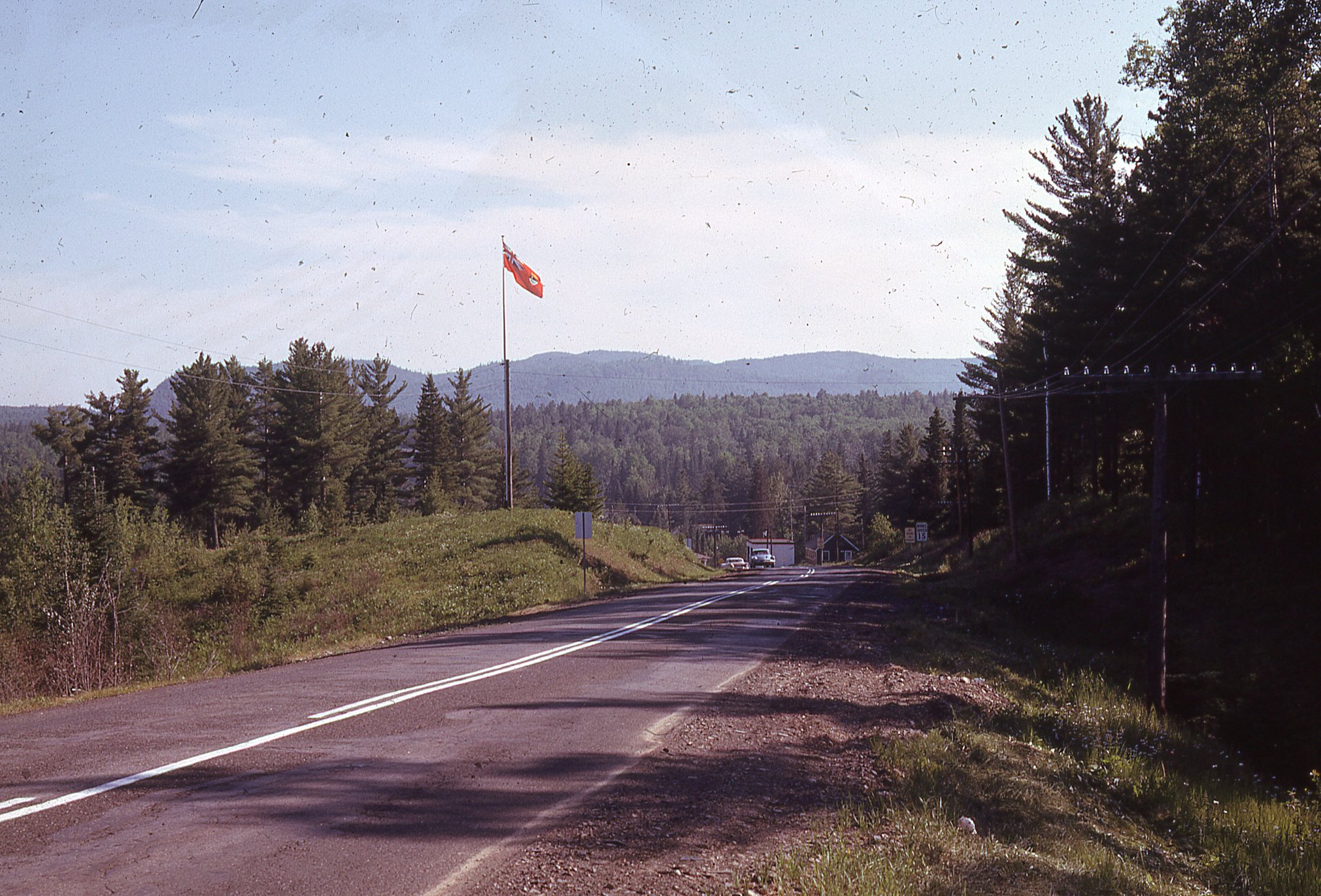
The first shot in this set is unlabeled and undated but was probably taken in the early 1960s. It was obviously taken at a beach and it looks like a Florida East coast beach to me but it could be from somewhere else. The second and third photos were processed in October 1962 and appear to be of some kind of party or perhaps a church youth group gathering. The last photo was processed in July 1961. The flag in the background appears to be the Canadian Red Ensign which was the official Canadian flag before the current maple leaf design was adopted in 1965. It looks like this could be at a border crossing.
Processed October 1962
Processed October 1962
Processed July 1961
The entire collection that has been scanned and uploaded so far can also be found here.
Americans are facing 40-year high inflation and there’s been no shortage of discussion on the topic. It’s the number one issue on the mind of Americans heading into midterms, and every day on TV and in newspapers pundits are debating how long it will last and deciding who is to blame.
What’s most astonishing amid the flurry of news is just how badly the commentary misses. While there is broad agreement that the US is experiencing dangerously high inflation, partisanship and ideology have polluted basic economics.
Progressive politicians like Robert Reich and Sen. Elizabeth Warren tweet incessantly that “corporate greed” is to blame, an idea even Democratic economists have summarily dismissed. President Joe Biden, meanwhile, has blamed Vladmir Putin. Republicans, on the other hand, have consistently made the case that Joe Biden is the inflation culprit.
All of these explanations are entirely or mostly wrong.
While it’s true that Putin and Biden deserve some blame—particularly in terms of high energy prices—there seems to be an unspoken bipartisan consensus to ignore the elephant in the room: the Federal Reserve’s unprecedented money printing.
One person not playing the game is Kevin O’Leary, the Canadian entrepreneur and investor who regularly appears on ABC’s Shark Tank. While speaking to journalist Daniela Cambone, O’Leary bluntly explained why Americans are experiencing the highest inflation in generations.
“The printing presses have gone insane,” O’Leary said. “That’s why we have inflation in the first place.”
By printing presses, O’Leary is talking about the Federal Reserve. The central bank has been expanding the supply of money for decades, and the clip has picked up in recent years. Nothing, however, has compared to the monetary expansion that occurred during the pandemic, something Fed Chairman Jerome Powell recently admitted in a 60 Minutes interview with Scott Pelley.
"You flooded the system with money," the CBS journalist said.
"Yes, we did," Powell responded.
This is what O’Leary is getting at. “Flooding the system with money” is what drove inflation to historic highs, and the result was always an obvious one.
“For all the talk of inflation, you print $6.72 trillion in thirty months, what the hell did you think was going to happen?” O’Leary says. “Of course there’s going to be inflation.”
O’Leary’s figures are not wrong. Federal Reserve data show that in August 2019 there was $14.9 trillion total in circulation. By January 2022, there was $21.6 trillion.
In other words, more than 30 percent of dollars in circulation in January 2022 had been created in the previous 30 months.
What Is Inflation?
Money creation is the obvious driver of price inflation, a concept that most Americans have at least a vague understanding of because we see it all around us today. Prices are up for almost everything, and up a lot.
But are higher prices alone evidence of inflation? Prices are always changing, after all. Sometimes they go up and sometimes they fall; oftentimes it has nothing to do with money printing, but is simply a reflection of changes in supply and demand.
This is what makes inflation challenging to define, and in fact there are two definitions for it.
For centuries, inflation was defined essentially as an increase in the money supply. Basic economics holds that if you expand the money supply without expanding goods and services, prices will rise. So that was the definition of inflation: an increase in the supply of money.
Economists in the twentieth century added a second definition, however, calling inflation “a general and sustained increase in prices.” We can see from this definition that what separates inflation from simple price increases is that they are broad and sustained.
Some economists prefer the older definition of inflation, and Henry Hazlitt, author of Economics in One Lesson, can help us see why.
“Inflation is an increase in the quantity of money and credit. Its chief consequence is soaring prices,” Hazlitt explained. “Therefore inflation—if we misuse the term to mean the rising prices themselves—is caused solely by printing more money. For this the government’s monetary policies are entirely responsible.”
Hazlitt argues that rising prices are the consequence of inflation, which is an increase in the money supply. This is why some economists don’t like the new definition of inflation.
It’s not difficult to see why some economists see the traditional definition of inflation as superior. It gets right to the cause of price increases (an expansion of the money supply), while the new definition focuses on a symptom of inflation (“a general and sustained increase in prices”).
This second definition is far less clear, which might be precisely why some people like it.
Nobody wants to be blamed for inflation, after all, and under the first definition blame will always return to one spot: the people who control the money supply, and to a lesser extent the politicians, big banks, and bureaucrats who support the Fed and directly benefit from its largesse.
That’s a lot of pressure for central bankers and politicians. It’s far easier to say Vladmir Putin is primarily responsible for high prices, or the ”greedy corporations,” or Joe Biden’s Build Back Better policies.
Inflation: A Silent Killer
Now, some will tell you that if you’re under 60 this is probably the first time you’ve experienced inflation, but this is not true. Usually inflation is just small enough that people don’t notice it as much.
For example, government data show a dollar printed in 1990 had already lost 50 percent of its purchasing power by 2021. This is why inflation is often called a “silent killer.”
Yet history shows inflation often does not remain silent. It persists and grows, and over time it becomes a destroyer of civilizations.
“I do not think it is an exaggeration to say history is largely a history of inflation, usually inflations engineered by governments for the gain of governments,” the Nobel Prize-winning economist F.A. Hayek once observed.
This is why Hayek believed the only way to have sound money was to take control of it out of the hands of central bankers and planners.
“I don't believe we shall ever have a good money again before we take the thing out of the hands of government,” Hayek said.
This is precisely why there has been such enthusiasm around decentralized currencies like Bitcoin and Ethereum.
Whether cryptocurrencies can supplant the dollar remains to be seen, but one thing is clear: the primary cause of inflation is not a boogeyman. It’s not a Russian dictator, corporate greed, or bad legislation. 1
The primary cause of inflation is the printing presses, exactly like Kevin O’Leary says.