steem

Showing posts with label Atari 8-bit. Show all posts

Saturday, May 2, 2026

Dig Dug (1982)

Dig Dug (1982)

Dig Dug is an arcade game that was released by Namco in 1982. It was one of the immensely popular games during the golden age of arcade gaming. It was originally described as a "strategic digging game" and was pretty unique for the time and remains so today.

Arcade

As the title character, you spend your time digging through the earth in order to defeat various enemies. This can be done in one of two ways. First, you can inflate them with a bike pump. It works as a sort of spear gun so this attack has a short range. Once impaled, You can inflate them until they explode or if left partially inflated (perhaps because you had to flee from another enemy) they will float harmlessly for a brief time. You can't move around during the inflation process so sometimes you have to cut and run. The other way you can kill enemies is by digging under a rock which would cause it to fall on any enemy following you. The longer a round lasts, the faster the enemies will move. Enemy speed also increases (as do the number of enemies) as the levels increase.

Atari 2600

Dig Dug was hugely popular and has seen literally dozens of ports over the years. Initial ports included early video game systems like the Atari 2600 Intellivision as well as 8-bit computers like the Commodore 64 and Apple II. However, every generation of video games systems has seen a re-release of some kind of this game.

Commodore 64

More recent releases of Dig Dug, which are mostly emulations or near arcade perfect ports with added features, include Namco Museum Vol 3 (1996 for the PlayStation), Namco Museum / Namco Museum 64 (1999 for the Nintendo 64, Dreamcast and Game Boy Advance), Namco Museum 50th Anniversary (2005 for the GameCube, PlayStation 2 and Xbox), Namco Museum Remix (2007 for the Nintendo Wii), Namco Museum Essentials (2009 for the PlayStation 3) and Namco Museum Switch (2017 for the Nintendo Switch), and as a bonus in Pac-Man Party. It was also released as part of the Xbox Live Arcade series for the Xbox 360 and on Steam for Windows. There's probably a few I've missed.

Atari 8-bit

There were also a few sequels that came along (including Dig Dug II) but these were not nearly as popular or as good. If you want to give Dig Dug a try than any of the releases above from 1996 or later are fine. The early home ports are good as well but they aren't going to give you an arcade perfect experience. The 8-bit computer versions or the later NES version are generally going to be better than the other 1980s console versions.

Sunday, March 31, 2024

ANALOG Computing (July 1986)

ANALOG Computing (July 1986)

ANALOG computing was probably the best Atari 8-bit computer magazine published in the U.S. (though I suppose some might make an argument for Antic). They dabbled in Atari ST coverage when it came along but for the most part they stuck with 8-bit coverage. The July 1986 issue includes:

Features

  • The 810 Flip Switch - It was common practice to punch a hole (really a notch) in the side of a floppy disk in order to make it useable as a double-sided disk. The instructions here are to build a switch for the Atari 810 disk drive that accomplishes the same thing without having to clip your disk.

  • RAMcopy! - A type-in program that will automatically copy specified files to a RAMdisk upon startup.
  • An interview with Russell Smith and Wayne Smith - An interview with the people behind the ATR-8000, an Atari 8-bit expansion that adds CP/M capability.

  • Personal Robots - Robots that can be used with Atari computers.

  • Arm your Atari - Using the Armatron robotic arm with an Atari 8-bit computer.

  • Blast! - A type-in sci-fi themed shoot-em-up game.


Table of Contents from the July 1986 issue of ANALOG Computing

Reviews

  • Panak Strikes! - Reviews of various games including Spy vs. Spy Volume II: The Island Caper (First Star Software), The Mask of the Sun (Broderbund), and Ankh (Datamost).

  • Critical Connection - A software/hardware combo designed to allow you to use CP/M devices wth your Atari.

Columns

  • Editorial - Recent updates to the magazine.

  • Reader Comment - Letters from readers about the Gemini SG-10 printer, Atari ST monitors, sound capabilities of the Atari ST, and more.

  • 8-Bit News - Super BoulderDash released along with a re-release of the original, Microflyte ATC joystick released made especially for Flight Simulator, Star Fleet I released, new Atari 8-bit hardware announced, and more.

  • BASIC Editor - A new type-in program designed to help you accurately type-in BASIC listings from ANALOG.


Back cover of the July 1986 issue of ANALOG Computing

Read more: https://www.megalextoria.com/wordpress/index.php/2024/03/31/analog-computing-july-1986/

Monday, October 18, 2021

ANALOG Computing (November 1988)

ANALOG Computing (November 1988)

ANALOG Computing was perhaps the best known and one of the longest running magazines for Atari 8-bit Computers. The November 1988 issue includes:

Features

  • Atari Streamers - A quickie machine-language routine that allows you to create vertically scrolling text displays.

  • Slave II: Nimral's Grace - The sequel to last month's Slave Cellars of Golgoloth adventure. Who is trying to kill Shala?

  • Master Memory Map, Part IV - The memory exploration continues. Jon us on a romp through your computer's RAM and ROM.

  • Bits 'n' Pieces: POPS - This month ANALOG's electronic wizard presents a hardware project that'll add four-channel stereo sound to your Atari computer.

  • AUTORUN.SYS Secrets - This machine-language program will help you design AUTORUN.SYS files that'll do just about anything you want.

Reviews

  • 3-in-1 Football
  • Panak Strikes - This time around Steve takes a look at thinking games, plus gives us complete reviews of Solar Star and Drop Zone from Microsoft.
  • Battlezone

Columns

  • Boot Camp
  • Database DELPHI
  • Game Design Workshop
  • End User

Departments

  • Editorial
  • Reader Comment
  • 8-Bit News
  • BASIC Editor II
  • ST Notes

...and more!

Tuesday, May 26, 2020

Antic (February 1985)


Antic (February 1985)


Antic, subtitled "The Atari Resource", was one of the two largest Atari magazines in the U.S. I always thought of it primarily as an 8-bit magazine but it also later covered the Atari ST. The February 1985 issue includes:

Features

  • Syntegrated Software - Finally...compatible business applications for Atari
  • Home Loan Analyzer - APX 1983 prize winner - now in Antic!
  • Income Tax Spreadsheet - Preparing tax returns on Atari
  • Drum Synth / Bass Synth - Powerful AUDCTL rhythm section
  • Currency Changer - Convert your drachmas to pesos
  • Beat The Beeps - Turn off annoying keyboard sound
  • Jack Tramiel Declares War! - Antic's Exclusive Interview With The Atari Chairman

Departments

  • Game of the Month - Kooky's Quest
  • Communications - 200+ Atari Bulletin Boards
  • Assembly Language - S.A.M. Handler
  • Education - Music Flashcards
  • Toolbox - Parallel Bus Revealed: Part II

Software Library

  • Type-In Listings Section

  • Editorial
  • I/O Board
  • Help!
  • Product Reviews
  • Atari Service Centers
  • Advertiser's List
  • Shopper's Guide

Wednesday, May 20, 2020

Computer Palace (Atari 8-bit)

Computer Palace (Atari 8-bit)


I used to love ads like this. I could make whole Christmas lists out of one of these ads. Granted, I had a Commodore 64 and this particular one is for Atari 8-bit computer stuff but I always wanted one of those too.

It's fun to play with the numbers too. I see that ten single sided 5.25" disks could be had for the low, low price of $15.95. That's 1985 dollars so today that would be at least $20...probably closer to double but for simplicity's sake I'll say $20. That's about what you can get a spindle of 50 blank DVDs for today. Actually, if you went for the cheapest you could find you could probably get 100 for that much...

So let's see, 1 single sided 5.25" floppy disk for the Atari could hold a whopping 90 KB of data. That means it would take more than 52,222 floppies to hold what 1 DVD can hold. So a spindle of 50 would be equivalent to more than 2.6 million floppies. That's more than 260,000 ten packs of floppies...times $20 would be more than $5.2 million...but I'm sure you could get a bulk discount...

This particular ad is from the February 1985 issue of Antic, a magazine for Atari computers.

Wednesday, May 6, 2020

ANALOG Computing (October 1984)


ANALOG Computing (October 1984)


ANALOG Computing was perhaps the most popular Atari 8-bit magazine in North America. The October 1984 issue includes:

Features

  • A No-Frills Alternate Cursor
  • Climber
  • Minicomp
  • P/M Creator/Animator
  • Fire Bug
  • Another BASIC Bug
  • Graphics 8 Character Generator
  • Dark Horse

Reviews

  • Casadapter (Sar-An)
  • Family Finances (Atari)
  • TOP-DOS (Eclipse Software)
  • Donkey Kong Junior (Atari)
  • ATR-8000 (Southwest Microcomputer)
  • Dr. Wacko's Guide to Your Atari (Addison-Wesley)

Columns

  • Editorial
  • Reader Comment
  • Griffin's Lair
  • New Products
  • Ask Mr. Forth
  • C:CHECK/D:CHECK
  • Boot Camp
  • Control Characters
  • BASIC Training
  • Index to Advertisers

...and more!

Wednesday, February 19, 2020

Antic (July 1983)


Antic (July 1983)


Antic, subtitled "The Atari Resource", was one of the two most popular magazines to primarily cover Atari 8-bit computers in the U.S. (the other being ANALOG). The July 1983 issue would have been published a few months before the XL line of computers was widely available. It includes: Features
  • 400 Upgrade - Keyed up and RAMing to go
  • Adventuring - Participate in fantasy
  • Unfazed by the Fazer - Data buffer speeds printing
  • Conserve RAM - With BASIC's USR function
  • Talk is Cheap - Voice I/O for the Atari
  • Antic Pix Adventure - Seven adventure games
Departments
  • Profiles - Scott Adams
  • Starting Line - I/O and You
  • Inside Atari - E.T. Game for Computers - XL Line Debuts
  • Pilot Your Atari - Lines Away!
  • Systems Guide - List Assister
  • Dragonsmoke - Nice Dice
  • Education - Shoot 'Em Up Math
  • In the Public Domain - Stunt Clown
  • Games Department - Star Raiders Academy - Pacman - Dial-A-Game
  • Tape Topics - Ten Ten
  • Forth Factory - Why Go Forth
  • Assembly Language - Hokey Pokey Interrupts
  • I/O Board
  • Help!
  • New Products
  • Microscreens
  • Product Reviews
  • Atari Clinic
  • Computer Quiz
  • Looking At Books
  • Goto Directory
  • Public Domain Software
  • Listing Conventions
  • Advertisers' List
...and more!

Wednesday, December 11, 2019

Run For It (Apple II, Atari)


Run For It (Apple II, Atari)
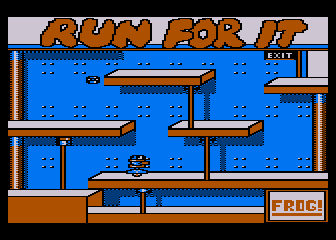
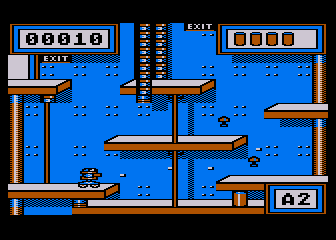
Run For It seems to be one of those rare games that was released for the Apple II and Atari 8-bit computers but not the Commodore 64. At least that seemed pretty rare by 1985 when this game was released. In this game you control a robot as he progresses upwards through a maze. This game is a fixed/flip screen game which was a popular genre before side-scrolling platformers took over the world. In this type of game, all game play takes place on a single screen at a time. You must overcome enemies and obstacles in order to reach the exit, wherever on the screen that may be. In the case of this game the exit would be near the top of each screen. Simply progressing through a maze isn't challenging enough so you have a timer and enemies to destroy or avoid. Your robot has a gun to aid in that task. Time can be increased by collecting tokens or will be decreased when you contact enemies. Your goal is to reach the top of the building before time runs out.
This is an okay game if you like this sort of thing but it's nothing exceptional. Like the side-scrolling platformers that came later there were just so many games of this type that it is hard to stand-out. It won't be terribly easy to find an original copy of this one either as this wasn't exactly a game that took the world by storm. Fortunately, it's easy enough to play via emulation.
The ad above is from the January/February 1985 issue of Enter magazine. The screen shots are from the Atari 8-bit version of the game.

Tuesday, August 20, 2019

A.N.A.L.O.G. Computing (February 1986)


A.N.A.L.O.G. Computing (February 1986)

ANALOG Computing was probably the most popular Atari 8-bit computer magazine, at least in North America. However, it also covered the Atari ST at times and that includes Atari's display at COMDEX 1985. Also prominently displayed at COMDEX that year was the Atari 130XE. The XE line represented the last of the Atari 8-bit computers. The Feburary 1986 issue of ANALOG Computing includes: Features
  • Unicheck - ANALOG Computing's universal checksum program.
  • High Noon - The showdown between Atari's 520ST and Commodore's Amiga for first place in home computing.
  • Load It - Autoboots any BASIC or machine language program.
  • Adventurous Programming - Dare to write your own adventure? Clayton gets you started.
  • Utilities for the 520ST - An in-depth look at what "tools" are available now for the Atari 520ST.
  • Formatter - Format 5.25-inch disks endlessly - and quickly!
  • Debug+ - A screen-oriented, machine language debugging utility.
  • C-manship, Part 1 - The first of a series of C programming tutorials for the beginner.
  • COMDEX 1985: Atari's back! - Atari can say, "We came, we saw, we conquered."
  • Calc Pi - A simple example of programming in C for the ST, in BASIC for the 8-bit users.
  • DOS Mods - Keep track of updated programs without losing the originals.
  • Program Helper - Convert constants to variables to save RAM.
  • XL CAPS Toggle - A modification for our Home-made Translator.
Reviews
  • SmartDOS - (The Programmer's Workshop) This DOS has a number of nice features, is it really the best?
  • Sparta DOS - (ICD, Inc.) We evaluate the performance of another DOS for the Atari.
  • Hippo ST Ramdisk - (Hippopotamus Software) Set aside any size portion of memory for use as a ramdisk.
  • XM301 - (Atari Corp.) This classy little modem is just what we've been waiting for.
  • Disk Wizard II - (C.A.P. Software) Four menu-driven disk utlities.
  • Critical Connection - (USS Enterprises) This powerful accessory means business.
  • Kennedy Approach - (Microprose Software) A fascinating, entertaining, and nerve-wracking experience.
Columns
  • Editorial
  • Reader Comment
  • New Products
  • ST News
  • The End User
  • Index to Advertisers
...and more!


Monday, July 22, 2019

ANALOG Computing (April 1987)


ANALOG Computing (April 1987)

ANALOG Computing was probably the most successful magazine dedicated to Atari 8-bit computers. If you watch closely, you can see at least one issue lying around in Ready Player One which I just watched the other day. By 1987 the last generation of Atari 8-bits (the XE series) had already been around a couple years and ANALOG was also giving some coverage to the Atari ST. The April 1987 issue of ANALOG Computing includes: Features
  • Music during the Musical Blank Interrupt - Part 3 in our series details what's involved in accomplishing music during the VBI.
  • Background Printer -= A device handler which lets your printer do its thing while you are doing yours.
  • Floyd the Droid Goes Blastin' - Wipe out the mutants just for kicks in this new machine-language game.
  • HardCopy and CheckWriter - Adding these two programs to MicroCheck (from issue 27) lets you prepare multiple copies and print checks.
  • Multicopy - A versatile utility for copying files, made even easier by keyboard or joystick use.
  • Bits & Pieces - The BSR home controller is just an article away from your Atari.
  • Modems and the Atari 8-bit - An introduction to the universe of telecommunications BBSs and networks.
  • The Baud Warrior - Advice for the experienced modem user.
Reviews
  • Lightspeed C - A detailed look at this structured language.
  • Soundwave 1 and Soundwave 8 - Two sequencers for the ST - do they live up to their claims?
  • The Learning Phone - Check out the Atari Plato cartridge.
  • Screens - Tricky screen formats are yours with this inexpensive, useful utility.
  • The New Technology Coloring Book - Hi-tech coloring for children.
  • Nite Lite - A close examination of one of the popular BBSs for the 8-bit and the Atari ST, too.
  • The Atari ST User's Guide - How worthy is the new ST Logo guide?
  • Blazing Paddles - Is this recently introduced art program an 8-bit DEGAS?
  • Carina BBS - Our BBS expert checks out this feature-packed program.
  • Panak strikes! - Flight Simulator II Scenery Disks, Mail Order Monsters, Moonmist, and Rommel Battles for Tobruk are examined.
  • Video Vegas - Slots, Keno, Blackjack and Draw Poker in one package...how do they stack up?
Columns
  • Editorial
  • Reader comment
  • M/L Editor
  • Scheduled Atari Fairs
  • ST notes
  • Atari Users' Groups
  • The End User
  • Database Delphi
  • Index to Advertisers
...and more!


Wednesday, July 10, 2019

Compute! (September 1984)


Compute! (September 1984)

Compute! was the best of the early multi-format computer magazines. In 1984 it was covering a variety of 8-bit computers such as the VIC-20, Commodore 64, Atari 8-bit, TI-9/4A plus the PC (mostly the PC and PC Jr.). The September 1984 issue includes: Features
  • The Educational Software Explosion
  • The Latest in Learning: New Trends in Educational Computing
  • Choosing The Best Educational Software
Education and Recreation
  • The Tester
  • Missile Math
  • Lightsaver
Reviews
  • Exodus: Ultima III For Commodore 64
  • The Seven Cities Of Gold
  • Word Flyer
Columns And Departments
  • The Editor's Notes
  • Readers' Feedback
  • Computers And Society: Discovery-Based Learning And Teenagers
  • Questions Beginners Ask
  • The Beginner's Page: ROM And RAM
  • The World Inside The Computer: Build A Computer In Your Mind
  • Learning With Computers: Aids For The Blind
  • INSIGHT: Atari
  • Machine Language: Math And Tables
  • Programming The TI: Writing An Educational Program
  • 64 Explorer
The Journal
  • Lightning Sort
  • Atari Bubble And Bulldozer Sorting
  • Commodore Autoboot
  • Atari Paddle Fixer
  • Apple Editing Hints
  • Commodore Disk Pattern Matching, Part 1
  • SYSound
  • Musical TI Keyboard
...and more!

Tuesday, May 7, 2019

Antic (February 1984)


Antic (February 1984)

Antic was one of the two big magazines in the U.S. that covered the Atari 8-bit computer line. In early 1984, the Atari 600XL and 800XL were just becoming widely available though they had technically been available, at least in limited quantities, since the Fall of 1983. The February 1984 issue of Antic includes: Features
  • A Greeting Card For All Seasons - Say it on cassette
  • Follow That Stock - A spreadsheet for your stock portfolio.
  • Money Matters - Atari reckons with personal finance
  • Typo - Type your program once
  • Atari At War - The wild world of conflict simulation
  • Fast Finger - Autoboot with a ghost at the keyboard
  • Phone Book - Simulate string arrays in Atari BASIC
  • Character Graphics - Redefine the set any way you choose
Departments
  • Inside Atari - It's Official
  • Starting Line - A Cinderella Story
  • Education - The End Of Odd Man
  • LOGO/Pilot - LOGO Books
  • In The Public Domain - The Gauntlet - **Bonus Game** Galactic Gloop
  • Tape Topics - The 410 HI-REL Mod
  • Systems Guide - Nightmare Detour
  • Assembly Language - DRAWTO FILL
  • I/O Board
  • Help!
  • Public Domain Software
  • New Products
  • Product Reviews
  • Advertisers List
  • Listing Conventions
  • Shopper's Guide
  • Microscreens
...and more!

Wednesday, March 13, 2019

Antic (June 1984)


Antic (June 1984)

Antic: The Atari Resource was probably the 2nd most popular magazine for Atari 8-bit computers. It its later years it shifted more focus onto the Atari ST though. The June 1984 issue, which was still a while before the 16-bit ST was introduced, includes: Features
  • Anatomy of an Atari 800XL - Inside the belly of the beast
  • Exploring the XL - One programmer's perspective
  • Scroll Your Way to the Top - A short course on coarse scrolling
  • Use BASIC to Animate - An easier way to program your own games
  • Color Finetuner - Adjust your colors to a "T"
  • Antic Pix Furniture - Computing in comfort
Departments
  • Inside Atari: Evolution of the XL Computers
  • Education: Alphabet Music
  • Languages: Talk to your Robot
  • Profiles: Activision's James Levy
  • Toolbox: BASIC - A Variable Approach
  • Game of the Month: Escape From Epsilon
  • Assembly Language: Shortcuts to Success
  • I/O Board
  • Help!
  • Public Domain Software
  • New Products
  • Product Reviews
  • Advertisers List
  • Listing Conventions
  • Shopper's Guide

Friday, March 8, 2019

Synapse (Atari 8-bit)


Synapse (Atari 8-bit)

There can be no doubt that the early 1980s were the golden age for games on the Atari 8-bit computers. The Commodore 64 was rapidly surpassing Atari by this point but Atari was still going strong though it wouldn't be for much longer. Synapse made a ton of great games for the Atari 8-bit and other 8-bit computers. This ad from the June 1984 issue of Antic highlights several of them. Encounter
Alone on a distant planet, you stumble into a futuristic 8-level tank battlefield that really plays for keeps! Watch out for the deadly drones and sneaky saucers.
This one was sort of a clone of Battlezone, the vector based arcade game. Dimension X
Test yourself with incredible 3-D action that never stops! An alien invasion fleet has the capital city surrounded, and it's up to you to stop the destruction! Good luck - you'll need it.
This one tries to be a slightly more advanced version of something like Battlezone or Encounter but at the end of the day, the game play wasn't as good with this game. Zeppelin
First the prison break, but that's only the beginning! The underground world of Zarkafir is full of surprises, from the lethal energy fields to devastating earthquakes. Can you defeat the Timelords?
This was a side-scrolling shooter of sorts that takes place in underground caverns. A funny place for a zeppelin perhaps but this was a really good game and large for its time with 250 rooms to blast your way through. Uniquely, up to four players could play with the extra players controlling various guns on the zeppelin that player 1 was flying. Other titles listed include Blue Max, Fort Apocalypse, Shamus and Shamus Case II, Necromancer, Pharoah's Curse, and Quasimodo. I played most of these and they were all excellent games though I played them on the Commodore 64 and not the Atari 8-bit. While Synapse had the occasional mediocre game, the average quality was quite high. It's a shame they went out of business so early (later in 1984) in part because they were ripped off by Jack Tramiel who refused to pay them for software they shipped for Atari. To make matters worse they made a decision to start emphasizing text adventures which started fading in popularity around the same time.

Tuesday, February 26, 2019

Analog Computing (April 1989)


Analog Computing (April 1989)

Analog computing was one of the two major Atari 8-bit magazines in North America. It was a great magazine for owners of those systems and it had a long life. The April 1989 issue includes: Features
  • Krazy Mazes - An exciting two-player game of mazes and chases written entirely in machine langauge.
  • Master Memory Map, Part IX - ANALOG's official memory map continues
  • Univert - How many decimeters are ther in a cubit? How many leagues in a light year? With Univert you can easily convert from any unit of measurement to another.
  • Pixel Averaging on the Atari - This graphics technique will allow you to hide those jagged edges in your computer art masterpieces.
Reviews
  • Panak Strikes - This month Steve looks at Gauntlet (Atari) and Richard Petty's Talladega (Cosmi).
  • The Converter (No Frills Software)
  • Cheat! (Alpha Systems)
Columns
  • Database DELPHI
  • Game Design Workshop
  • ST Notes
  • The End User
Departments
  • Editorial
  • Reader Comment
  • 8-bit News
  • M/L Editor
  • BASIC Editor II


Wednesday, September 12, 2018

The Halley Project


The Halley Project

The Halley Project, subtitled "A Mission In Our Solar System", was a game released by Mindscape for the Commodore 64, Atari 8-bit and Apple II in 1985. A version with updated graphics was also released for the Amiga in 1986. For those old enough to remember, 1986 was the year Halley's comet made it's once every 86 year visit to the inner solar system. It was definitely a big deal at the time so it isn't surprising that a game would be made to capitalize on that publicity.

The Halley Project is actually a pretty good game. It's a sort of space flight simulator and you are recruited as a star pilot to participate in the "greatest scientific adventure in history". This consists primarily of traveling to and exploring different objects in the solar system. The game is fairly high on realism for the time with realistic distances used. The game does give you a hyperdrive so you don't have to spend months or years on each mission though. After completing all of the missions, you would be given a code that you would then have to mail to Mindscape in order to receive instructions on how to access the final secret mission. This basically just involved them sending you the password.

The Halley Project is a relatively obscure game by today's standards. It has not been re-released and there are no sequels (maybe when Halley's comet comes around again). If you want to give this one a try, you'll have to find an original disk or use emulation. The Amiga version has somewhat better graphics than the others but they all play basically the same so you can just choose your favorite platform.

The screen shots above are from the Amiga version and the ad is from the January 1986 issue of Amiga World.

Monday, January 15, 2018

ANALOG Computing (March 1989)


ANALOG was probably the most popular Atari 8-bit magazine in the U.S. and had the longest life among Atari 8-bit magazines. Of course, it only had one serious competitor. The March 1989 issue includes:

Features

  • Cartridge Games for Your XEGS - An overview of the cartridge based games available for the Atari XEGS. Basing a game system on Atari XE computers wasn't necessarily a bad idea but most games that Atari released were really just re-releases of old games.
  • Pebbles - A type-in puzzle game from ancient Egypt featuring stones and holes.
  • Master Memory Map, Part VIII - Part 8 of a massive series on the entire Atari 8-bit memory map.
  • Un-Sprites - A type-in program for creating software based sprites along with a couple of demo programs.
  • Atari Videodisc System - Using an Atari 8-bit computer as a laserdisc controller.
  • DUPing BASIC - A way to automatically enable and disable BASIC when entering and leaving DOS.
  • Disk Games for Your XEGS - Though the XEGS was a cartridge based game system, you could still connect a standard Atari floppy disk drive externally and play disk based games that work with Atari 8-bit computers.
  • Electra-Ball - A type-in futuristic sports games in which you manipulate deflectors to get the ball to go where you want.

Reviews

  • Turboword - The first full-featured 80-column word processor for the Atari 8-bit. It required an 80-column expansion board and monitor which were non-standard for the Atari.
  • Quintopus - Basically a port expander for Atari 8-bit computers that allows for more peripherals to be attached.

Columns

  • Database DELPHI - Help using the Delphi online service from an Atari user's perspective.
  • The End User - A look back at the last four years of the column which included various interviews, new products, etc.
  • Game Design Workshop - A continuation of a tutorial on Player/Missile graphics as well as continued work on BASIC Invaders, a Space Invaders clone.

Departments

  • Editorial - Some newspaper column gives a half-baked criticism of video games in general. Meanwhile, this issue of ANALOG is dedicated to gaming.
  • Reader Comment - One reader writes in about his perception of the lack of support for Atari 8-bit machines.
  • 8-Bit News - Covox announces text adventure game Escape From Planet X featuring speech synthesis; Super Database 1-2-3 database and report generator available for Atari 8-bit; Cheat!, a program that allows modifications of 120 games to add unlimited lives, released; SpartaDOS X released; and more.
  • M/L Editor - A type-in program designed to assist with entering machine language programs published in ANALOG.
  • Basic Editor II - A type-in program designed to assist with entering BASIC programs that are published in ANALOG.

...and more!